Calendar Icon White
December 29, 2025
Clock Icon
7
 min read

Enterprise DLP Solutions: A Complete Guide for Enterprises

Learn what enterprise DLP solutions are, why enterprises need them, key features, compliance requirements, and how to choose the right platform.

Enterprise DLP Solutions: A Complete Guide for Enterprises
ChatGPT
Perplexity
Grok
Google AI
Claude
Summarize and analyze this article with:

TL;DR

    1. Enterprise DLP solutions protect sensitive data across SaaS, cloud, APIs, endpoints, and AI workflows; not just email or network perimeters.
    2. Traditional DLP fails at enterprise scale due to data sprawl, remote work, and SaaS-first architectures; modern enterprise DLP is cloud-native and API-driven.
    3. Effective enterprise DLP combines continuous data discovery, real-time enforcement, and automated remediation (redaction, masking, blocking).
    4. Compliance frameworks expect evidence, not policies; enterprise DLP generates audit-ready logs, controls, and remediation records.
    5. Architecture matters; agentless, cloud-native DLP deploys faster and reduces operational overhead compared to legacy agent-based tools.
    6. Enterprises must secure data where it flows today; across collaboration tools, cloud storage, customer systems, developer APIs, and generative AI.
    7. The best enterprise DLP solutions scale with the business, minimize false positives, and protect sensitive data in real time without slowing teams down.
  • Enterprise DLP solutions are data loss prevention platforms built to protect sensitive data across large, complex enterprise environments. Unlike traditional DLP tools, enterprise DLP solutions are designed for cloud-first, SaaS-heavy organizations where data moves continuously across applications, users, APIs, and third-party services.

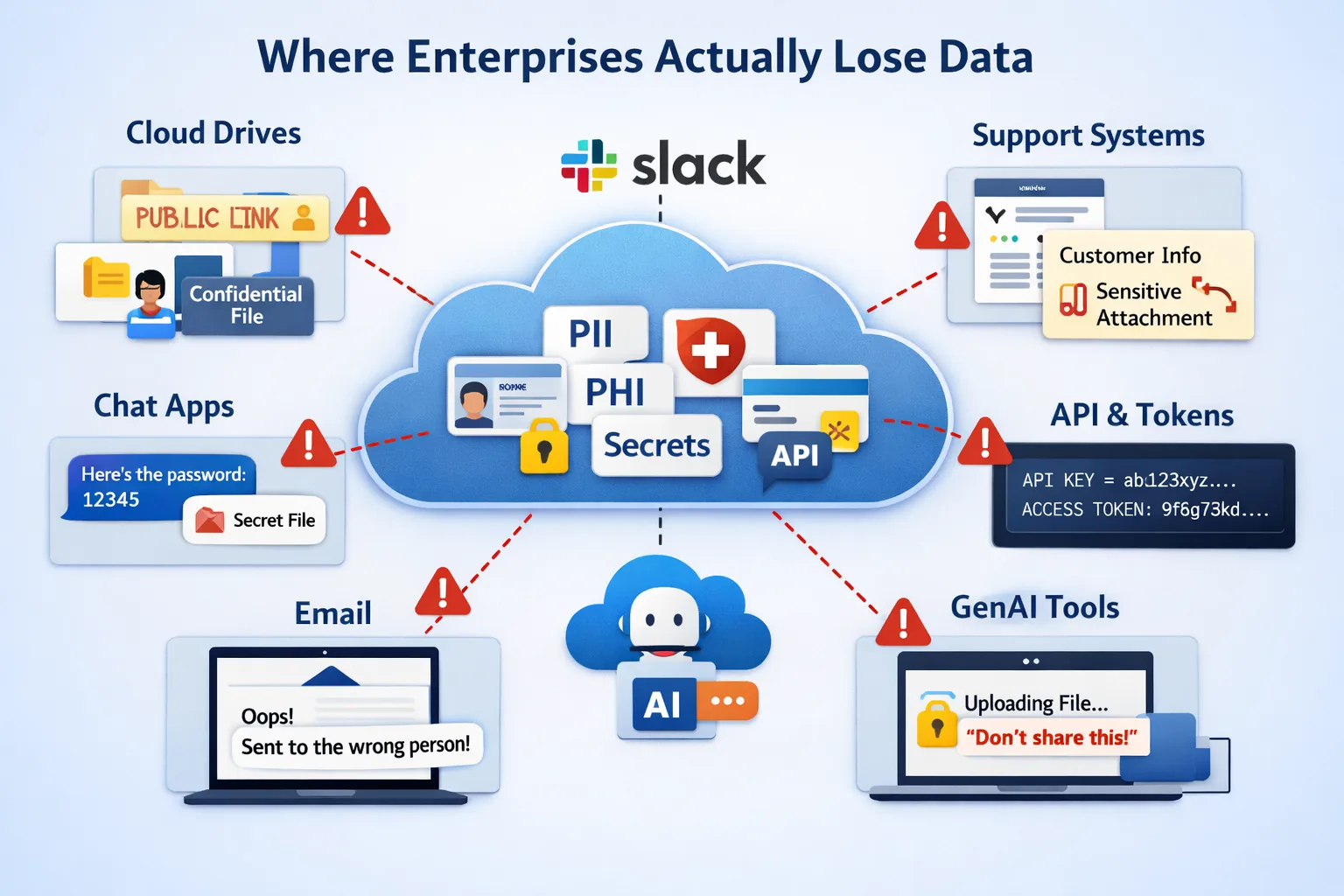
    Today’s enterprises face an unprecedented data protection challenge. Sensitive data is no longer confined to on-prem systems or corporate networks; it lives inside collaboration tools, cloud storage, customer support platforms, developer workflows, and AI-powered applications. As SaaS adoption accelerates and teams become more distributed, security and compliance leaders must manage massive data sprawl while maintaining visibility, control, and accuracy. At the same time, regulatory pressure continues to increase, with frameworks like GDPR, HIPAA, PCI DSS, and SOC 2 demanding provable controls and audit-ready evidence.

    This guide breaks down enterprise DLP solutions from an enterprise buyer’s perspective. It explains what enterprise DLP is, why traditional approaches fail at scale, which features and architectures matter most, how DLP supports compliance requirements, and how to evaluate enterprise DLP platforms in modern SaaS and cloud environments.

    What Is Enterprise DLP?

    Enterprise data loss prevention (DLP) refers to a class of security solutions designed to protect sensitive data across large-scale, highly distributed enterprise environments. Enterprise DLP solutions focus on continuously discovering, classifying, monitoring, and enforcing controls on sensitive data as it moves across SaaS applications, cloud platforms, APIs, endpoints, and modern collaboration workflows.

    At its core, enterprise DLP is about maintaining control over sensitive information in environments where data volume, velocity, and complexity are significantly higher than in small or mid-sized organizations. Unlike traditional tools that rely on static rules or network boundaries, enterprise DLP solutions are built to operate where data actually flows in modern enterprises.

    From a functional standpoint, enterprise DLP solutions are designed to protect a broad range of sensitive data types, including:

    • Personally identifiable information (PII) such as names, emails, and identifiers
    • Protected health information (PHI) regulated under healthcare compliance frameworks
    • Payment card data (PCI) and financial records
    • Intellectual property (IP), source code, and proprietary business data
    • Credentials, API keys, tokens, and other secrets embedded in files or messages

    The difference between enterprise DLP and traditional or SMB-focused DLP becomes clear at scale. Legacy DLP tools were often built for on-premise networks, email gateways, or a limited set of endpoints. Enterprise environments, however, require DLP solutions that can operate across dozens of SaaS tools, cloud storage systems, customer platforms, and internal APIs without introducing excessive noise or administrative burden.

    Scale and complexity fundamentally change DLP requirements. Enterprises must handle continuous data creation, thousands of users, multiple business units, and overlapping regulatory obligations. As a result, enterprise DLP solutions must deliver high accuracy, real-time enforcement, low false positives, and audit-ready visibility; not just detection. Without these capabilities, DLP becomes unmanageable and ineffective in large, fast-moving organizations.

    ✨Why Enterprises Need Data Loss Prevention

    Enterprise DLP solutions exist because the way enterprises create, share, and store data has fundamentally changed. Sensitive information now moves continuously across people, platforms, and processes, often outside traditional security perimeters. This shift is already creating measurable risk; industry research cited by ENISA shows that more than half of organizations have experienced a SaaS security incident, underscoring that data exposure in cloud environments is no longer theoretical. For large organizations, preventing data loss is no longer about locking down a network; it is about controlling data everywhere it flows..

    Several risk drivers make data loss prevention a necessity at enterprise scale:

    • Insider risk, both intentional and accidental, remains the leading cause of data exposure; employees routinely paste credentials into chat tools, upload sensitive files to shared drives, or include regulated data in support tickets without malicious intent.
    • SaaS and cloud data sprawl has decentralized data across dozens or hundreds of applications, making it difficult to track where sensitive information lives or who can access it.
    • Remote and hybrid workforces rely heavily on collaboration tools, cloud storage, and messaging platforms, increasing the number of uncontrolled data-sharing pathways.
    • Regulatory exposure and audit pressure continue to rise as enterprises must demonstrate compliance with frameworks such as GDPR, HIPAA, and PCI DSS, not just through policies but through enforced, auditable controls.

    A common enterprise failure scenario illustrates this risk clearly. A global organization allows customer support teams to operate through a SaaS ticketing system integrated with email and chat. Over time, customers begin sharing payment details and personal data directly in tickets and attachments. Without enterprise DLP solutions in place, this sensitive data remains exposed to broad internal access, backups, and third-party integrations. During a compliance audit or breach investigation, the organization cannot prove where the data resides, how it was protected, or whether access was restricted; resulting in regulatory findings, remediation costs, and reputational damage.

    For enterprises, data loss prevention is no longer optional or reactive. Enterprise DLP solutions provide the visibility, control, and enforcement required to manage modern data risk proactively, reduce exposure across SaaS and cloud environments, and meet increasing regulatory and audit expectations with confidence.

    Strac Enterprise DLP

    Key Features of Enterprise DLP Solutions

    Enterprise DLP solutions are defined not just by what they detect, but by how effectively they operate at scale. As enterprise environments grow more distributed and data-driven, DLP platforms must deliver accuracy, automation, and performance across a constantly changing data landscape. The features below represent the core capabilities enterprises should expect from modern enterprise DLP solutions.

    1. Data Discovery and Classification

    Enterprise DLP solutions must be able to identify sensitive data wherever it exists, regardless of format or location. In large organizations, sensitive information spans both structured and unstructured sources, and static discovery approaches quickly become obsolete.

    Key capabilities include:

    • Structured data coverage, such as databases, CRM records, and data warehouses where sensitive fields are well-defined
    • Unstructured data coverage, including documents, messages, tickets, chat conversations, images, and file attachments
    • Continuous discovery, which ensures new data is identified as it is created or modified, rather than relying on periodic scans

    Without continuous discovery and classification, enterprises lose visibility as data moves across SaaS applications and cloud services, creating blind spots that increase risk over time.

    2. Policy Enforcement and Controls

    Effective enterprise DLP solutions must go beyond detection to enforce data protection policies automatically. In large environments, alert-only models create excessive noise and shift the burden of response onto already stretched security teams.

    Modern enterprise DLP platforms differentiate themselves through:

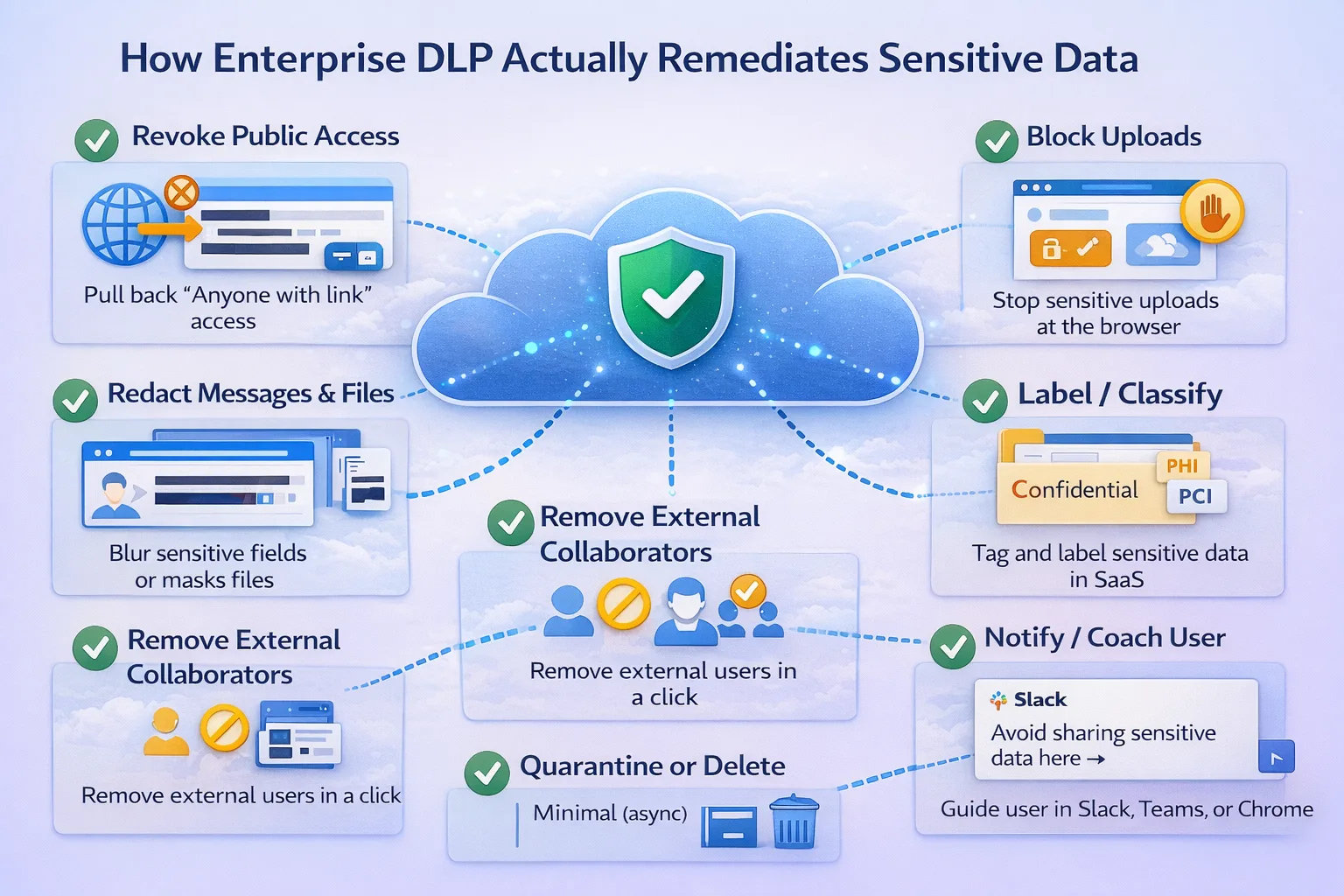
    • Real-time enforcement, where sensitive data is blocked, redacted, or masked at the moment of exposure
    • Alert-only enforcement, which may still be useful for monitoring or phased rollouts but is insufficient as a primary control
    • Context-aware policies, which evaluate data type, user role, destination, and workflow context before taking action

    Context-aware enforcement allows enterprises to reduce false positives while maintaining strong security controls aligned with business operations.

    3. SaaS, Cloud, and Endpoint Coverage

    Enterprise DLP solutions must reflect how enterprises actually operate today. Email remains important, but it is no longer the primary channel for sensitive data exchange. Most enterprise data now flows through SaaS platforms, cloud storage, APIs, and collaboration tools.

    This makes broad coverage essential, including:

    • SaaS applications such as collaboration, CRM, and customer support platforms
    • Cloud storage and cloud-native services where data is persistently stored and shared
    • Endpoints used by remote and hybrid employees

    Enterprises that rely on email-only or network-bound DLP leave large portions of their data environment unprotected.

    4. Incident Response and Remediation

    Detection without action does not meaningfully reduce enterprise risk. Enterprise DLP solutions must support automated incident response capabilities that minimize exposure immediately and consistently.

    Common remediation actions include:

    • Redaction, removing sensitive data from messages, tickets, or documents
    • Masking, obscuring sensitive values while preserving usability
    • Blocking, preventing data from being shared or transmitted
    • Deletion, removing sensitive data entirely when required by policy

    Automated remediation reduces reliance on manual intervention and helps enterprises enforce data protection policies at scale.

    5. Scalability and Performance

    At enterprise scale, performance is as critical as security. Enterprise DLP solutions must process high data volumes across thousands of users and applications without introducing latency or operational friction.

    Key performance considerations include:

    • High throughput, to handle continuous data flows across SaaS and cloud environments
    • Low latency, ensuring real-time enforcement does not disrupt user workflows
    • Low false positive rates, which are essential to maintain trust and reduce administrative overhead

    Without strong scalability and performance characteristics, even feature-rich DLP platforms struggle to deliver value in large, fast-moving enterprise environments.

    Enterprise DLP Architecture and Deployment Models

    Enterprise DLP architecture determines how effectively data loss prevention operates at scale. As enterprises grow across SaaS applications, cloud platforms, and distributed teams, architectural choices directly influence visibility, deployment speed, performance, and long-term operational cost. An enterprise DLP solution must be designed to support continuous change without creating friction for security or IT teams.

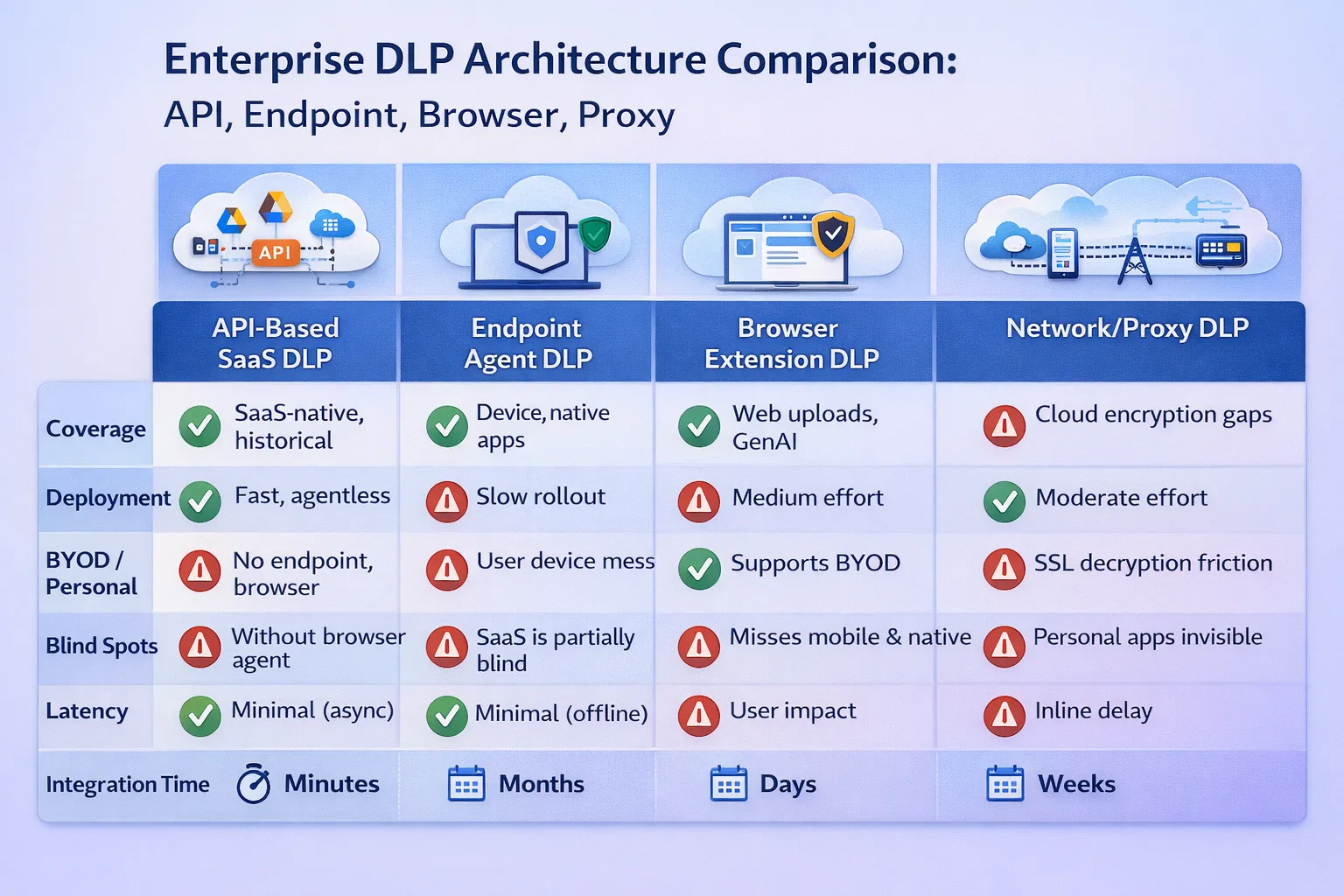
    One of the most critical architectural decisions is the choice between agent-based and agentless DLP:

    • Agent-based DLP relies on software installed on endpoints or network devices; this can offer deep control but introduces deployment friction, ongoing maintenance, and performance overhead at enterprise scale.
    • Agentless DLP integrates directly with SaaS platforms and cloud services using APIs; it eliminates endpoint deployment, reduces maintenance effort, and enables faster enterprise-wide rollout.

    Deployment models further shape how enterprise DLP solutions perform in real-world environments:

    • Cloud-native DLP is built to operate entirely in cloud environments, scaling automatically with enterprise workloads and aligning with SaaS-first strategies.
    • On-prem DLP is typically used in legacy or highly regulated environments but often struggles to keep pace with cloud adoption and remote work.
    • Hybrid DLP models attempt to combine both approaches, but frequently increase architectural complexity and administrative burden.

    Modern enterprise DLP solutions increasingly depend on API-based enforcement to function effectively:

    • APIs enable real-time inspection and control of data inside SaaS applications, cloud storage, collaboration tools, and internal services.
    • Enforcement occurs where data is created, shared, and stored; rather than at outdated network chokepoints.
    • API-based controls support granular, context-aware actions such as inline redaction, masking, or blocking.

    At enterprise scale, operational overhead becomes a deciding factor in DLP success:

    • Large environments require managing thousands of users, integrations, policies, and incidents.
    • Architectures that demand constant tuning, agent updates, or manual remediation quickly become unsustainable.
    • Enterprise DLP solutions must prioritize automation, simplicity, and scalability to reduce administrative load while maintaining strong, auditable controls.

    For enterprises, the right DLP architecture is not just a technical preference; it is a prerequisite for maintaining effective data protection across modern, fast-moving environments.

    Compliance and Regulatory Requirements for Enterprise DLP

    Enterprise DLP solutions play a critical role in compliance because regulators and auditors evaluate outcomes, not intentions. In enterprise audits, having written policies is not sufficient; organizations must demonstrate that sensitive data is continuously discovered, protected, and controlled across SaaS, cloud, and internal systems. This is why enterprise DLP should be viewed as an evidence-generation capability, not just a data protection tool.

    Most enterprises must align DLP controls with multiple regulatory and security frameworks at the same time, including:

    • GDPR, which requires appropriate technical and organizational measures to protect personal data based on risk
    • HIPAA, which emphasizes technical safeguards such as audit controls and monitoring of access to electronic protected health information
    • PCI DSS, which focuses on protecting cardholder data and maintaining logging and monitoring to track access and handling
    • SOC 2, which evaluates how organizations manage access controls, monitoring, and incident response across their systems
    • ISO 27001, which requires a formal information security management system supported by enforceable data handling controls

    From an auditor’s perspective, enterprise DLP solutions are expected to produce clear, consistent evidence that controls are active and effective. Common audit expectations typically include:

    • Data discovery and classification outputs, showing where regulated data exists and how it is categorized across environments
    • Access and activity logs, demonstrating who accessed sensitive data, when, and through which systems
    • Policy definitions with enforcement history, proving that controls are not only configured but actively enforced
    • Incident detection and remediation records, including actions such as redaction, blocking, or deletion of sensitive data
    • Retention and reporting capabilities, ensuring logs and evidence can be retrieved during audits or investigations

    When enterprise DLP solutions are designed with compliance in mind, they reduce audit friction significantly. Instead of assembling proof reactively, enterprises maintain continuous, auditable visibility into how sensitive data is handled; making compliance a byproduct of daily operations rather than a periodic scramble.

    How to Choose an Enterprise DLP Solution

    Choosing enterprise DLP solutions is a strategic decision that affects security posture, compliance readiness, and operational efficiency across the organization. At enterprise scale, the right platform must align with how data actually flows through SaaS, cloud, and internal systems; not how security teams wish it behaved. Evaluation should therefore focus on practical effectiveness, not feature volume.

    When assessing enterprise DLP solutions, the following criteria are critical:

    • Integration coverage; the solution should support the SaaS applications, cloud platforms, developer tools, and data stores already in use, with native or API-based integrations rather than custom workarounds.
    • Deployment time; long rollout cycles extend exposure and consume internal resources, while modern platforms should deploy in days or weeks rather than months.
    • False positive rates; high noise undermines trust in the system and creates alert fatigue, making accuracy and context-aware detection essential.
    • Administrative overhead; policy tuning, incident management, and reporting should be largely automated, not dependent on constant manual intervention.
    • Compliance alignment; the platform should map naturally to regulatory frameworks and generate audit-ready evidence without extensive customization.
    • Total cost of ownership; beyond licensing, enterprises must account for operational effort, infrastructure requirements, and long-term maintenance costs.

    Enterprises should also evaluate how well a DLP platform scales over time. A solution that works during a pilot but becomes difficult to manage as data volume and integrations grow will create long-term risk. The strongest enterprise DLP solutions combine broad coverage, fast deployment, low operational friction, and clear compliance support; enabling security teams to protect sensitive data without slowing the business.

    👉 Read our blog on How Strac’s AI Agent Reduces DLP False Positive Alert Noise in Trellix (McAfee) Enterprise DLP

    🎥Protect Customer Sensitive Data in Real-Time with Strac Enterprise DLP

    Strac Enterprise DLP is designed for enterprises that need to protect sensitive customer data as it moves through modern systems, not after exposure has already occurred. In SaaS-first organizations, customer data flows continuously through collaboration tools, customer support platforms, cloud storage, internal services, APIs, and increasingly through generative AI workflows. Strac addresses this reality by enforcing data protection policies directly within these environments, in real time, without adding operational friction.

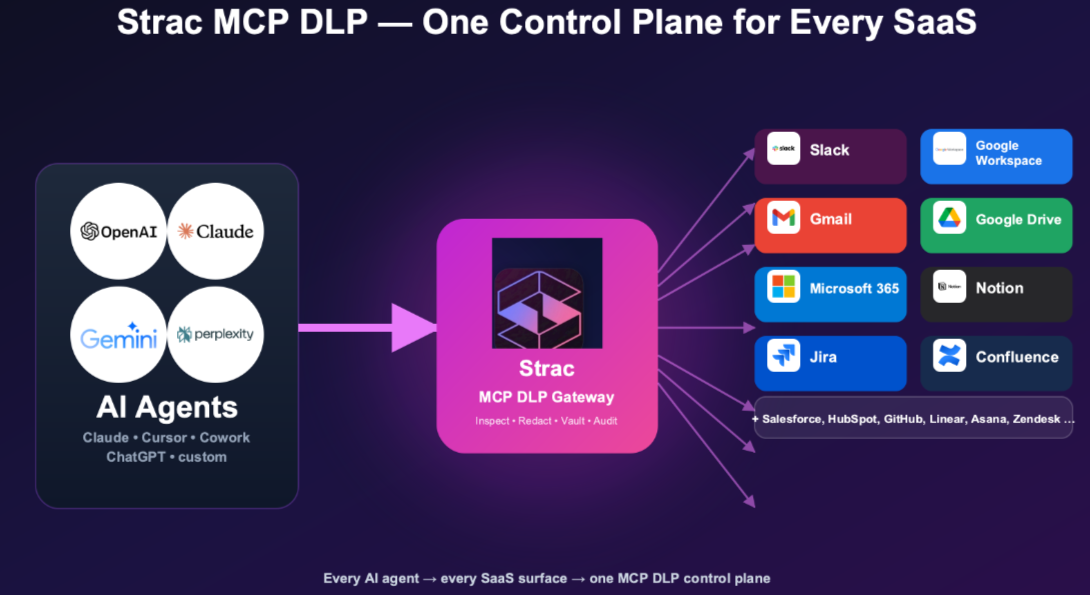
    At the architectural level, Strac is built as an agentless, cloud-native enterprise DLP platform. Instead of relying on endpoint agents or network appliances, Strac integrates directly with SaaS applications and cloud services using APIs. This approach allows enterprises to deploy protection quickly, scale across environments, and maintain consistent enforcement without managing software on thousands of devices.

    Strac Enterprise DLP focuses on real-time remediation rather than alert-only detection, enabling enterprises to reduce risk immediately. Key capabilities include:

    • Detecting and protecting sensitive customer data in real time; including PII, PHI, PCI data, credentials, secrets, intellectual property, and proprietary information before it spreads downstream.
    • Applying inline remediation automatically; redacting, masking, blocking, or removing sensitive data inside SaaS apps, support tools, messages, files, workflows, and AI prompts or responses, instead of relying on post-incident alerts.

    Modern enterprises also require DLP coverage that reflects how data actually flows across systems. Strac provides SaaS, API, and AI coverage in a unified platform, supporting:

    • Collaboration platforms, CRMs, ticketing systems, and cloud storage
    • Internal and external APIs where sensitive data is exchanged programmatically
    • Generative AI workflows, including prompt and response flows, where sensitive data may be unintentionally introduced or propagated

    Beyond enforcement, Strac unifies DSPM and DLP capabilities to give enterprises both visibility and control. Continuous data discovery and classification establish where sensitive data lives and how it is accessed, while DLP policies enforce protection at the point of use. This combination helps enterprises move from reactive data protection to proactive risk management, without deploying separate tools for posture and prevention.

    Finally, Strac is designed for faster enterprise deployment and lower operational overhead. Its agentless, API-driven model allows security teams to roll out protection in days or weeks rather than months. Content-aware detection using machine learning and OCR reduces false positives across structured data, unstructured content, attachments, images, and AI-generated text; minimizing noise while maintaining accuracy at enterprise scale.

    Together, these capabilities position Strac Enterprise DLP as a practical, AI-ready solution for protecting customer-sensitive data across modern enterprise environments; focused on real-time risk reduction, operational efficiency, and compliance readiness rather than reactive alerting.

    Bottom Line: Choosing the Right Enterprise DLP Solution

    Enterprise DLP solutions are no longer optional controls layered onto the edge of the network. In modern enterprises, sensitive data lives inside SaaS applications, cloud platforms, APIs, and generative AI workflows; and effective data loss prevention must operate directly within those environments. Traditional, perimeter-based DLP tools struggle to keep up with this reality, creating visibility gaps, operational friction, and compliance risk at scale.

    The most effective enterprise DLP solutions combine continuous data discovery, real-time enforcement, broad SaaS and cloud coverage, and audit-ready evidence generation. They reduce risk at the moment data is shared or created; not after an incident has already occurred. Just as importantly, they do so without overwhelming security teams with false positives, manual remediation, or complex infrastructure.

    For enterprises evaluating data loss prevention today, the focus should be on platforms that align with modern architectures and workflows. Solutions that are cloud-native, agentless, API-driven, and AI-aware are better positioned to scale with the organization, support regulatory requirements, and protect sensitive data wherever it flows. In that context, enterprise DLP is not simply a security tool; it is a foundational capability for operating securely, compliantly, and confidently in a SaaS- and AI-driven world.

    🌶️Spicy FAQs on Enterprise DLP

    What is an enterprise DLP solution?

    An enterprise DLP solution is a data loss prevention platform built to protect sensitive data across large, complex enterprise environments. Unlike basic DLP tools, enterprise DLP solutions operate across SaaS applications, cloud platforms, APIs, endpoints, and AI workflows, providing continuous data discovery, policy enforcement, and remediation at scale. Their purpose is not only to detect sensitive data, but to actively control how it is used, shared, and protected across the enterprise.

    How is enterprise DLP different from traditional DLP?

    The difference between enterprise DLP and traditional DLP becomes clear when you look at where data actually flows today. Traditional DLP was designed around network perimeters and email gateways, while enterprise DLP solutions are built for distributed, cloud-first environments. In practice, enterprise DLP solutions differ by offering:

    • Coverage across SaaS, cloud storage, APIs, and collaboration tools; not just email or endpoints
    • Real-time, inline enforcement instead of alert-only monitoring
    • Architecture that scales across thousands of users and integrations with lower administrative overhead

    These differences make enterprise DLP usable in modern environments where legacy tools often fail.

    Is enterprise DLP required for compliance?

    Enterprise DLP is not always explicitly mandated by regulations, but it is frequently required to meet audit expectations. Frameworks such as GDPR, HIPAA, PCI DSS, SOC 2, and ISO 27001 expect organizations to demonstrate control over sensitive data, including where it lives, who can access it, and how incidents are handled. Enterprise DLP solutions provide the technical evidence auditors look for, turning compliance from a documentation exercise into an enforceable, auditable process.

    How long does enterprise DLP deployment take?

    Deployment time depends heavily on architecture. Legacy, agent-based DLP platforms can take months to roll out across an enterprise due to endpoint installation, tuning, and infrastructure changes. Modern enterprise DLP solutions that are cloud-native and API-driven can often be deployed in days or weeks. Faster deployment reduces exposure quickly and allows security teams to expand coverage incrementally without disrupting business operations.

    Can enterprise DLP protect SaaS and AI workflows?

    Yes. Modern enterprise DLP solutions are specifically designed to protect SaaS and AI-driven workflows where sensitive data is increasingly processed. This includes collaboration tools, customer support systems, cloud storage, internal APIs, and generative AI prompt and response flows. By enforcing policies directly within these systems, enterprise DLP ensures sensitive data is protected at the point of use; not after it has already spread downstream.

    Discover & Protect Data on SaaS, Cloud, Generative AI
    Strac provides end-to-end data loss prevention for all SaaS and Cloud apps. Integrate in under 10 minutes and experience the benefits of live DLP scanning, live redaction, and a fortified SaaS environment.
    Users Most Likely To Recommend 2024 BadgeG2 High Performer America 2024 BadgeBest Relationship 2024 BadgeEasiest to Use 2024 Badge
    Trusted by enterprises
    Discover & Remediate PII, PCI, PHI, Sensitive Data

    Latest articles

    Browse all

    Get Your Datasheet

    Thank you! Your submission has been received!
    Oops! Something went wrong while submitting the form.
    Close Icon