Best DLP Solutions for SASE (2026): Unified SASE DLP Guide
Looking for the best DLP for SASE or unified SASE? Here's how DLP fits the SASE/SSE stack, which vendors bundle it, what edge-based DLP misses (SaaS data at rest, GenAI, MCP), and how to close the gaps.
In a SASE architecture, DLP lives in the SSE layer — inline inspection of web, cloud, and private-app traffic as it crosses the service edge. Every major unified SASE vendor (Netskope, Zscaler, Palo Alto Prisma, Forcepoint, Cato) bundles some level of DLP there.
The best DLP for SASE depends on what you're protecting. Edge DLP is strong on managed-device traffic egress. It is structurally blind to data at rest inside SaaS apps, cloud-to-cloud sharing, unmanaged devices, and most of the GenAI and AI-agent (MCP) data paths that never cross the user's network edge.
Practical answer for 2026: use your SASE vendor's inline DLP for the traffic path, and pair it with an API-native data security platform like Strac for the surfaces the edge can't see — SaaS data at rest, endpoint, browser-level GenAI prompts, and MCP connectors — with redaction, not just blocking.
This guide covers how SASE DLP works, the vendor landscape, the blind spots, and a decision framework for unified SASE deployments.
How DLP Fits Into a SASE Architecture
SASE (Secure Access Service Edge) converges networking (SD-WAN) with security service edge (SSE) functions — secure web gateway, CASB, zero trust network access, and firewall-as-a-service — delivered from the cloud. DLP in SASE is a function of the SSE layer: as user traffic flows through the vendor's edge, content is inspected inline, and policies block or quarantine sensitive data leaving through web uploads, email, and cloud apps.
That placement is the whole story of both its strengths and its limits. Inline DLP sees what crosses the edge — and only what crosses the edge. When you evaluate the best DLP solutions for SASE, you are really answering two questions: how good is the inspection on the traffic path, and what happens to sensitive data that never takes the traffic path at all?
The Best DLP Solutions for SASE in 2026
1. Strac — best data-native complement to any SASE stack. Strac is not a SASE vendor, and that is the point: it protects the data surfaces the service edge can't reach. It connects to SaaS apps via API (data at rest, sharing changes, historical files), runs endpoint DLP on macOS and Windows, inspects GenAI prompts in the browser (ChatGPT, Claude, Gemini, Copilot), and governs AI-agent access through MCP connectors — with remediation that goes beyond block: redact, mask, tokenize, warn the user, or quarantine, plus compliance evidence mapped to SOC 2, HIPAA, and PCI. Pair it with any SASE vendor's inline DLP for full coverage.
2. Netskope — best DLP depth among unified SASE platforms. Netskope built its SASE up from CASB roots, so its inline DLP and app-instance awareness are among the strongest in the category. A natural pick if DLP quality is the deciding factor in your SASE vendor choice.
3. Zscaler — best for large-scale inline inspection. Zero Trust Exchange inspects traffic (including TLS) at very large scale, with DLP policies across web, email, and endpoints. Strong when you're standardizing everything on the Zscaler edge.
4. Palo Alto Networks Prisma SASE — best for Palo Alto-standardized enterprises. Enterprise DLP is consistent across Prisma Access and the firewall estate — one policy language if you already run Palo Alto.
5. Forcepoint ONE — best for policy granularity. Forcepoint's DLP heritage shows in its policy engine and its coverage of regulated-industry templates within an SSE package.
6. Cato Networks — best for simplicity in single-vendor SASE. Cato's DLP is younger than the specialists' but delivered in a genuinely converged single-vendor platform, attractive for lean teams adopting unified SASE.
✨ What Edge-Based SASE DLP Misses
These are structural gaps, not vendor flaws — inline inspection can only inspect the traffic path:
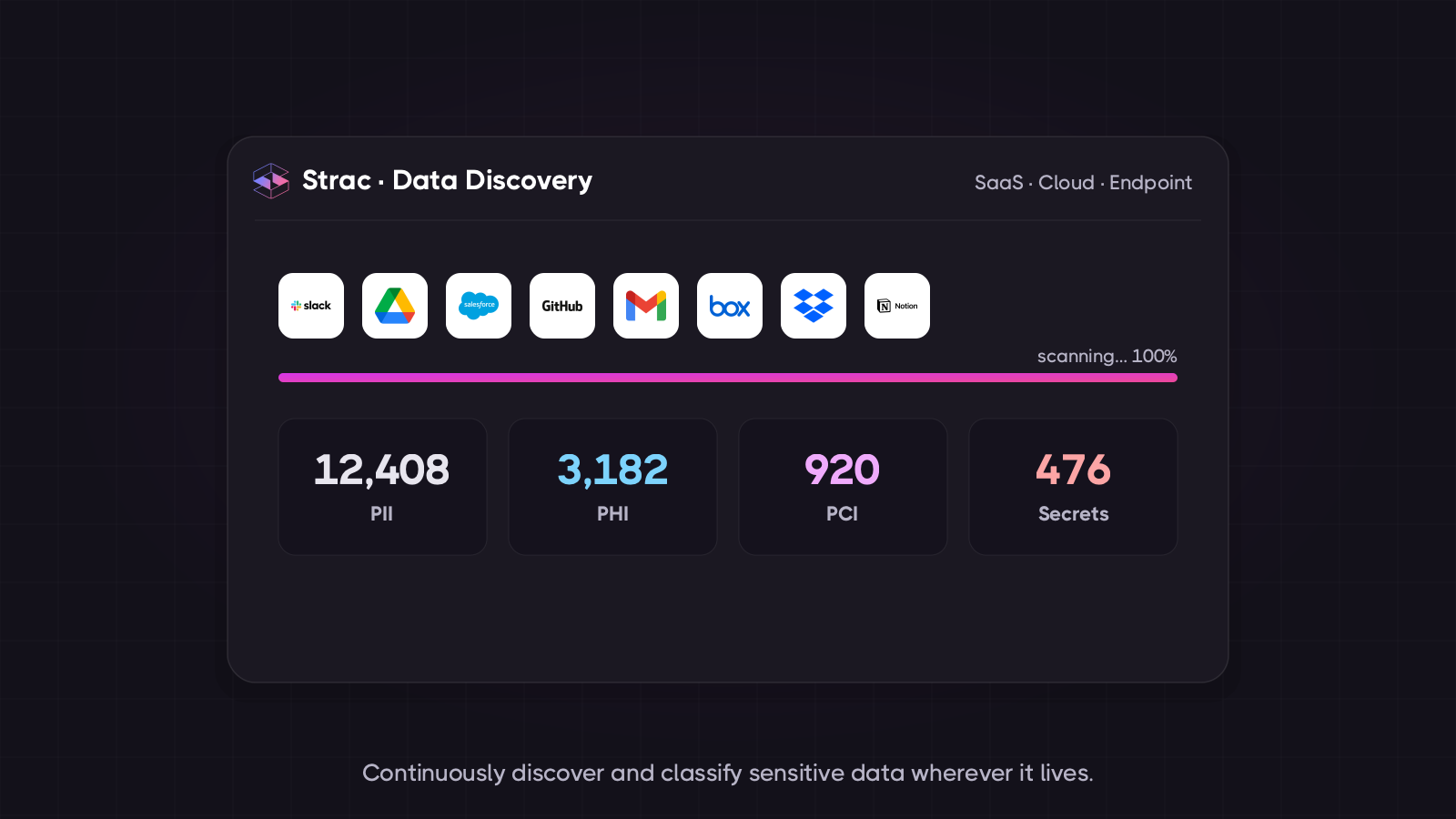
The blind spot in numbers: Strac's API-native discovery finds the sensitive data already at rest in SaaS — files the service edge will never inspect.
Data at rest in SaaS. Files already sitting in Google Drive, SharePoint, or Slack — including years of history and links shared before SASE was deployed — never cross the edge again until someone moves them. API-native scanning is the only way to find and remediate them.
Cloud-to-cloud flows. A Salesforce-to-Slack integration or a third-party app with OAuth access moves data between clouds without touching your service edge.
Unmanaged devices and BYOD. Traffic from devices outside the SASE agent's control bypasses inspection entirely.
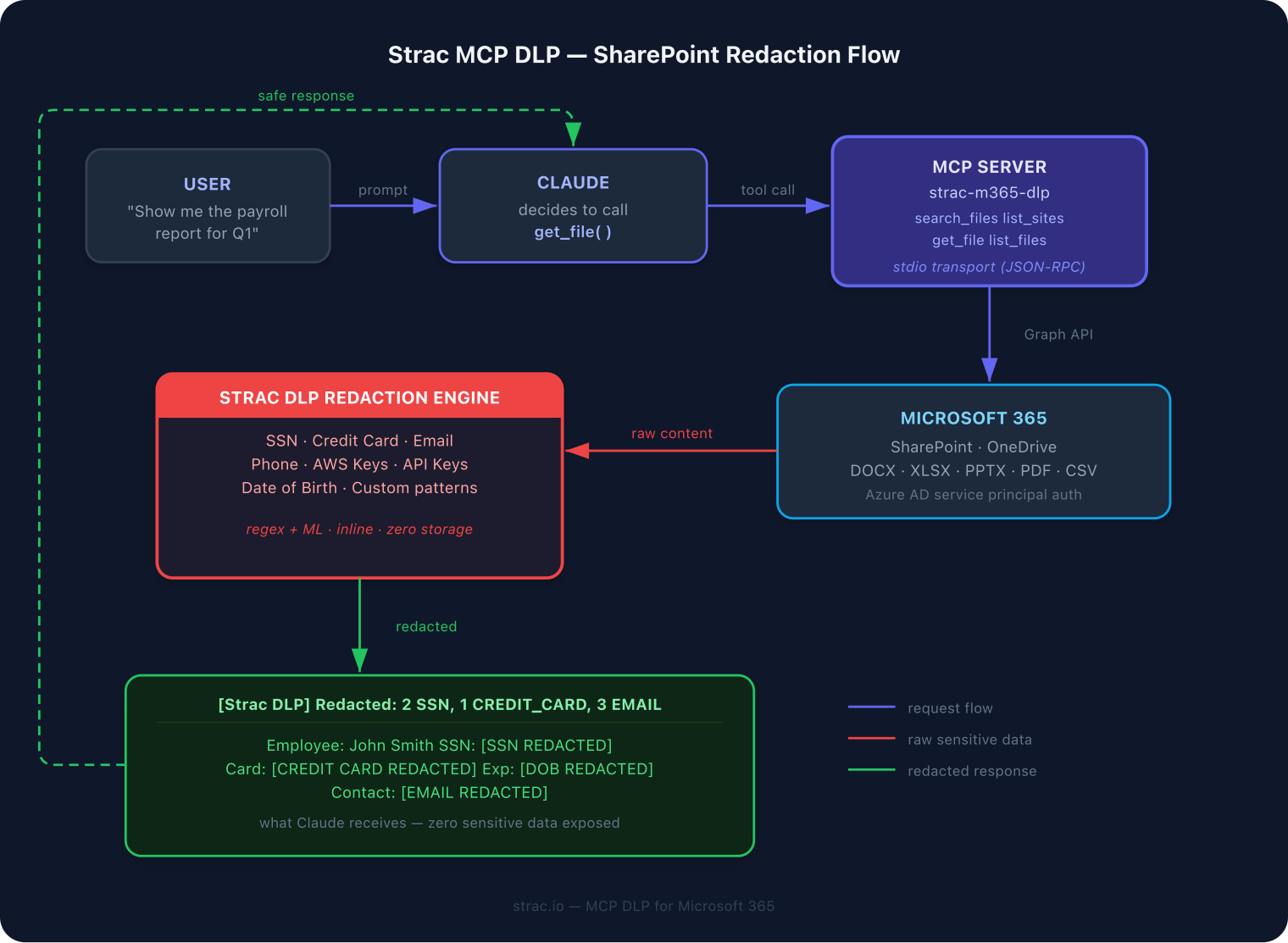
GenAI prompts and AI agents. Some GenAI traffic is inspectable inline, but the real exposure — a prompt assembled in the browser, an AI agent pulling SaaS data through MCP connectors server-to-server — largely bypasses the user's network edge. See MCP data security for why agent traffic is the new blind spot.
Remediation depth. Edge DLP's primary verb is block. It generally cannot redact a sensitive field inside a file at rest, tokenize a stored card number, or fix an over-shared link — remediation that data-native platforms perform in place.
✨ Decision Framework: Choosing DLP for a Unified SASE Deployment
If you're selecting a SASE vendor and DLP quality matters most → weight Netskope or Forcepoint heavily; validate detection accuracy on your real data, not demo data.
If your SASE vendor is already decided → use its inline DLP for the traffic path, then close the gaps with an API-native layer for SaaS-at-rest, endpoint, GenAI, and MCP. That pairing — edge DLP + Strac — is the most common pattern we see in 2026 architectures.
If GenAI and AI agents are your board-level risk → prioritize the data-native layer first: the edge sees the least of that traffic, and blocking is the wrong verb for AI workflows — you want redact-and-continue.
If compliance evidence is the driver → make sure whatever DLP you choose logs findings as audit-ready evidence (SOC 2 CC6, HIPAA, PCI Req. 3/10), not just security telemetry.
AI-agent traffic moves server-to-server through MCP connectors — Strac redacts it in the tool call, where the network edge has no vantage point.
Quick Comparison: SASE Edge DLP vs. Data-Native DLP
For the traffic path itself, Netskope and Forcepoint offer the deepest bundled DLP among unified SASE vendors, with Zscaler and Palo Alto strong for their respective ecosystems. But the best unified SASE deployments in 2026 pair that edge DLP with a data-native platform like Strac, because the edge cannot see SaaS data at rest, cloud-to-cloud sharing, or AI-agent traffic over MCP — and it can only block, not redact.
Does SASE include DLP?
Yes — DLP is a standard function of the SSE layer inside SASE, applied inline as traffic crosses the service edge. The bundled depth varies significantly by vendor: some inherited mature DLP engines (Netskope, Forcepoint), others added DLP more recently as a checkbox. Bundled inclusion does not mean complete coverage: inline DLP inspects the traffic path only.
Can SASE DLP protect data in generative AI tools?
Partially. Inline inspection can catch some GenAI traffic from managed devices, but prompts assembled in the browser and AI agents pulling data through MCP connectors largely bypass the user's network edge. That's why GenAI data protection is usually handled at the browser and connector layer — inspecting and redacting the prompt or tool call itself before it reaches the model — rather than at the network edge.
Do I still need separate DLP if I have SASE?
If your sensitive data only ever moved through web uploads from managed devices, no. In practice, most exposure now lives where the edge can't see: files at rest in SaaS with risky sharing, unmanaged devices, and AI workflows. A data-native layer closes those gaps and adds remediation the edge can't perform — redacting or tokenizing data in place instead of only blocking it in motion.
Is Strac a SASE vendor?
No — and it doesn't try to be. Strac is a data security platform that complements SASE: API-native SaaS coverage, endpoint DLP, browser-level GenAI protection, and MCP-layer redaction for AI agents, with compliance evidence built in. Keep your SASE vendor for the network path; add Strac for the data itself.
The Bottom Line
The best DLP for SASE is a pairing, not a product. Use your SASE vendor's inline DLP for what it's built for — inspecting traffic at the service edge — and be clear-eyed that the fastest-growing exposure in 2026 (SaaS data at rest, cloud-to-cloud, GenAI prompts, MCP agents) never crosses that edge. Close those gaps with a data-native platform that can redact and remediate, not just block.
Book a 30-minute demo to see how Strac pairs with Netskope, Zscaler, or any unified SASE stack — one data-security layer across SaaS, endpoint, browser, and AI.
For the traffic path itself, Netskope and Forcepoint offer the deepest bundled DLP among unified SASE vendors, with Zscaler and Palo Alto strong for their respective ecosystems. But the best unified SASE deployments in 2026 pair that edge DLP with a data-native platform like Strac, because the edge cannot see SaaS data at rest, cloud-to-cloud sharing, or AI-agent traffic over MCP — and it can only block, not redact.
Does SASE include DLP?
Yes — DLP is a standard function of the SSE layer inside SASE, applied inline as traffic crosses the service edge. The bundled depth varies significantly by vendor: some inherited mature DLP engines (Netskope, Forcepoint), others added DLP more recently as a checkbox. Bundled inclusion does not mean complete coverage: inline DLP inspects the traffic path only.
Can SASE DLP protect data in generative AI tools?
Partially. Inline inspection can catch some GenAI traffic from managed devices, but prompts assembled in the browser and AI agents pulling data through MCP connectors largely bypass the user's network edge. That's why GenAI data protection is usually handled at the browser and connector layer — inspecting and redacting the prompt or tool call itself before it reaches the model — rather than at the network edge.
Do I still need separate DLP if I have SASE?
If your sensitive data only ever moved through web uploads from managed devices, no. In practice, most exposure now lives where the edge can't see: files at rest in SaaS with risky sharing, unmanaged devices, and AI workflows. A data-native layer closes those gaps and adds remediation the edge can't perform — redacting or tokenizing data in place instead of only blocking it in motion.
Is Strac a SASE vendor?
No — and it doesn't try to be. Strac is a data security platform that complements SASE: API-native SaaS coverage, endpoint DLP, browser-level GenAI protection, and MCP-layer redaction for AI agents, with compliance evidence built in. Keep your SASE vendor for the network path; add Strac for the data itself.
Discover & Protect Data on SaaS, AI, MCP, Endpoints & Cloud
Strac provides end-to-end data loss prevention for all SaaS and Cloud apps. Integrate in under 10 minutes and experience the benefits of live DLP scanning, live redaction, and a fortified SaaS environment.


.webp)




.avif)



.gif)
