November 20, 2026

6
min read
SaaS Discovery Tools: Complete Guide for AI & Shadow SaaS Visibility
SaaS discovery tools find every SaaS and AI app your team uses and the OAuth access behind it. Compare 8 tools and see how Strac adds data protection.
SaaS discovery tools identify every SaaS and AI application your workforce uses, whether IT approved it or not, and map who uses it and what it can access. A good tool answers three questions: which apps are in use, who connected them, and what data they can read.
That inventory covers far more than the apps in your SSO portal:
SaaS discovery sits where four programs meet: SaaS security posture management (SSPM), DSPM, data loss prevention, and AI data governance. Discovery finds the app. The other three decide what happens to the data inside it.
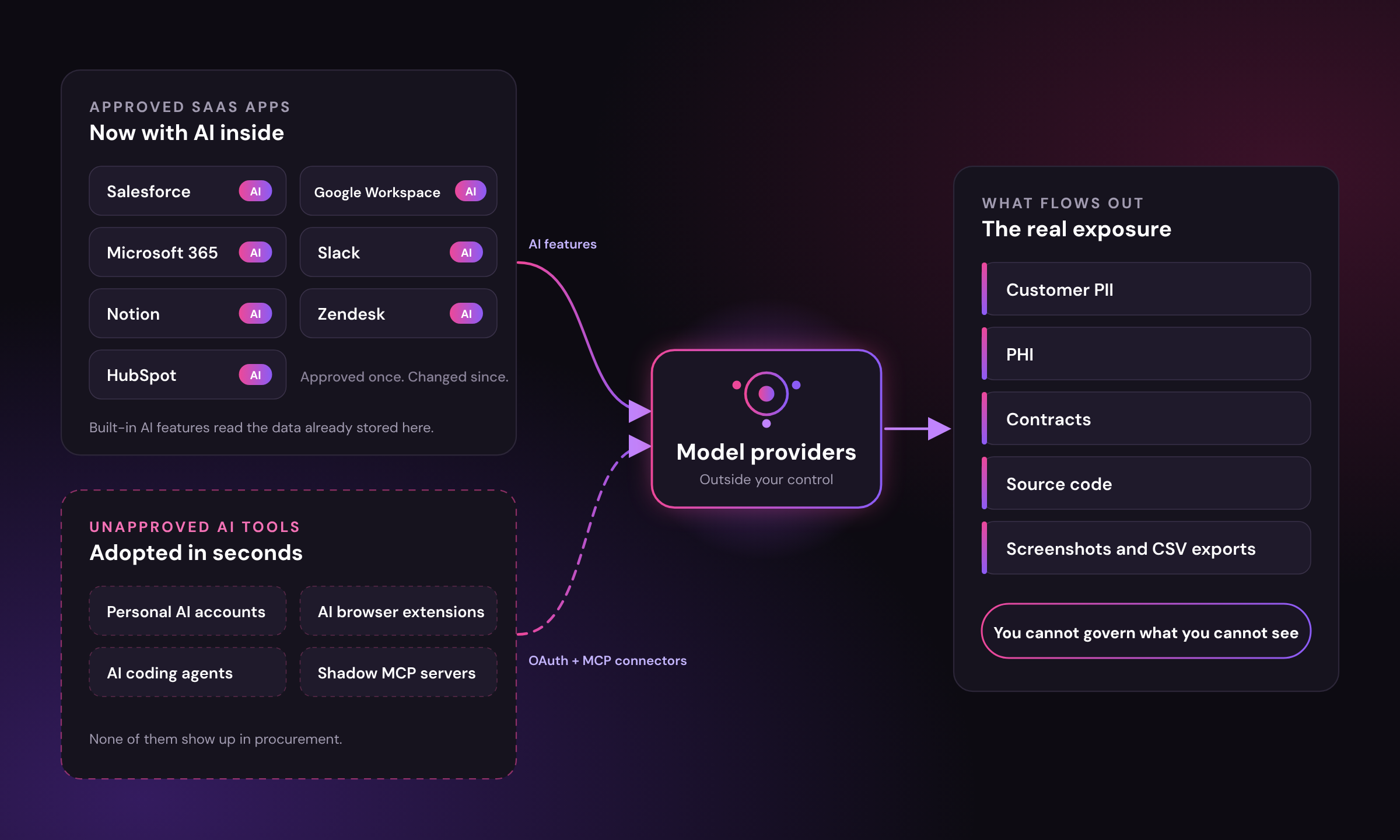
The SaaS sprawl problem has become an AI sprawl problem. Salesforce, Google Workspace, Microsoft 365, Slack, Notion, Zendesk, and HubSpot all ship AI features that read the data already stored there. An app security approved two years ago may now send records to a model provider.
At the same time, employees adopt AI tools faster than any review process can keep up. A marketer signs into a new writing assistant with Google. A support agent installs an extension that summarizes tickets. An engineer connects an AI coding agent to GitHub and a production database over MCP. Each takes seconds, and none of them shows up in procurement.
What flows into those tools is the real exposure: customer PII, PHI, contracts, source code, screenshots, and CSV exports. Without discovery, you have:
You cannot govern an app you cannot see. AI turned discovery from an IT housekeeping task into a security control.
Most tools combine four signals. The more of them a tool uses, the fewer apps slip past it.
1. SSO and identity logs. The tool reads sign-in events from Google Workspace, Microsoft Entra ID, Okta, or OneLogin. This shows every app employees log into with a company identity, along with the OAuth scopes each one requested, such as:
2. OAuth consent and connected app data. The tool pulls the list of third-party apps users have authorized inside each core platform: Chrome extensions, AI plugins, marketplace add-ons, and AI assistant connectors. This is where risky grants such as "read all files in Google Drive" surface.
3. Browser visibility. A browser extension sees activity that never touches SSO, such as personal AI accounts and free tools. With browser DLP, that includes what employees do inside those tools: file uploads, drag and drop, copy and paste, screenshots, and PDF uploads into AI apps.
4. API integrations with core SaaS apps. The tool connects directly to Google Drive, Slack, Notion, Zendesk, Confluence, SharePoint, Jira, and Salesforce, then maps every app and bot connected inside them. API access is also what lets a tool scan the data in those apps instead of only listing them.
Identity logs show who signed in; browser and API signals show what happened to the data afterward.
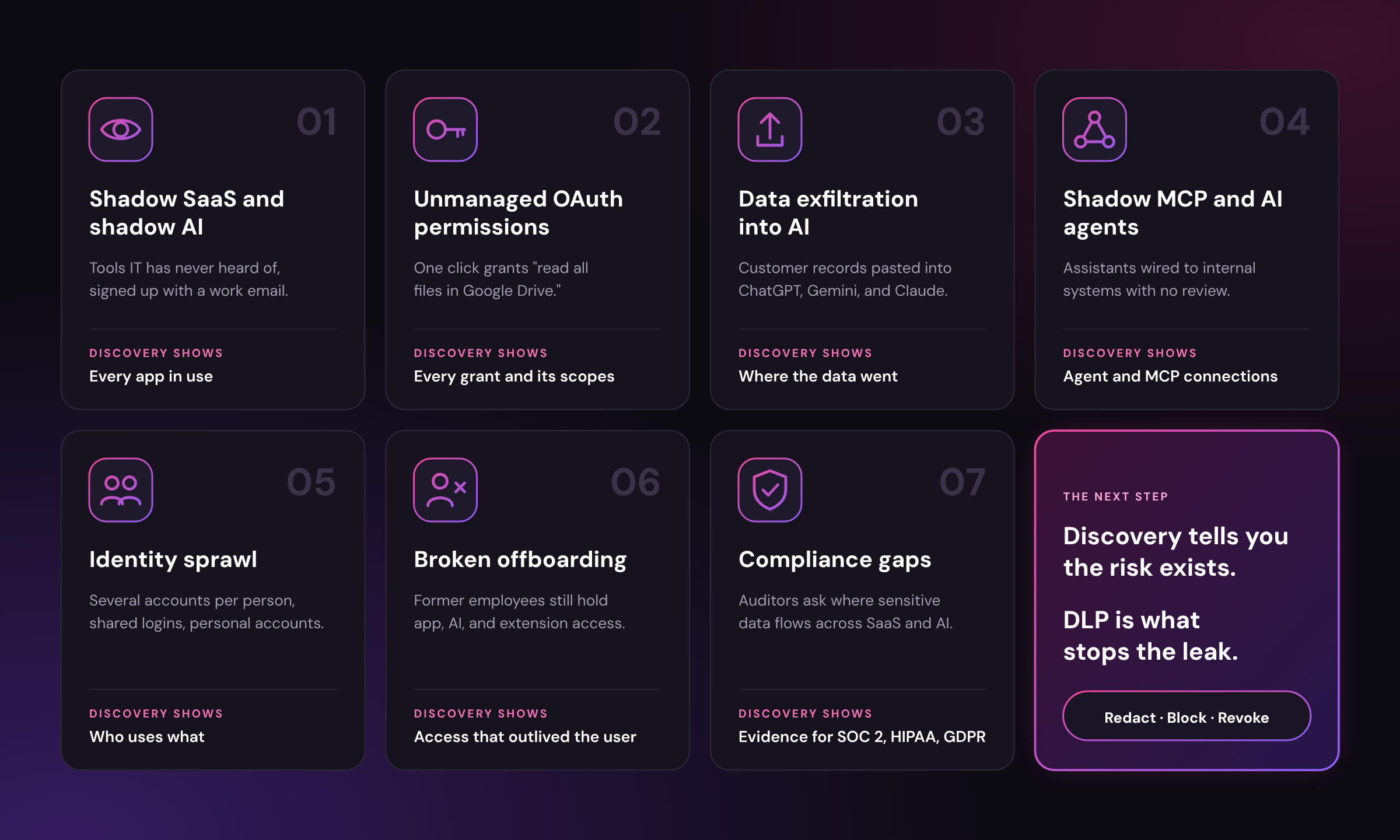
Shadow SaaS and shadow AI. Employees use tools IT has never heard of. Discovery turns those tools into a list you can review and act on. See how to detect shadow AI and shadow IT discovery for the detection methods in more depth.
Unmanaged OAuth permissions. An AI app asks for "read all files in Google Drive," and one click grants it. Discovery shows every grant and its scopes, so you can revoke the broad ones.
Data exfiltration into AI assistants. Employees paste customer records and upload files into ChatGPT, Gemini, Claude, Copilot, Perplexity, and AI extensions. Discovery shows where it happens; AI DLP stops it.
Shadow MCP and AI agents. Developers connect assistants to internal systems through MCP servers that security never reviewed. Shadow MCP is the newest blind spot, and it moves data with no person in the loop. Discovery here means you also need to discover AI agents, not only apps.
Identity sprawl. Several accounts per person, shared logins, and personal accounts used for work make access hard to audit.
Broken offboarding. Former employees keep access to apps they signed into with Google, AI tools that store their chat history, and extensions that still process company data.
Compliance gaps. Auditors for SOC 2, HIPAA, PCI DSS, GDPR, NYDFS, and the SEC cybersecurity rules increasingly ask the same question: do you know where sensitive data flows across your SaaS and AI apps?
Discovery without enforcement is a report; discovery with enforcement is a control.
The market splits into three groups: security platforms that discover apps and protect the data in them, identity and access tools that include discovery, and SaaS management tools built for IT and procurement. The right choice depends on whether your main problem is data exposure, access, or spend.
Strac discovers SaaS and AI apps across the workforce and then protects the data flowing into them. Where most discovery tools stop at OAuth logs, Strac adds real-time AI upload detection, browser DLP, SaaS DSPM, SaaS DLP, and AI data governance in one platform.
Best for: Security teams that need visibility and real-time enforcement across SaaS, AI, browser, cloud, and endpoints.
Key capabilities:
Strac lists every SaaS and AI app in use alongside the sensitive data each one can reach.
👉 Related reading:
BetterCloud is one of the longest-running SaaS management platforms. It focuses on automating user lifecycle and admin tasks across core apps.
Todyl includes SaaS discovery inside a broader security platform aimed at small and midsize businesses and MSPs.
Wing uses a browser extension for SaaS visibility and has added OAuth insight on top.
Lumos is an access request and access review platform with SaaS discovery built in.
Grip focuses on identity risk and account takeover, with SaaS discovery as part of its identity layer.
Zluri is an IT operations platform that uses discovery for procurement, license, and spend control.
Vendr is a procurement platform, not a security tool. Some teams use it for discovery because it tracks SaaS invoices, contracts, and spend.
A spend tool tells you what you pay for; a security tool tells you what your data touches. For tools that focus on the configuration of managed apps, see the top 10 SSPM solutions, and for AI-specific detection, the shadow AI detection tools roundup.
Finding an app is step one. Strac connects the inventory to the data, so every discovered app comes with the sensitive data it holds or receives. When a policy matches, Strac acts:
The same policy covers the flagship surfaces: Google Workspace DLP, Slack DLP, AI DLP, and MCP DLP.
Discovery shows you the risk. Redaction removes it.
For a broader review, pair this list with the ultimate SaaS security checklist and the shadow IT security checklist.
Strac closes the blind spot behind both shadow IT and shadow AI. Start at the shadow AI hub, or read about shadow IT and shadow AI third-party risk.
SaaS discovery tools answer the first question in any SaaS or AI security program: what are people actually using. In 2026 that list changes every week, and every app on it can read company data. Inventories, identity controls, and approval workflows all miss something eventually; the data layer is the backstop. Find the apps, find the data inside them, and redact it before it leaves, and a missed app never becomes a breach.
Book a demo to see Strac discover and protect your SaaS and AI data.
No. SSPM checks the configuration of the core apps you already manage, such as Slack and Google Workspace. SaaS discovery finds the long tail of apps and AI tools you do not manage. Most teams need both; see SSPM for how they fit together.
Not on its own. Discovery tells you employees use those tools. Keeping sensitive data out of them takes AI DLP in the browser and on the endpoint, which redacts or blocks the sensitive part of an upload while the rest of the prompt goes through.
No. Blanket blocking pushes employees to personal devices, where the problem gets harder to see. Redacting sensitive data in prompts and uploads lets teams keep using AI tools while customer records, PHI, and secrets stay inside the company.
Not with certainty. Personal devices, personal email signups, and tools used off the corporate network can stay hidden. That is why the data layer matters: if sensitive data is redacted before it leaves, an app you missed has nothing to leak.
None of them name SaaS discovery directly, but each expects you to know where sensitive data lives and who can reach it. Discovery and DSPM produce that evidence. See AI data governance for the full picture.
“Don’t just alert on problems, fix them.”
Scott Roberts, Chief Information Security Officer, UiPath









Customers include