In this article, we explore why the Gartner DLP Magic Quadrant ended, what replaced it, and practical steps for any organization seeking an effective data loss prevention strategy.
The Gartner DLP Magic Quadrant helped businesses map top data loss prevention providers until its retirement in 2018.
Gartner now offers Market Guides instead, emphasizing integrated and emerging security frameworks.
Enterprise DLP provides comprehensive multi-channel protection, while integrated DLP is cost-effective for narrower use cases.
Advanced AI-driven solutions and broader frameworks like SSE and IRM are paving the future of DLP analytics.
Strac brings a modern twist to DLP with automated redaction, AI-driven detection, and quick cloud integrations.
The Gartner DLP Magic Quadrant was one of the most influential resources for security leaders evaluating data loss prevention solutions; it shaped how CIOs and CISOs compared vendors, assessed market maturity, and made long-term security investments. Then, in 2018, the Enterprise DLP Magic Quadrant quietly disappeared. No annual update. No direct replacement. Yet data exposure risk has only accelerated since; driven by SaaS sprawl, cloud adoption, collaboration tools, and now generative AI.
This left many organizations asking the same question: what replaced the Gartner DLP Magic Quadrant; and how should modern DLP solutions be evaluated today? Understanding why Gartner discontinued the DLP Magic Quadrant is critical for making the right security decisions now.
Strac answers this call by offering cutting-edge automated data protection; from detecting sensitive information to seamlessly redacting it; so businesses remain in full control of their critical assets.
✨ What was in the Gartner DLP Magic Quadrant?
The Gartner DLP Magic Quadrant was a visual representation of Data Loss Prevention vendors that aimed to help organizations navigate the DLP market. Gartner, one of the leading research & advisory companies, released this recurring report to map out DLP providers based on their ability to execute & the completeness of their vision. Vendors were plotted into four quadrants:
Leaders: Vendors with both a high ability to execute and a high completeness of vision.
Challengers: Vendors that excelled in execution but had a more narrowly focused vision.
Visionaries: Vendors with an innovative vision but needed more track record or breadth in execution.
Niche Players: Vendors focusing on a small segment of the market or lacking a full range of capabilities.
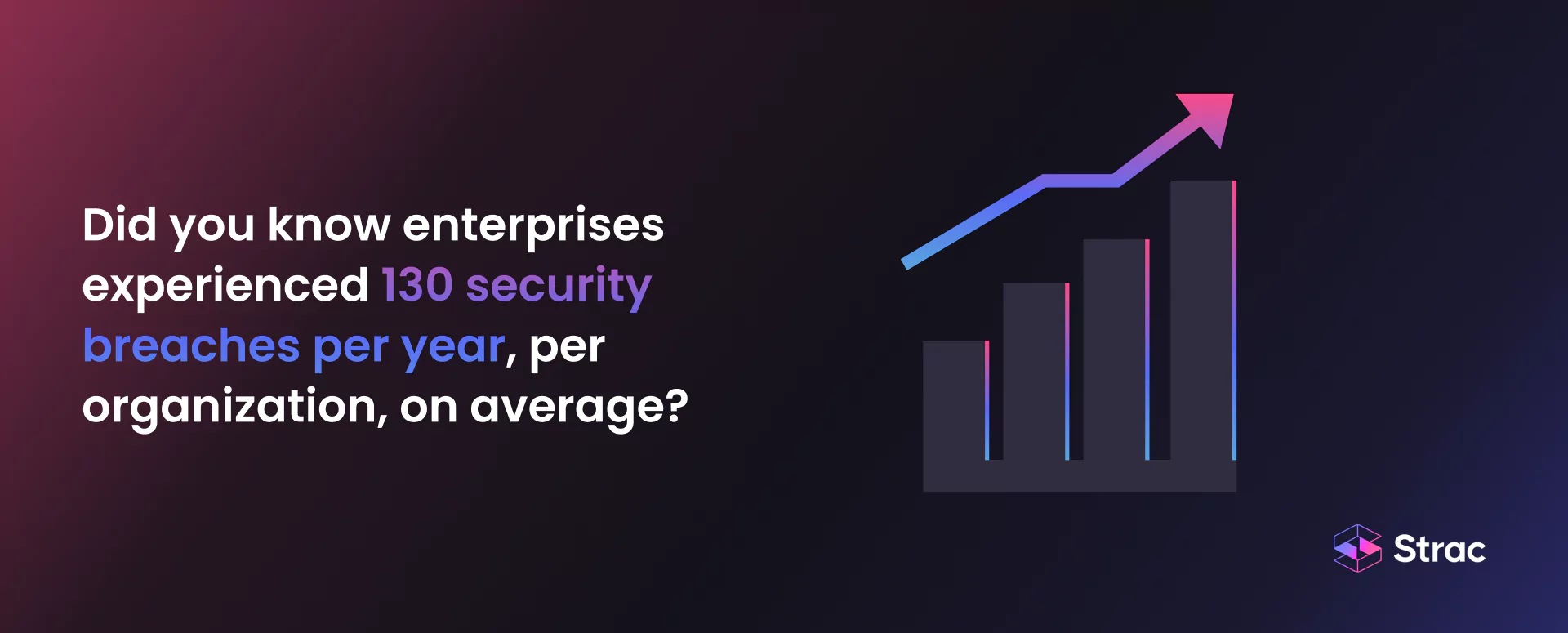
Gartner Magic Quadrant DLP: Security Breach Stats
The Magic Quadrant format quickly became tremendously influential because it offered a straightforward, at-a-glance comparison of key players in a rapidly maturing technology sector. At the time, the DLP market was dynamic, and Gartner compiled vendor information to help prospective buyers make critical decisions about tool selection. These editions often included:
Vendor Profiles: Detailed breakdowns of each vendor’s strengths and weaknesses.
Market Trends Analysis: Insights into emerging DLP use cases, region-specific developments, and technology adoption patterns.
Overall Market Outlook: Predictions about where DLP technology was heading, including potential mergers/acquisitions or expansions in functionality (e.g., integration with cloud security).
Because the Magic Quadrant garnered significant attention, it often acted as a barometer for how the industry was shifting. Vendors worked diligently to demonstrate their capabilities to remain competitive, and large organizations frequently used Gartner’s evaluations to justify their buying decisions at the executive or board level.
✨ What is the Criteria for the Gartner DLP Magic Quadrant?
Gartner had a fairly standardized approach to evaluating industry segments for Magic Quadrants. Even though it ceased specifically publishing a Magic Quadrant for DLP in 2018, the criteria it relied upon remained consistent across many of its other MQ reports, such as those for endpoint protection or enterprise backup. Broadly, when Gartner was evaluating DLP products, it analyzed them based on:
Ability to Execute:
Product or Service Quality: Did the solution reliably enforce data protection policies across endpoints, networks, and cloud?
Overall Viability: Were the vendor’s financial health and organizational stability strong enough to ensure long-term support?
Sales and Marketing Execution: Did the vendor resonate with the market and successfully translate their value proposition?
Geographic Strategy: Could the vendor support customers across multiple regions adequately?
Completeness of Vision:
Market Understanding: Did the vendor show awareness of changing data security trends and compliance demands?
Sales Strategy: How did the vendor tailor its go-to-market approach?
Offering (Product) Strategy: Was the technology scalable, extensible, and reliable?
Business Model and Innovation: To what extent did the vendor drive or respond to product innovation?
Vertical/Industry Strategy: Did the product cater specifically to different regulatory environments or specialized industry use cases?
Gartner Magic Quadrant DLP: Sensitive Data Discovery & Classification with Strac
Evaluating both Ability to Execute and Completeness of Vision allowed Gartner to rank vendors along the X and Y axes, culminating in a quadrant placement. The ultimate objective was to give organizations a holistic view rather than simply listing features. By doing so, Gartner offered an ecosystem-level view of the DLP market, taking into account differentiation, innovation, financial health, and customer support.
What happened to the Gartner DLP Magic Quadrant?
Gartner retired the DLP Magic Quadrant after 2018. The primary reason cited was that DLP had become sufficiently mature as a technology market, with many vendors offering comparable baseline capabilities.
Once a market no longer sees huge leaps in new entrants or radical innovation, Gartner sometimes refocuses its attention to an adjacent or emergent area—this occurred in the DLP sphere, where coverage moved to Market Guides and other frameworks like Insider Risk Management (IRM) or Security Service Edge (SSE).
Gartner’s shift reflected the fact that DLP had expanded far beyond the original “blocking and monitoring” model into more integrated solutions spanning endpoint, cloud, insider threat, and zero-trust. Thus, a single Magic Quadrant for “Enterprise DLP” no longer captured the entire landscape of data security solutions.
Moreover, many products rebranded or repositioned themselves within newly combined categories like Secure Access Service Edge (SASE), SSE, or Cloud Security Posture Management (CSPM), diluting the lines between a standalone DLP and the broader security market.
While Gartner ceased releasing an annual or biennial Magic Quadrant for DLP, it continues to engage with DLP topics through Market Guides, curated analyses, and new frameworks that recognize how data protection is now part of a broader, integrated cybersecurity posture.
✨ Is the Gartner Magic Quadrant different from the Gartner Market Guide?
Yes. Although both the Magic Quadrant and the Market Guide are produced by Gartner, they serve distinct purposes:
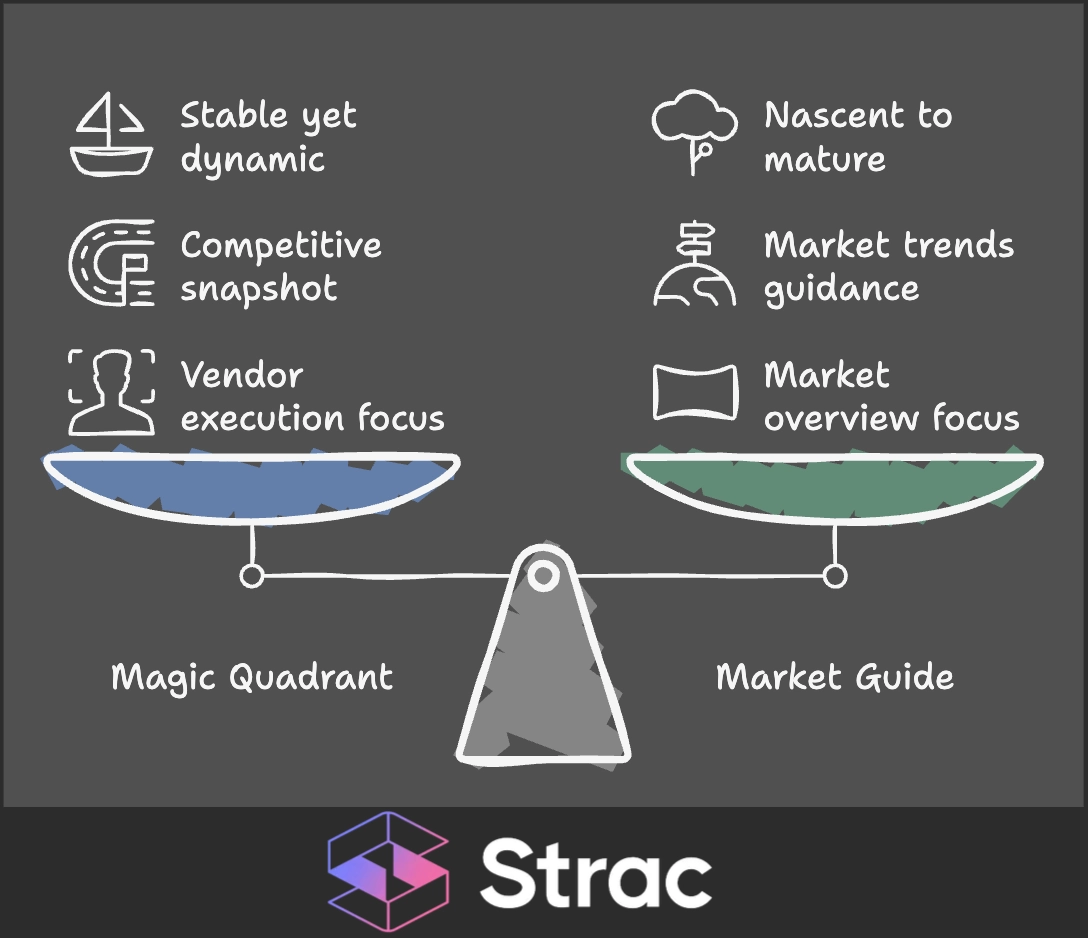
Magic Quadrant:
Based on a vendor’s ability to execute and completeness of vision.
Most useful for markets that have some stability but are still dynamic enough to see potential shifts or new entrants.
Provides a competitive snapshot, showing which players outperform in specific areas.
Often used by organizations to shortlist vendors based on quadrant positions (Leaders, Challengers, Visionaries, Niche Players).
Market Guide:
Provides a broader overview of an entire market.
Focuses on market direction, trends, and guidance rather than ranking vendors in quadrants.
Advises organizations on how to approach the market and what features to look for.
Useful in either a very nascent market (where vendors, products, and solutions shift rapidly) or a mature market (where major players and features are well established, and the changes are incremental).
Gartner Magic Quadrant DLP: Choose the right Gartner tool for your market needs
Since Gartner deemed enterprise DLP to be relatively mature, they transitioned from a Magic Quadrant to a Market Guide. In a stable market, the same vendors often remain in similar positions year after year, making an annual MQ less useful.
Instead, the Market Guide delves into how best to deploy DLP, how DLP fits in with compliance, data discovery, or advanced security workflows, and which technological bells and whistles you should be mindful of when evaluating a purchase.
What’s the future of Gartner DLP analysis?
The Gartner DLP Magic Quadrant may be gone, but the problem it tried to measure hasn’t disappeared. If anything, it’s become harder. Data no longer sits in a few controlled systems; it constantly moves across SaaS apps, cloud storage, collaboration tools, endpoints, and now AI workflows. As a result, DLP hasn’t evolved as a single category; it’s evolved in how teams actually use it.
Today, DLP is increasingly evaluated alongside data discovery, lineage, and real-time enforcement; as well as adjacent areas like DSPM, insider risk, and data detection and response. This mirrors how data exposure happens in the real world; continuously, across many tools, and often in ways legacy DLP was never designed to handle. If analyst coverage returns in the future, it will likely focus less on static controls and more on how effectively platforms reduce risk as data moves; in real time, and at scale.
✨ What are the four types of DLP?
Data Loss Prevention solutions are generally categorized based on the vector or environment in which they operate. The commonly recognized four types of DLP are:
Network DLP:
Monitors data as it moves through the corporate network.
Often deployed on a perimeter firewall or specialized network appliances to detect and block unauthorized data transfers.
Focuses on preventing exfiltration through email, web uploads, FTP, or other network protocols.
Endpoint DLP:
Installed on individual devices like laptops, desktops, and servers.
Monitors local data storage, USB usage, clipboard activity, and printing.
Offers granular visibility and enforcement at the user-device level.
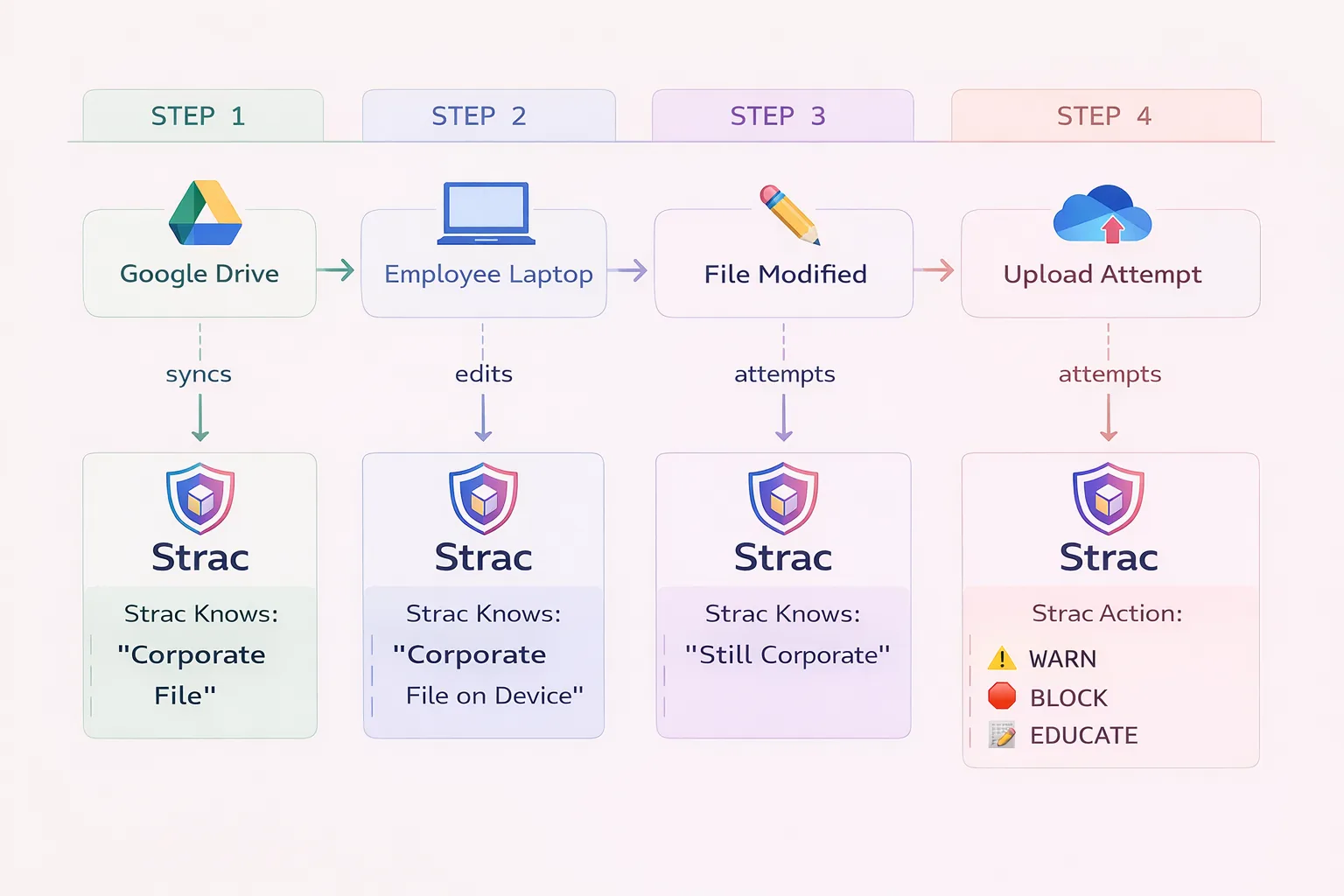
Strac Endpoint Data Lineage
3. Cloud DLP:
Addresses data residing in or traveling to and from SaaS, IaaS, or PaaS solutions.
Monitors and controls data stored in cloud repositories like Google Drive, Microsoft 365, Slack, or other corporate SaaS apps.
Often integrated with CASB (Cloud Access Security Broker) functionalities.
Strac Zendesk DLP
4. Discovery DLP (Data-at-Rest DLP):
Focuses on scanning and classifying data at rest—in file shares, databases, cloud storage, or endpoints.
Helps organizations identify and categorize sensitive information (PII, PCI, PHI, IP) and apply the proper remediation actions, such as encryption or quarantine.
Each type can be part of an “Enterprise DLP Suite” or can exist as standalone, integrated modules in solutions like Secure Email Gateway or CASB. The actual classification sometimes varies by vendor marketing, but the broad categories remain consistent.
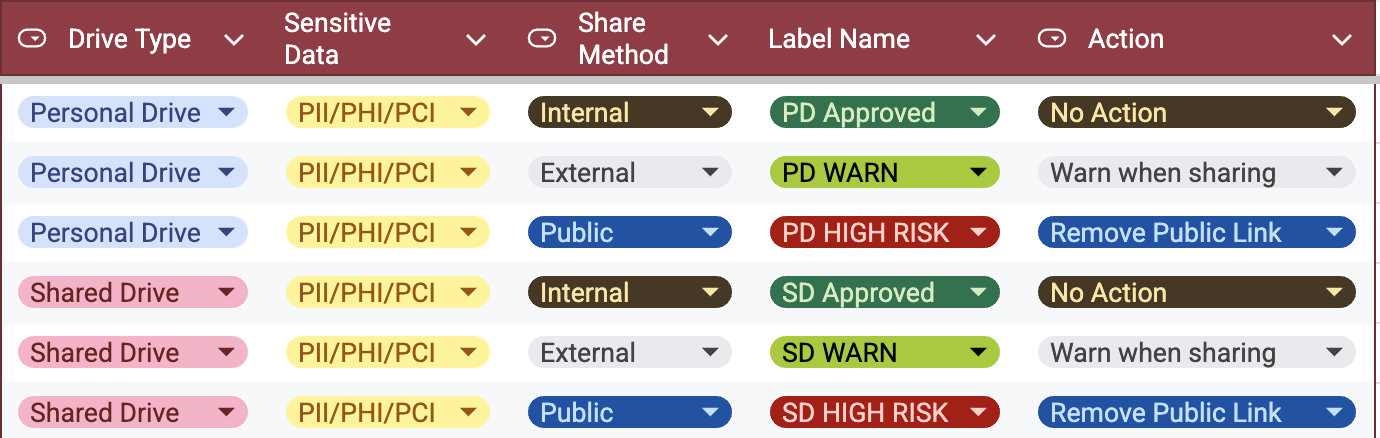
Strac Data Classification and Labeling
Enterprise DLP vs. Integrated DLP
Enterprise DLP
Enterprise DLP provides advanced content inspection techniques, robust workflows, and unified policy management that can span multiple data channels. It often involves:
Consistent Policies Across Channels: Policies that apply uniformly across network, endpoint, cloud, and discovery.
Granular Enforcement and Workflow Engines: Allows for role-based remediation, multiple levels of inspection, and compliance workflows.
Advanced Analytics: Some enterprise solutions incorporate behavioral analysis, machine learning, or AI to detect anomalous data movements.
Long-Term Scalability: Enterprise-grade solutions are designed to handle thousands or tens of thousands of endpoints & large-scale data environments.
Integrated DLP
Integrated DLP is built into other security or productivity solutions, such as an email gateway, web gateway, endpoint protection, or CASB. Typically:
It has a narrower scope: e.g., scanning emails in an email gateway or attachments in a cloud collaboration tool.
It is cost-effective but lacks the unified policy orchestration that a full enterprise DLP provides.
May require “piecemeal” management across multiple consoles, leading to possible policy fragmentation.
Enterprise DLP remains the gold standard for organizations with a broad set of use cases and a high need for data visibility. By contrast, integrated DLP is suitable for narrower or simpler data protection demands.
Why Do Some Businesses Turn Towards Integrated DLP?
While Enterprise DLP is attractive for its depth and breadth, some organizations opt for Integrated DLP for specific reasons:
Cost-Effectiveness:
Small or mid-sized companies with limited budgets may find integrated DLP solutions in existing security stacks more financially accessible.
Immediate Use Cases:
If a company’s primary DLP concern revolves around email data leakage, a Secure Email Gateway that includes integrated DLP might be enough.
Administrative Simplicity:
Configuration and deployment can be easier if DLP is pre-packaged within a known environment, such as an endpoint protection suite or default email security system.
Lack of Complexity:
For organizations with fewer compliance requirements or simpler data flows, integrated DLP solutions may meet essential needs without the overhead of a dedicated enterprise DLP platform.
However, as businesses grow or face more complex regulations and advanced insider threats, they often find integrated solutions insufficient over the long term, prompting an upgrade to enterprise-level DLP.
What Replaced the Gartner DLP Magic Quadrant?
Since discontinuing the Magic Quadrant for Enterprise DLP, Gartner has funneled its analysis into:
Market Guide for DLP:
Offers a broad overview of critical DLP features.
Discusses how DLP intersects with newer security capabilities like Insider Risk Management, UEBA (User and Entity Behavior Analytics), and Cloud Security.
Insider Risk Management (IRM) or Security Service Edge (SSE) Reports:
Because data exfiltration frequently originates from insider threats, Gartner has begun analyzing solutions addressing that aspect.
SSE addresses the shift toward cloud-based security services that integrate multiple controls, including (or supplanting) DLP.
Broader Data Security Frameworks:
Gartner’s coverage now includes advanced categories like Data Detection and Response (DDR), focusing on real-time identification of risky data movement.
With shifts toward zero-trust architectures, there is also more emphasis on restricting data access at a more granular level.
Looking forward, Gartner could combine DLP features and analytics across insider risk, cloud edges, and threat detection. DLP, in essence, is no longer siloed. It is a piece in a broader security puzzle, integrated with identity, cloud posture, and threat intelligence.
The Way Forward to Benefit from Gartner Analysis for the DLP Market
Check the Latest Gartner Market Guides:
While you won’t find a new Magic Quadrant for DLP, the most recent Gartner Market Guide on DLP or related areas (IRM, SSE, SASE) can provide relevant vendor lists.
Use it to understand market trends, typical breadth of DLP functionality, and additional modules like machine learning or cloud integration.
Contextualize Gartner’s Perspective for Your Own Needs:
If you need enterprise-wide coverage with complex compliance, you might need an Enterprise DLP approach multiple vendors are known for.
For smaller, narrower use cases, explore integrated or partial DLP solutions.
Evaluate Vendor Maturity Post-2018:
Some vendors that were challengers or niche players in 2017–2018 might have grown significantly in capabilities since then.
Similarly, “leaders” might have pivoted their solutions to SSE or SASE, or have undergone acquisitions.
Focus on Capabilities Over Quadrant Placement:
As the DLP market grows more integrated with identity and cloud security, specialized solutions might not appear in any “traditional” DLP coverage.
Evaluate features such as behavioral analysis, AI-driven policy creation, or automated endpoint responses.
Consider Vendor Roadmaps and Security Ecosystem Fit:
DLP alone rarely suffices as a data protection strategy. Look for synergy with your broader security frameworks, including insider threat solutions, endpoint detection and response, or cloud posture management.
Ultimately, using Gartner’s resources as an informed starting point—rather than a conclusive yardstick—helps security teams craft a more flexible, future-proof DLP approach.
✨ How Strac Enhances Data Loss Prevention Strategies
Although the Gartner DLP Magic Quadrant no longer exists, modern DLP solutions continue to evolve, exemplifying many qualities Gartner emphasized—like unified policy management, advanced detection capabilities, and broad coverage of data channels. One such innovator in the space is Strac, a SaaS/Cloud and Endpoint DLP provider focusing on streamlined data protection and compliance.
Comprehensive Coverage:
Strac provides holistic protection for cloud apps, endpoints, email, and removable media. This multi-layer coverage aligns closely with the four types of DLP: network, endpoint, cloud, and discovery.
Gartner Magic Quadrant DLP: Strac Integrations
2. Advanced AI/ML for Detection:
Leveraging AI and ML, Strac refines detection accuracy, reducing false positives and false negatives. This approach resonates with Gartner’s emphasis on the need for modern DLP to incorporate machine learning and data analytics to address insider threats and more complex data flows.
3. Inline Redaction and Automated Response:
Strac’s solution can automatically detect sensitive data in motion—like in Gmail or Slack—and redact it to prevent unauthorized exposure. The platform integrates workflow automation for incident response, thus shrinking the window between threat detection and remediation.
4. Compliance-Focused Approach:
Strac supports compliance for PCI, HIPAA, GDPR, SOC 2, ISO 27001, and more, which is crucial for businesses that must meet multi-faceted regulatory demands. Gartner’s DLP assessments have always stressed the significance of compliance coverage, making Strac’s approach appealing to compliance-driven industries (finance, healthcare, etc.).
5. Scalability and Quick Deployment:
Modern organizations require agile solutions that can integrate within existing infrastructures. Strac prides itself on a 10-minute integration for scanning, classification, and redaction across SaaS environments. This scalability and quick start map to Gartner’s notes on the importance of deployment flexibility in DLP.
6. Evolving Architecture and Zero Data Backend:
Strac aligns with the shift toward cloud-native architectures, offering a “zero data” approach, meaning sensitive information isn’t stored unprotected on backend systems. As data security frameworks increasingly emphasize least privilege and zero-trust approaches, Strac’s architecture is well-positioned for modern enterprises.
7. Real-Time Visibility and Reporting Dashboards:
Continuous monitoring and analytics provide necessary intelligence for security teams. This kind of real-time intelligence is exactly what Gartner’s frameworks are leaning towards, whether represented in IRM or SSE categories.
With data flows changing rapidly—due to distributed workforces, BYOD, and the proliferation of cloud services—solutions like Strac illustrate what next-generation DLP entails: multi-channel coverage, machine learning-driven intelligence, robust compliance out of the box, and scalability. Although the Gartner Magic Quadrant has shifted, the underlying principles continue to guide how to evaluate a DLP provider.
Conclusion
While the Gartner Magic Quadrant DLP is no longer published, its historical insights help us understand the foundational expectations for DLP: multi-channel protection, strong workflows, robust vendor viability, and a comprehensive vision that addresses evolving data security challenges. Gartner has shifted more of its focus to Market Guides and emerging security areas like IRM or SSE, reflecting how modern data protection fits into a broader cybersecurity ecosystem.
The future of DLP analysis involves deeper integration of AI, machine learning, cloud security, insider threat detection, and compliance frameworks. Understanding these aspects—along with the legacy concepts from the original Magic Quadrant—will help your organization select the right DLP to protect your critical data in an era of complex and ever-evolving cybersecurity threats.
🌶️ Spicy FAQs: Gartner DLP Magic Quadrant
1. Does Gartner still publish a DLP Magic Quadrant?
No. Gartner discontinued the Magic Quadrant for Enterprise Data Loss Prevention in 2018. Since then, DLP analysis has been distributed across Market Guides and broader data security research rather than a single quadrant.
2. Why did Gartner discontinue the DLP Magic Quadrant?
The Magic Quadrant was retired as DLP stopped functioning as a standalone category. Data protection expanded beyond traditional perimeter controls into SaaS, cloud, insider risk, and real-time data movement; making a single quadrant less representative of how DLP operates in modern environments.
3. What replaced the Gartner DLP Magic Quadrant?
Gartner now evaluates DLP capabilities across multiple research areas, including the Market Guide for DLP, Insider Risk Management (IRM), Security Service Edge (SSE), and newer data security frameworks such as Data Detection and Response (DDR).
4. How should organizations evaluate DLP solutions without a Magic Quadrant?
Instead of relying on quadrant positioning, organizations should evaluate DLP based on real-world effectiveness; including visibility across SaaS and cloud data, accuracy of sensitive data detection, ability to remediate in real time, and how well the solution integrates with broader data security workflows.
5. Will Gartner bring back the DLP Magic Quadrant?
There is no public indication that Gartner plans to reinstate a standalone DLP Magic Quadrant. If quadrant-style coverage returns, it is more likely to reflect integrated data security platforms that combine DLP with posture management, insider risk, cloud security, and runtime enforcement.
Discover & Protect Data on SaaS, AI, MCP, Endpoints & Cloud
Strac provides end-to-end data loss prevention for all SaaS and Cloud apps. Integrate in under 10 minutes and experience the benefits of live DLP scanning, live redaction, and a fortified SaaS environment.


.webp)











.avif)



.gif)
