September 4, 2026

4
min read
Endpoint Agent DLP vs. SaaS/Cloud Agentless DLP: Key Differences
Compare Endpoint Agent DLP vs. Agentless SaaS, Cloud & AI DLP. Learn the key differences, benefits, use cases, and why modern organizations need both.
· EndpointDLP protects data on managed Windows and macOS devices by monitoring local useractivity such as USB transfers, printing, clipboard usage, and file movement.
· AgentlessDLP protects sensitive data directly inside SaaS, cloud, GenAI, andMCP-connected applications without installing software on employee devices.
· Modern data no longer lives only on endpoints—itmoves continuously across Slack, Microsoft 365, Google Workspace, Salesforce,AWS, ChatGPT, Claude, GitHub, and hundreds of cloud applications.
· Agentless DLP provides faster deployment,broader coverage, and protects BYOD users because enforcement happens where thedata resides.
· Thestrongest security strategy combines endpoint protection with agentless SaaS,Cloud, AI, and DSPM capabilities to eliminate blind spots
Data no longer lives only on employee laptops. It moves constantly between Microsoft 365, Google Workspace, Slack, Salesforce, cloud platforms, browsers, GenAI applications, and AI agents. As a result, Data Loss Prevention (DLP) has evolved beyond protecting just endpoints.
These aren’t competing choices — they’re two enforcement points sharing one brain. Agentless SaaS/cloud DLP governs data living in your apps; the endpoint agent governs data leaving the device through paths the network and your SaaS APIs never see.
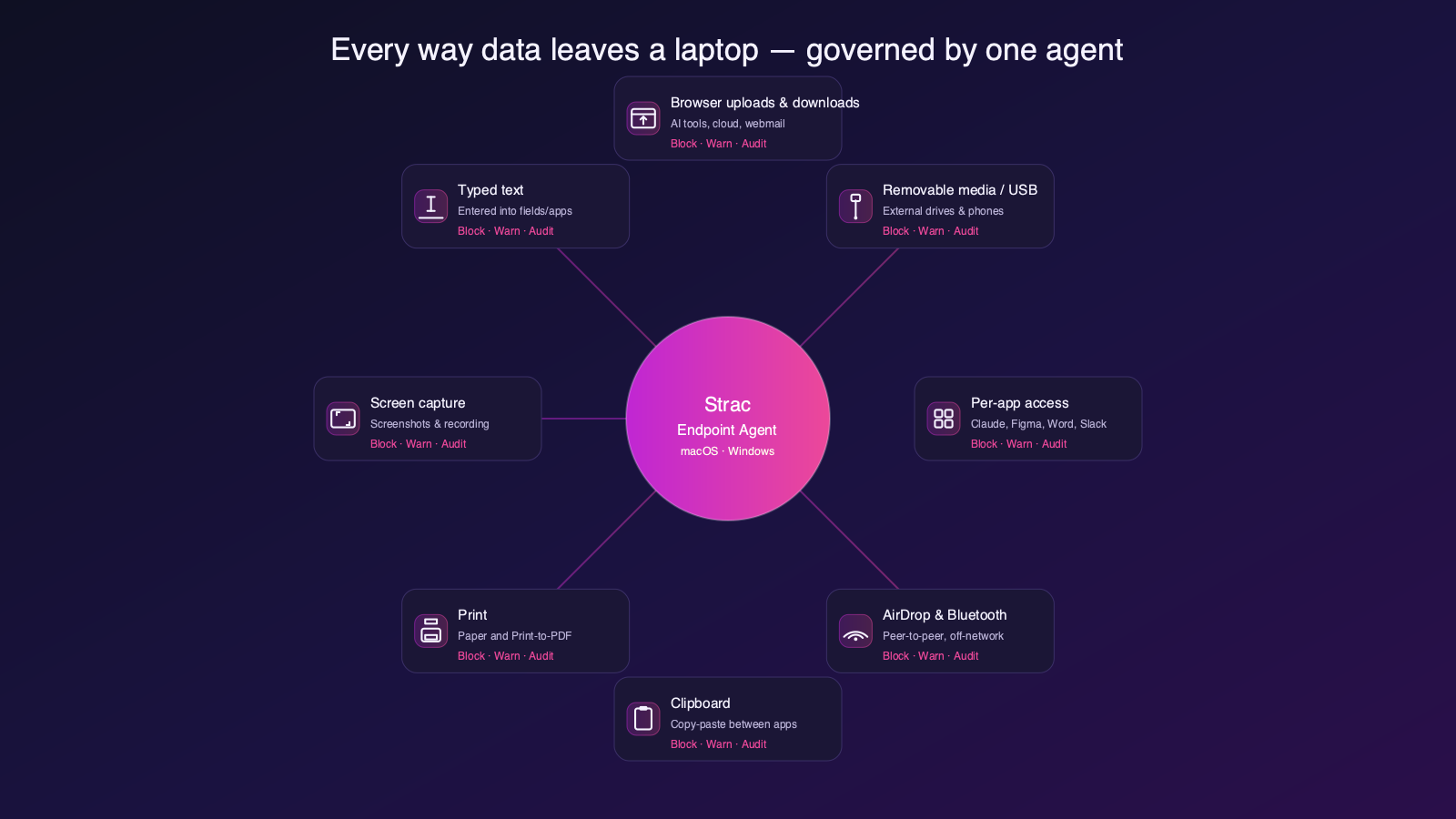
Block, Warn, or Audit — per data type, per channel. See the full eight-channel breakdown in the endpoint DLP agent guide.
While Endpoint DLP remains essential for securing managed devices and preventing local data loss, it can't protect every place sensitive data is created, shared, or stored. That's why many organizations are adopting agentless DLP to secure SaaS, cloud, AI, and MCP-connected applications without deploying software to every device.
In this guide, we'll compare Endpoint Agent DLP and Agentless DLP, explore where each solution excels, and explain why modern organizations increasingly use both to build a comprehensive data security strategy.
A decade ago, sensitive information primarily lived on employee laptops and file servers.
Today, organizations create, edit, and share data inside:
Employees constantly switch between managed laptops, personal devices, mobile phones, browsers, and AI assistants. Sensitive information rarely stays on a single endpoint.
This shift has fundamentally changed how Data Loss Prevention should work.
Instead of protecting only devices, organizations now need to protect the data itself—wherever it lives.
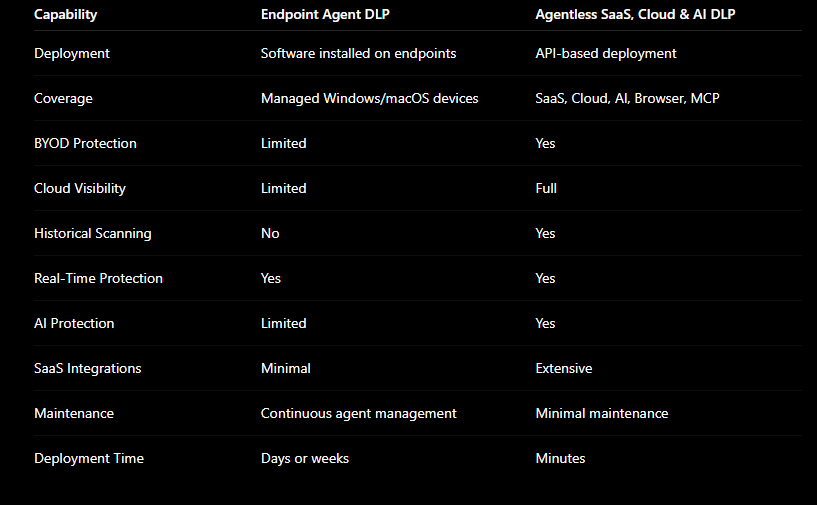
Ten years ago, protecting sensitive data mostly meant securing employee laptops. Today, that same data flows through Slack conversations, Microsoft 365 documents, Salesforce records, cloud storage, AI assistants, browser uploads, and even autonomous AI agents connected through MCP.
This shift has fundamentally changed Data Loss Prevention (DLP). While Endpoint DLP remains critical for protecting managed devices, it can no longer see every place where sensitive data moves. That's why many organizations are expanding beyond endpoint security and adopting agentless DLP for SaaS, cloud, GenAI, and AI agent environments.
In this guide, we'll compare Endpoint Agent DLP and Agentless DLP, explain where each excels, and show why most modern security teams deploy both as part of a unified data protection strateg
Endpoint DLP relies on software installed directly on employee devices.
The agent monitors activity occurring locally, including:
While powerful, every corporate device requires deployment, updates, monitoring, and maintenance.
Organizations with contractors, remote workers, or BYOD policies often struggle to achieve complete coverage.
Agentless DLP connects directly to applications using secure APIs.
No endpoint software is required.
Instead, protection happens inside platforms like:
Deployment typically takes minutes rather than weeks while protecting every user accessing those platforms.
Endpoint solutions focus primarily on files stored locally, including:
They also monitor how users interact with those files.
Examples include:
Modern organizations generate much more than files.
Agentless DLP protects:
It continuously scans both historical and newly created content to discover existing exposure as well as prevent future leaks.
Today's biggest data leaks rarely happen through USB drives alone.
Common examples include:
Endpoint DLP cannot always see these cloud-native workflows.
Agentless DLP protects data directly inside the applications where these risks occur.
Typical actions include:
These controls are excellent for device-level security.
Modern SaaS DLP can automatically:
Instead of simply generating alerts, remediation occurs where the data is stored, reducing exposure immediately.
Today's enterprises operate across far more than employee laptops.
A modern DLP platform should secure:
Endpoint DLP focuses on devices.
Agentless DLP focuses on protecting the data itself regardless of where users access it.

One of the biggest changes since traditional DLP platforms were designed is the explosion of AI.
Employees now routinely interact with:
Sensitive information can easily enter prompts, responses, uploaded files, or AI-generated content.
Modern agentless DLP extends protection to these AI workflows by detecting, classifying, redacting, or blocking sensitive data before it becomes exposed.
Legacy endpoint-only solutions generally cannot monitor these interactions comprehensively.
Both deployment models help satisfy compliance requirements, but in different ways.
by continuously discovering, classifying, monitoring, and remediating sensitive information across SaaS, cloud, and AI environments while maintaining detailed audit logs.
The answer isn't one or the other.
They solve different problems.
Choose Endpoint DLP if your priority is:
Choose Agentless DLP if your priority is:
Most organizations benefit from combining both approaches into a unified data protection strategy.
Modern organizations need visibility beyond the endpoint.
Strac combines Endpoint DLP, agentless DLP, and DSPM into a single platform that discovers, classifies, monitors, and remediates sensitive data across the environments where work actually happens.
Key capabilities include:
Rather than relying on multiple disconnected security products, organizations gain a single view of sensitive data across their entire environment while reducing deployment complexity through agentless integrations wherever possible.
Endpoint DLP isn't becoming obsolete—it's becoming one piece of a much larger data security strategy.
Endpoints still matter. Employees continue to download files, copy sensitive information to USB drives, print confidential documents, and work offline. Endpoint agents remain the best way to monitor and control those device-level activities.
But in 2026, most sensitive data no longer stays on a laptop. It moves continuously between Microsoft 365, Google Workspace, Slack, Salesforce, cloud storage, AI assistants, browsers, and increasingly, AI agents connected through MCP. Protecting only the endpoint leaves large blind spots where modern data leakage actually occurs.
The most effective organizations combine Endpoint DLP, agentless SaaS and Cloud DLP, AI governance, and DSPM into a unified strategy. This provides visibility across every location where sensitive data is created, shared, stored, and processed—whether it's on an employee's laptop, inside a cloud application, or flowing through an AI workflow.
Yes. Endpoint DLP remains essential for controlling device-level activities such as USB transfers, printing, clipboard usage, local file downloads, and offline access. However, it should be complemented with SaaS, Cloud, and AI DLP since much of today's sensitive data never resides solely on an endpoint.
Not entirely. Agentless DLP excels at protecting data inside SaaS applications, cloud storage, browsers, and AI platforms without installing software on employee devices. However, it cannot enforce device-specific controls like blocking USB drives or preventing local printing. Most enterprises benefit from using both approaches together.
Agentless DLP is generally better suited for remote and Bring Your Own Device (BYOD) environments because protection happens within the applications employees use, regardless of whether they access them from a managed laptop, personal computer, or mobile device. Endpoint DLP typically requires software to be installed on every managed device.
AI assistants and MCP-connected agents introduce entirely new ways for sensitive data to leave an organization. Employees can unintentionally expose customer records, source code, financial information, or intellectual property through AI prompts, uploaded documents, or automated agent workflows. Modern DLP platforms should monitor and enforce policies across GenAI applications and MCP integrations—not just traditional endpoints.
Endpoint DLP protects user activity on devices, while Data Security Posture Management (DSPM) continuously discovers, classifies, and monitors sensitive data across SaaS applications, cloud storage, databases, and AI environments. Together, they provide complete visibility into where sensitive data exists and help organizations reduce risk before data loss occurs.
.avif)


.gif)


.webp)