September 16, 2026

7
min read
Data Loss Prevention Importance
Explore the Data Loss Prevention importance and learn how Strac's advanced features and integrations can safeguard your organization's sensitive data.
· DLP matters more in 2026 because sensitivedata moves across SaaS, Cloud, GenAI, browsers, endpoints, APIs, andMCP-connected AI systems.
· Discovery alone is not enough. Modern DLPneeds to detect sensitive data and take action through controls such asredaction, masking, blocking, quarantine, deletion, encryption, or usercoaching.
· AI has created entirely new data-loss paths.ChatGPT, Claude, Copilot, Gemini, Shadow AI tools, AI agents, and MCPconnections can all receive sensitive corporate information.
· DSPM and DLP increasingly belong together.Security teams need to know where sensitive data lives and enforce policieswhen that data moves.
· Straccombines DSPM + DLP across SaaS, Cloud, GenAI, Browser, Endpoint, and MCPenvironments, giving security teams one layer for discovering, classifying,monitoring, and remediating sensitive data.
Data Loss Prevention used to mean stopping someone from emailing a spreadsheet to the wrong person or copying confidential files onto a USB drive.
That definition no longer covers the problem.
In 2026, sensitive data moves through SaaS applications, cloud storage, browsers, employee endpoints, support tickets, AI prompts, and Model Context Protocol (MCP) connections. Organizations therefore need DLP that understands not only where sensitive data is stored, but where it is going and what happens to it next.
That is why modern DLP is becoming part of a broader data security architecture combining discovery, classification, posture management, lineage, and real-time enforcement.
Data Loss Prevention is the combination of technologies, policies, and controls used to identify sensitive information and prevent it from being exposed, misused, or transferred somewhere it should not go.
Traditional DLP concentrated heavily on email, networks, files, and managed endpoints.
Modern businesses operate very differently.
An employee might download customer information from Salesforce, paste part of it into ChatGPT, upload a document into Claude, discuss it in Slack, send it through Gmail, store it in Google Drive, or expose it to an AI agent through an MCP-connected application.
The sensitive data did not disappear.
The number of paths it can travel through exploded.
Modern DLP therefore has to answer three fundamental questions:
What sensitive data do we have?
Where is it located and moving?
What should happen when someone attempts to use it in a risky way?
This is where DLP increasingly overlaps with Data Security Posture Management (DSPM).
DSPM provides discovery and visibility into sensitive data. DLP provides enforcement when that data is accessed, shared, uploaded, copied, or moved.
In 2026, organizations increasingly need both.
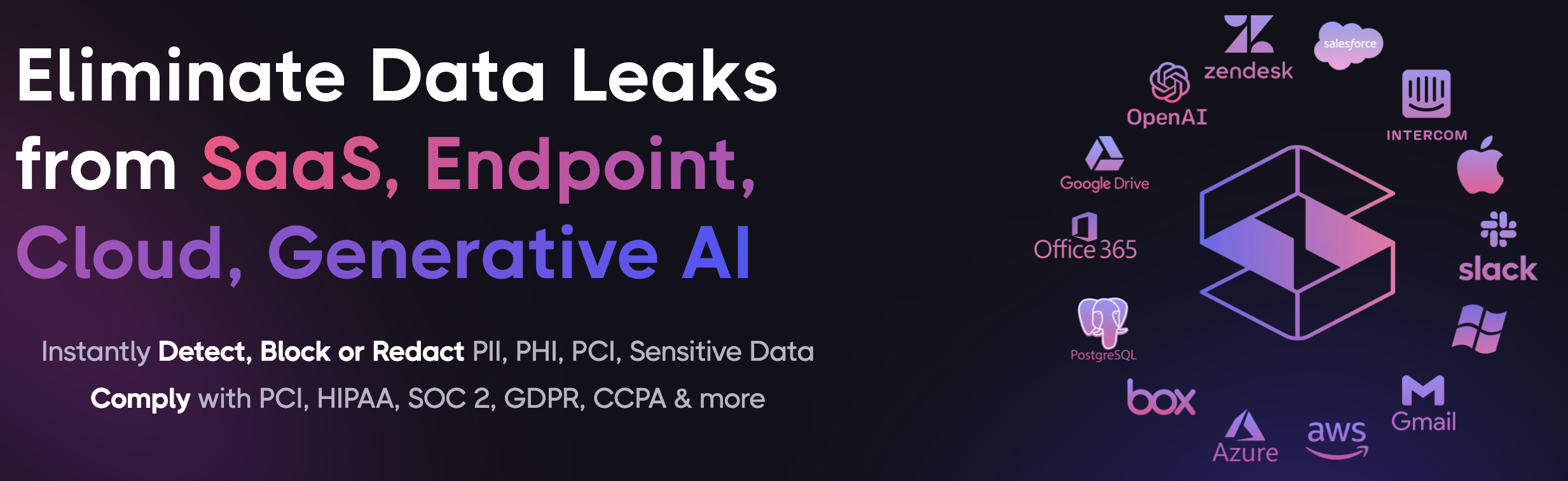
The importance of DLP comes down to a simple reality: businesses cannot protect sensitive information if they cannot see or control how that information moves.
And today's data moves constantly.
PII, PHI, PCI data, credentials, API keys, financial information, source code, customer records, intellectual property, and other confidential information can exist across dozens or hundreds of applications.
It can appear inside:
That makes point-by-point protection increasingly difficult.
Security teams need policies capable of following sensitive information across the environments employees actually use.
Generative AI has dramatically changed the DLP conversation.
Employees can now move corporate information outside traditional workflows with a copy, paste, prompt, or upload.
For example, an employee could paste:
"Summarize this customer support case."
The request sounds harmless.
But the case might contain a customer's name, email address, credit card number, medical information, authentication token, or another sensitive data element.
The security problem is therefore not necessarily the AI tool itself.
It is the data entering it.
Modern AI DLP needs to inspect prompts and uploads and enforce policy before sensitive information reaches unauthorized AI applications or models.
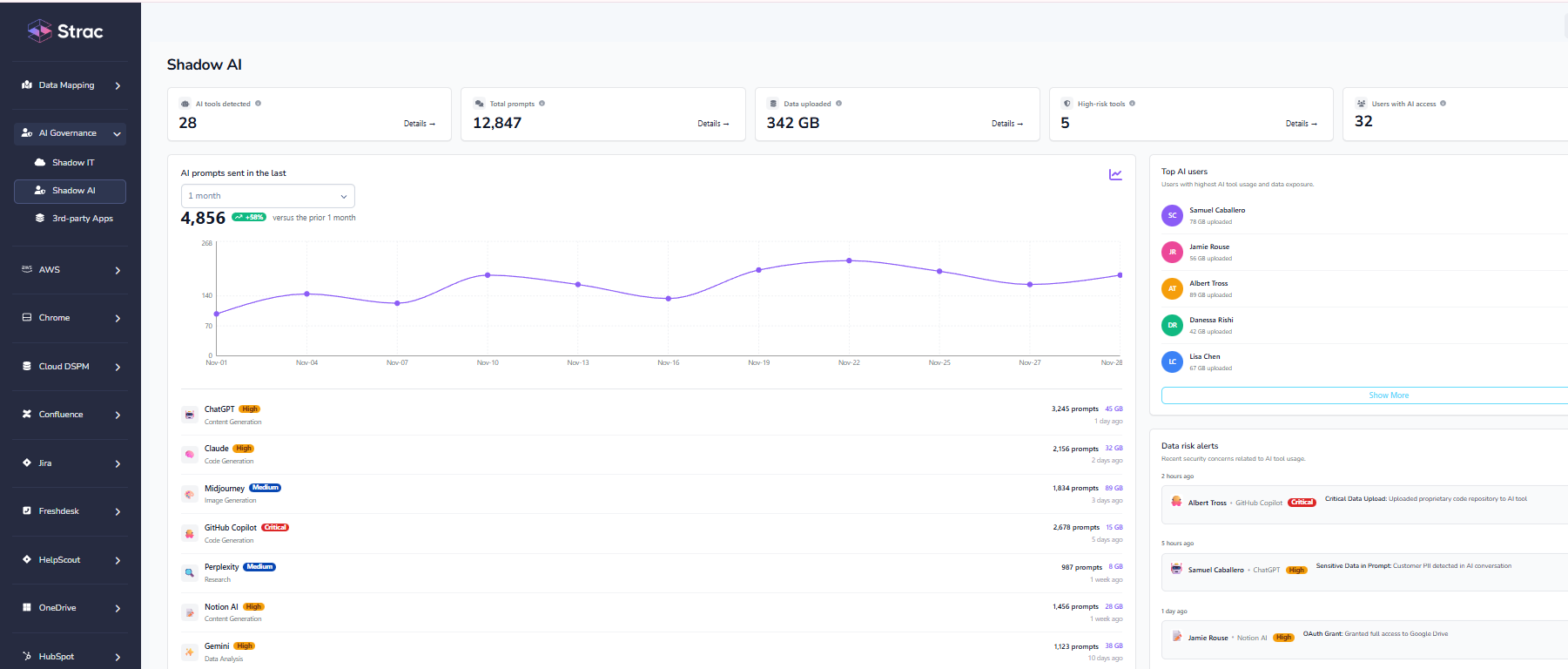
Organizations may approve tools such as ChatGPT Enterprise or Microsoft Copilot while employees independently use dozens of other AI applications.
That creates Shadow AI.
Security teams may have little visibility into which tools employees use, what information they paste into them, what files they upload, or whether those tools meet corporate data-handling requirements.
Browser-aware and GenAI-aware DLP can help organizations detect these interactions and apply controls based on the data involved rather than relying entirely on employees to make the correct decision.
👉 For example:
Employee pastes public marketing copy into an AI tool: allow it.
Employee pastes customer PII into an unapproved AI tool: block or redact it.
Employee attempts to upload a document containing credentials: block the upload and coach the employee.
That is substantially more useful than simply blocking every AI application.
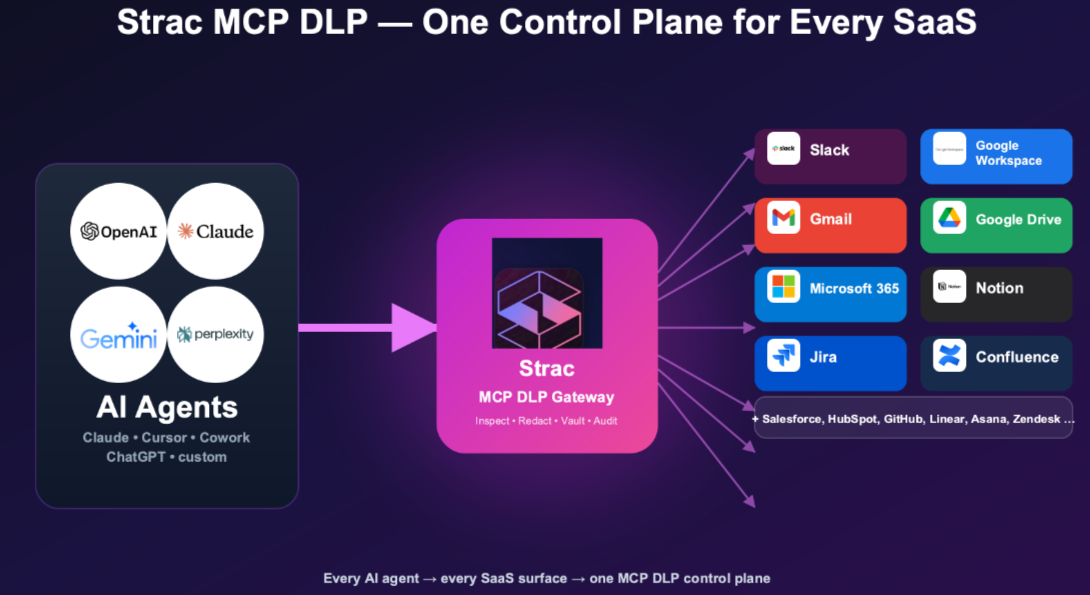
Model Context Protocol is making AI systems more powerful by allowing models and agents to connect with external tools, applications, and enterprise data.
But connectivity creates another data security challenge.
An AI system connected through MCP may be able to retrieve information from business systems and pass that information into an AI workflow.
The security question becomes:
What data should an AI agent actually be allowed to retrieve and transmit?
MCP DLP can act as a policy enforcement layer between AI systems and connected enterprise resources.
Instead of trusting every request because the AI has access to a tool, organizations can inspect the information moving through the MCP connection and enforce sensitive-data policies.
👉 For example, Strac's MCP DLP approach can help organizations detect sensitive information within MCP traffic and apply controls before that information reaches an unauthorized model, agent, or downstream application.
As AI moves from simple chatbots toward autonomous agents, this type of enforcement becomes increasingly important.
Modern DLP protects against more than deliberate data theft.
Many serious exposures happen during completely normal work.
An employee sends a file to the wrong customer.
A support agent copies sensitive information into a ticket.
Someone uploads a spreadsheet containing PII into an AI application.
A developer accidentally shares an API key in Slack.
These are ordinary human mistakes with potentially serious consequences.
DLP provides a safety layer capable of detecting the sensitive information and intervening before or immediately after exposure.
Not every data-loss event is accidental.
Employees and contractors may intentionally copy customer databases, intellectual property, credentials, financial records, or proprietary information.
Endpoint, Browser, SaaS, and Cloud DLP provide security teams with additional visibility into sensitive-data movement and the ability to enforce policies when risky activity occurs.
Employees increasingly use AI as part of everyday work.
That means confidential information can enter:
AI DLP extends data protection into these new environments.
Organizations rely on applications such as Slack, Salesforce, Google Workspace, Microsoft 365, Zendesk, Jira, and other SaaS platforms.
Sensitive information can accumulate inside messages, tickets, comments, attachments, shared files, and collaborative workflows.
The challenge is not simply stopping data from leaving the company.
It is understanding where sensitive information already exists inside the SaaS estate and remediating unnecessary exposure.
DLP also supports organizations working toward requirements associated with frameworks and regulations such as:
Compliance does not come from installing a DLP product alone.
But discovering sensitive information, controlling its movement, reducing unnecessary exposure, maintaining policies, and generating evidence can significantly strengthen a broader compliance program.
The definition of a strong DLP platform has changed.
Checking whether a vendor can scan emails or endpoints is no longer enough.
Security teams should evaluate whether a platform can protect the entire lifecycle of sensitive data.
You cannot protect data you do not know exists.
Modern DLP should identify sensitive information across SaaS applications, cloud repositories, files, endpoints, and other enterprise systems.
This is where DSPM becomes particularly important.
Security teams need visibility into questions such as:
Where is our PII?
Where is PHI stored?
Which repositories contain PCI data?
Where are credentials and secrets appearing?
Who has access?
Where is that information being duplicated?
Sensitive information does not always appear as clean text matching a predictable pattern.
It can exist inside:
Modern detection therefore needs more than static regex rules.
Strac uses detection technologies including machine learning and OCR to identify sensitive data across structured and unstructured content, including information embedded within documents and images.
Discovery tells you there is a problem.
DLP needs to help do something about it.
Depending on the integration, policy, and workflow, modern remediation can include actions such as:
Redact: Remove the sensitive portion while preserving usable content.
Mask: Hide sensitive values from unauthorized users or systems.
Block: Prevent an unsafe action.
Quarantine: Isolate content for investigation or review.
Delete: Remove sensitive information that should not remain in a system.
Encrypt: Protect information that needs to remain accessible.
Coach: Warn users about risky behavior and give them an opportunity to correct it.
The goal is not to generate another security alert.
The goal is to reduce the actual exposure.
Traditional security stacks frequently separate data discovery from data protection.
One platform discovers sensitive information.
Another monitors endpoints.
Another protects SaaS.
Another governs AI.
Another handles remediation.
The result is fragmented visibility and fragmented policy enforcement.
Combining DSPM and DLP creates a more direct workflow:
Discover → Classify → Understand Risk → Enforce Policy → Remediate → Audit
The same sensitive-data intelligence used to identify risk can inform the controls applied when that data moves.
This is the model Strac is building around.
Strac combines Data Security Posture Management and Data Loss Prevention so organizations can discover sensitive information and enforce controls across the places where modern work happens.
Instead of treating SaaS, AI, endpoints, browsers, and cloud environments as unrelated security problems, Strac provides a unified data protection layer across them.
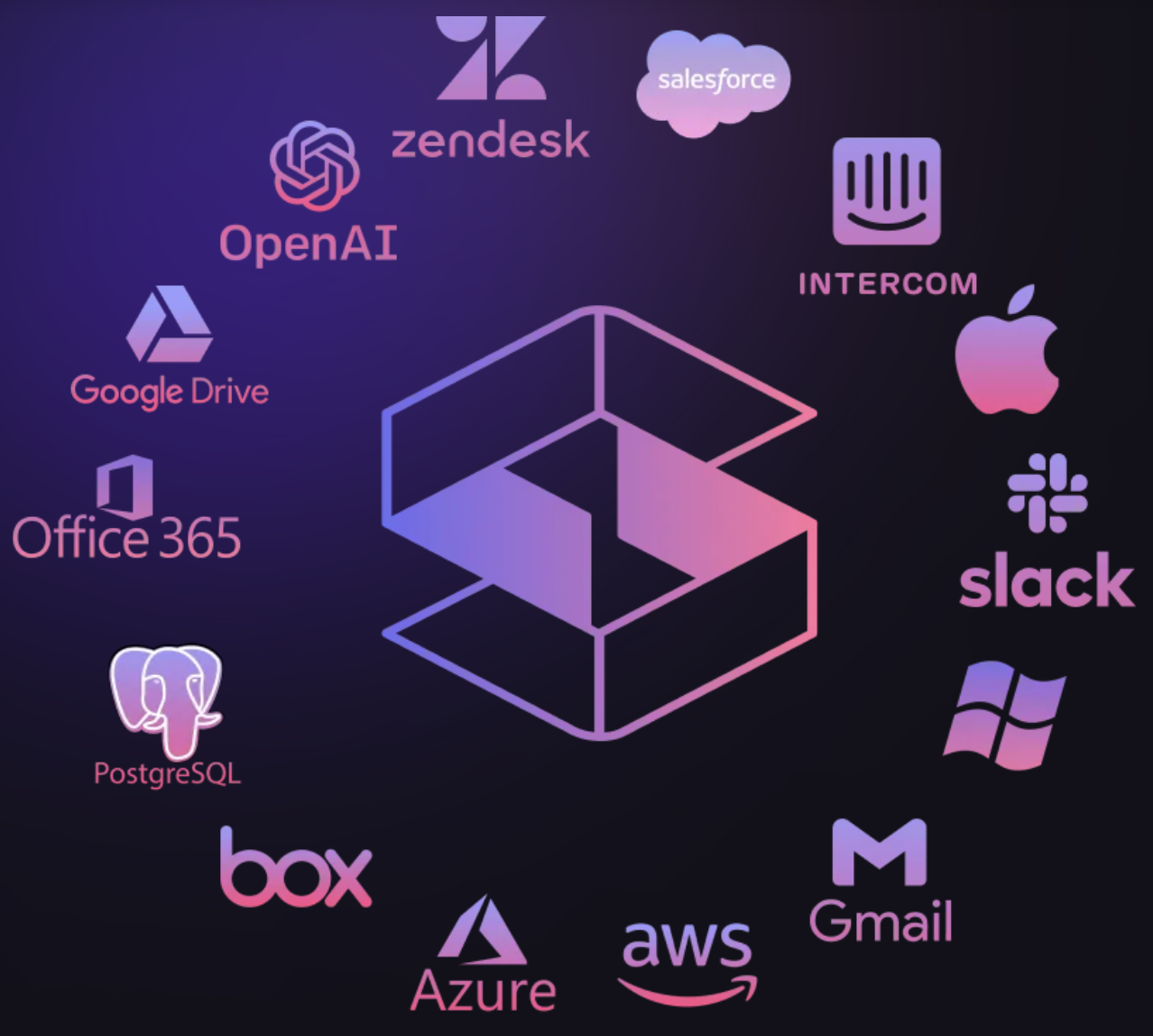
Strac helps discover and protect sensitive information across SaaS applications such as Slack, Google Workspace, Salesforce, Zendesk, Microsoft 365, and other business systems.
Policies can identify PII, PHI, PCI data, secrets, credentials, and custom sensitive data elements inside messages, files, tickets, attachments, and other application content.
Where supported, Strac can remediate sensitive data directly instead of merely generating an alert.
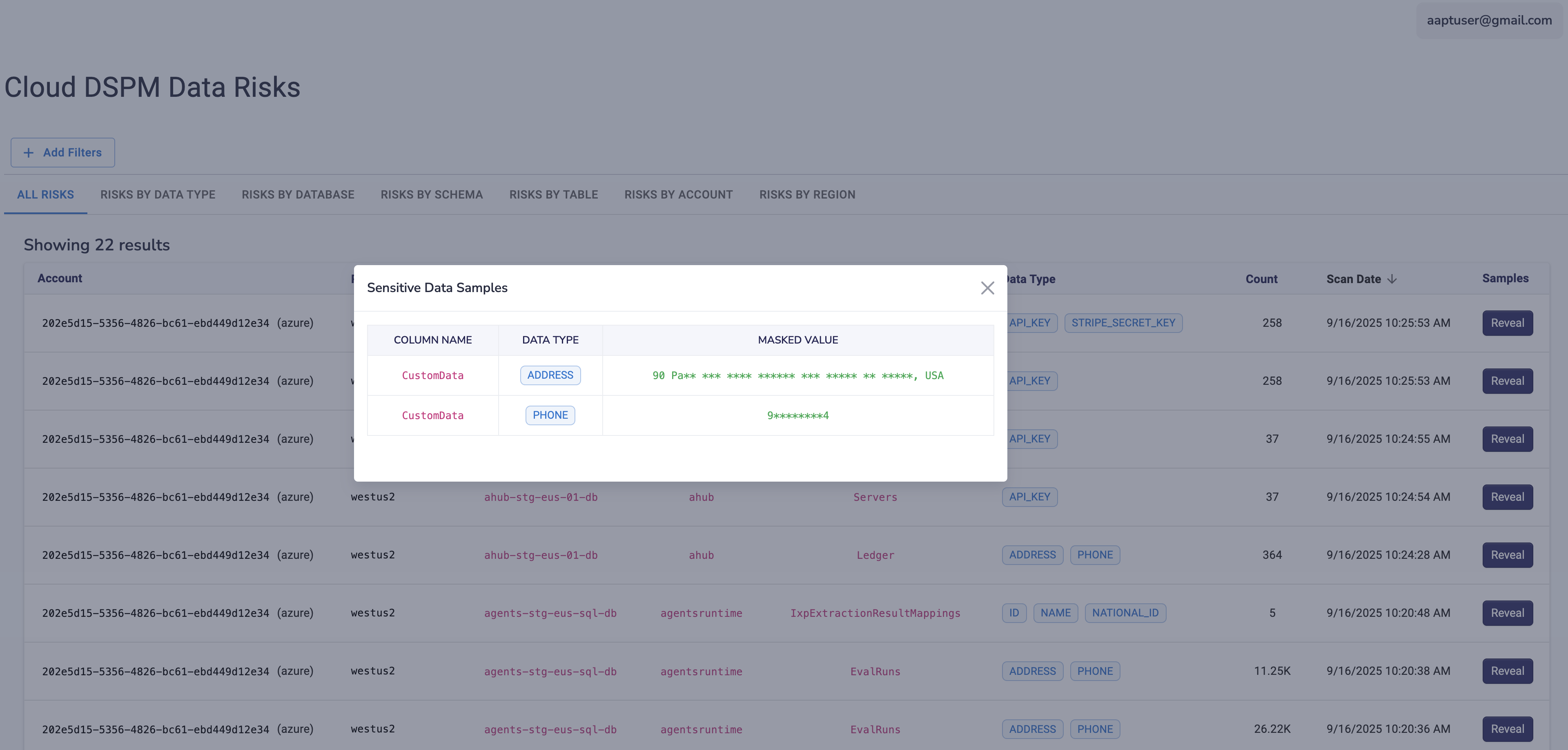
Sensitive information can accumulate across cloud repositories and storage environments without security teams realizing it.
Strac's discovery and classification capabilities help teams locate sensitive data, understand exposure, and apply policies to reduce unnecessary risk.
This connects posture management directly with protection.
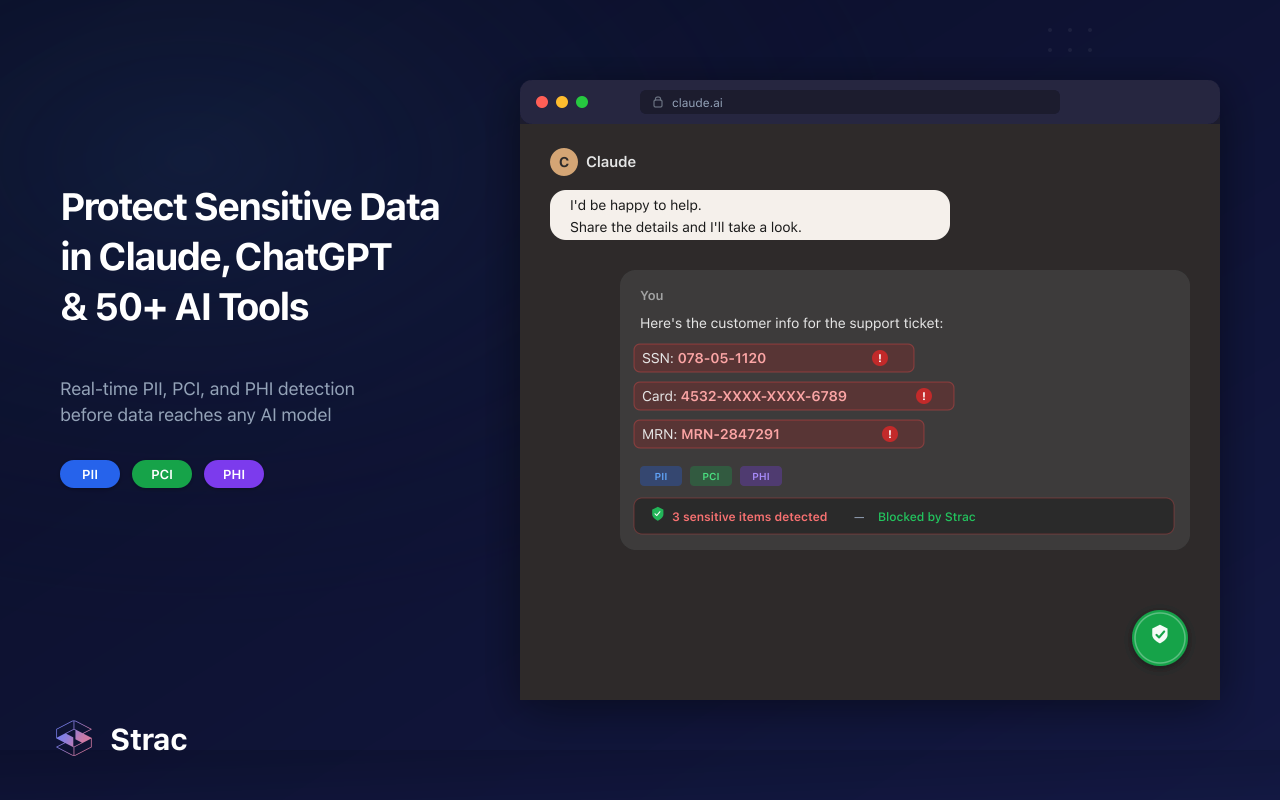
Strac extends DLP controls into generative AI workflows.
Organizations can identify sensitive information employees attempt to send to AI systems through prompts and uploads and enforce policies according to the AI application, user, and data involved.
This enables businesses to adopt AI without treating sensitive corporate data as an acceptable cost of innovation.
.gif)
The browser has become one of the biggest enterprise data movement layers.
Employees access SaaS applications, AI tools, webmail, file-sharing platforms, and countless other services directly through it.
Browser DLP helps organizations enforce sensitive-data policies at this critical point of interaction, including activity involving unsanctioned applications and Shadow AI.
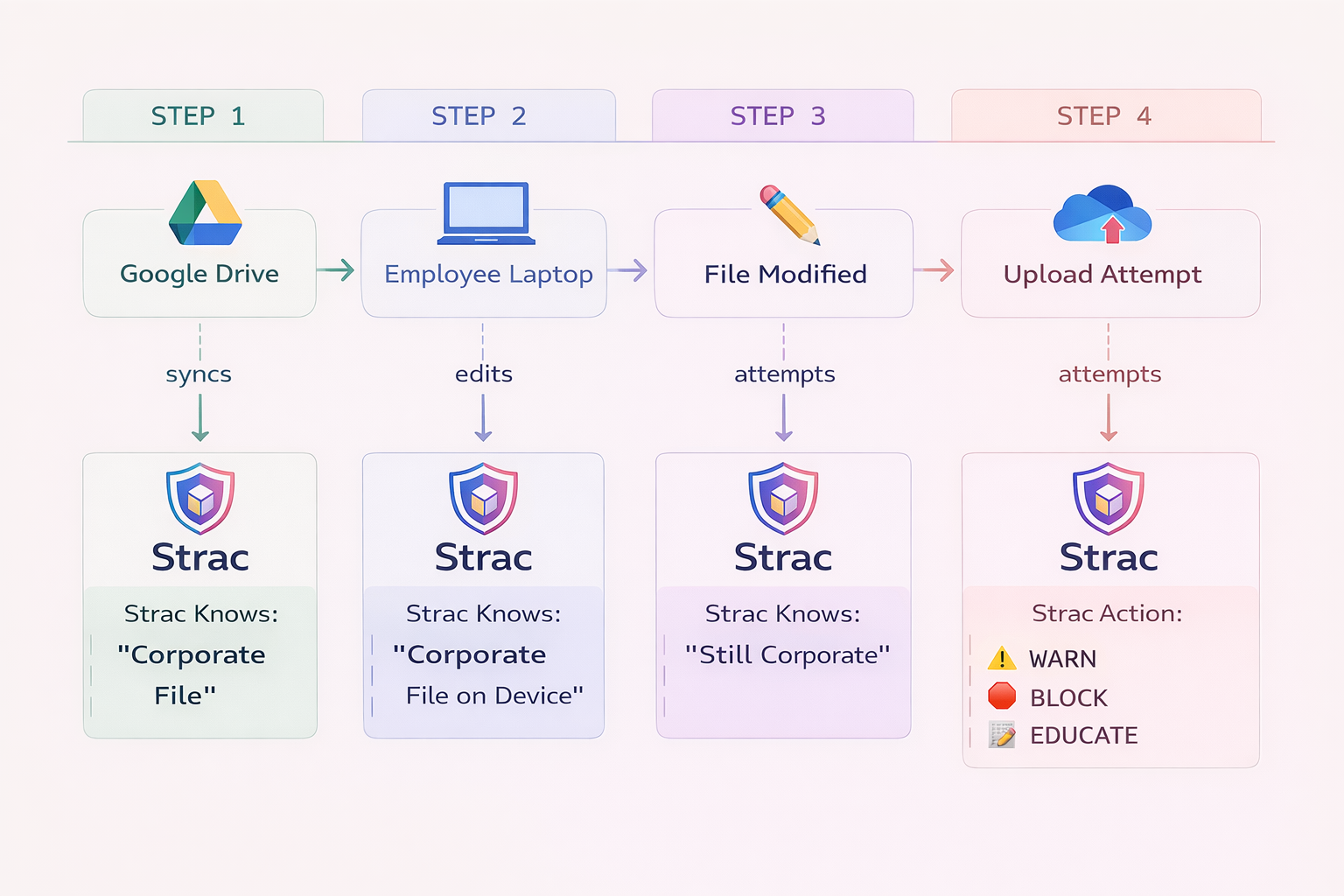
Endpoints remain essential because employees can move sensitive information through local applications, files, browsers, removable media, and other workflows.
Strac's Endpoint DLP extends policy enforcement to Windows and macOS environments while connecting endpoint activity with the broader data protection strategy.
Knowing that sensitive information exists on an endpoint is useful.
Knowing where it came from and where it went is much more powerful.
Endpoint Data Lineage provides context around sensitive-data movement, helping security teams investigate how information traveled across applications and workflows.
Instead of seeing an isolated alert, teams gain a clearer picture of the data's path.
As organizations connect AI systems to enterprise tools through MCP, Strac provides a security layer for sensitive information flowing through those connections.
Policies can inspect MCP traffic and help prevent sensitive enterprise information from being exposed to AI models, agents, or downstream tools where it should not appear.
This extends DLP into the emerging agentic AI architecture.
Consider a customer record containing:
Name: Jane Smith
Email: jane@example.com
SSN: 123-45-6789
Card: 4111 XXXX XXXX 1111
That information might begin in Salesforce.
Then it gets copied into Slack.
Later it appears in a support ticket.
Someone downloads it onto their laptop.
Another employee uploads it into ChatGPT.
An AI agent retrieves related information through an MCP connection.
From the organization's perspective, it is still the same sensitive data.
The security controls protecting it should not disappear every time the application changes.
That is the larger purpose of modern DLP.
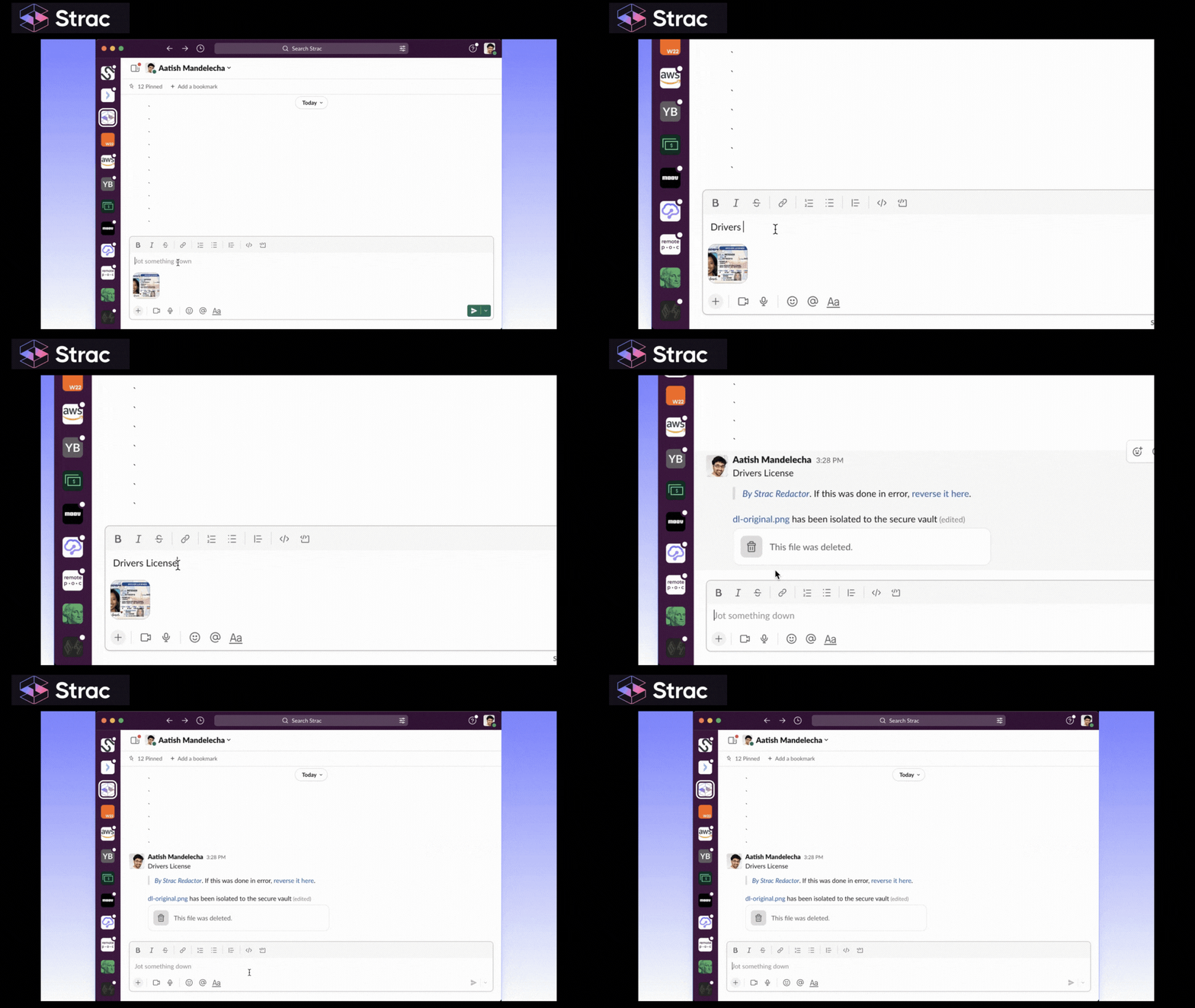
One of the biggest differences between legacy monitoring and modern DLP is what happens after detection.
Suppose an employee posts a customer's credit card number into a support ticket.
An alert-only system might:
Meanwhile, the card number remains exposed.
A remediation-oriented DLP workflow can detect the sensitive information and automatically redact or otherwise remediate it according to policy.
The distinction is important:
Detection tells you something went wrong.
Remediation reduces the exposure.
Security teams need both.
Data Loss Prevention is more important in 2026 because the perimeter around sensitive information has effectively disappeared.
Data moves continuously between SaaS applications, cloud repositories, employee devices, browsers, AI tools, APIs, and increasingly autonomous AI agents.
That requires a new DLP model.
Organizations need to discover sensitive data, understand its context, follow its movement, enforce policy, and remediate exposure across the entire modern data environment.
Strac brings DSPM and DLP together across SaaS, Cloud, GenAI, Browser, Endpoint, and MCP workflows, helping security teams move beyond simply finding sensitive data toward actively controlling what happens to it.
Modern DLP is no longer just about preventing files from leaving the network.
It is about protecting sensitive data wherever modern work takes it.
Not obsolete, but definitely incomplete. Traditional DLP was designed around email, networks, files, and endpoints. Sensitive data now moves through SaaS apps, browsers, ChatGPT, Claude, Copilot, Shadow AI tools, APIs, and MCP-connected agents. If your DLP cannot see or control those workflows, you have significant blind spots regardless of how mature your legacy DLP deployment is.
Because an alert does not remove the sensitive data. If an employee exposes a credit card number, SSN, API key, or patient record, telling security about it five minutes later still leaves the data exposed. Modern DLP needs inline remediation capabilities such as redact, mask, block, quarantine, delete, encrypt, or coach, turning detection into actual risk reduction.
Increasingly, yes. Employees can paste confidential information into ChatGPT, upload documents to Claude, use AI coding assistants, or access unsanctioned Shadow AI applications directly through their browsers. AI DLP extends protection into prompts, uploads, responses, and AI workflows that traditional DLP architectures were never designed to govern.
Potentially, yes. MCP allows AI models and agents to connect directly with enterprise tools and data, which means sensitive information can move through machine-to-machine workflows without the traditional human actions DLP products were built to monitor. MCP DLP creates an enforcement point where organizations can inspect and control sensitive data before it reaches models, agents, or downstream tools.
They can be, but separating them creates an obvious problem: DSPM finds the risk while DLP is expected to stop it. Strac combines DSPM + DLP so sensitive-data discovery, classification, posture, monitoring, and remediation can operate as one workflow across SaaS, Cloud, GenAI, Browser, Endpoint, and MCP environments. In 2026, knowing where sensitive data lives is useful; controlling what happens to it is what actually reduces risk.
.avif)


.gif)


.webp)