Comprehensive Guide to Data Classification Programs: Key Concepts and Implementation
Learn what data classification is, why it matters, and how AI-powered data discovery, DSPM, and DLP help protect sensitive data across SaaS, cloud, AI, and endpoints.
· Strac combines data discovery, classification,DSPM, and DLP in one platform, helping organizations discover, classify,monitor, and remediate sensitive data wherever it exists.
✨ What is Data Classification?
Data classification is the process of identifying, labeling, and organizing data based on its sensitivity, business importance, and regulatory requirements.
The goal is simple: understand what data you have so you can protect it appropriately.
For example, marketing assets may only require basic access controls, while customer records containing Social Security numbers, payment card information, or medical records require far stronger protections.
Without classification, organizations have little visibility into where sensitive information lives or who can access it.
Why Data Classification Matters More Than Ever
Five years ago, most sensitive data lived inside databases and file servers.
Today, it's everywhere.
Organizations create and share sensitive information across:
Google Workspace
Microsoft 365
Slack
Salesforce
Zendesk
Notion
Jira
AWS S3
Azure Blob Storage
ChatGPT
Microsoft Copilot
Claude
Gemini
Browser uploads
Employee endpoints
Every new SaaS application or AI assistant introduces another place where sensitive information can be copied, stored, or exposed.
Data classification provides the visibility organizations need before they can enforce security policies or prevent data loss.
Data Classification vs. Data Discovery
Although they're often used interchangeably, they're different.
Data discovery answers:
Where is my sensitive data?
Data classification answers:
What kind of sensitive data is it, and how should it be protected?
Discovery finds the data.
Classification labels it.
Modern security platforms perform both continuously rather than treating them as separate projects.
✨ How Modern Data Classification Works
Modern classification is no longer a manual exercise.
Instead of relying on employees to label documents correctly, organizations use automated discovery and AI-powered classification engines that continuously scan their environments.
A typical workflow includes:
1. Discover Data
Scan SaaS applications, cloud storage, databases, endpoints, AI conversations, email, and collaboration platforms.
2. Identify Sensitive Information
Automatically detect sensitive content such as:
Personally Identifiable Information (PII)
Protected Health Information (PHI)
Payment Card Information (PCI)
Financial records
API keys and secrets
Credentials
Intellectual property
Source code
Contracts
Customer conversations
3. Classify the Data
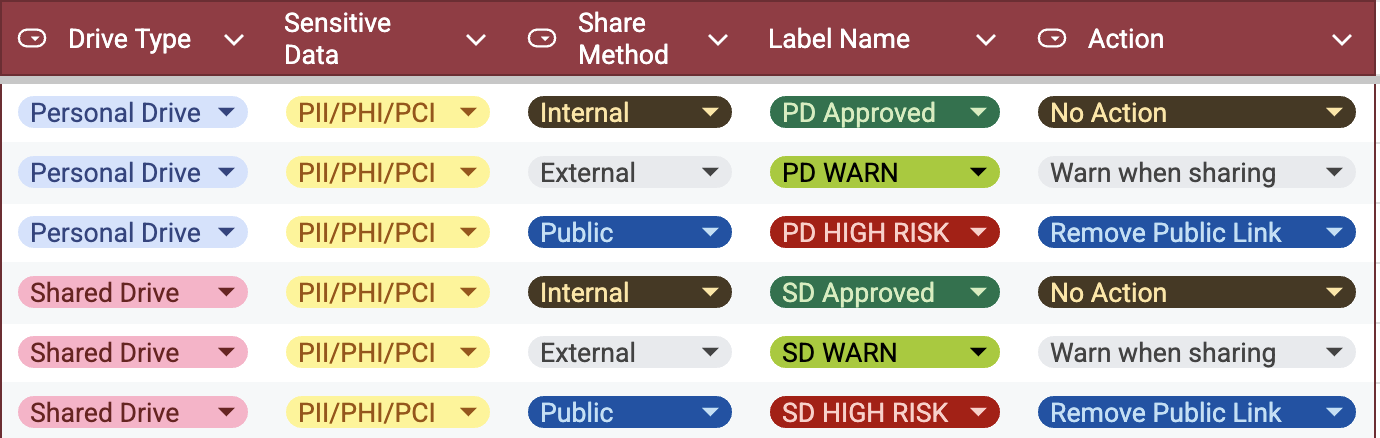
Assign sensitivity labels such as:
Public
Internal
Confidential
Restricted
Highly Confidential
Organizations can also classify data based on compliance frameworks or internal business policies.
4. Enforce Security Policies
Once classified, organizations can automatically:
Redact sensitive content
Mask confidential fields
Restrict access
Block sharing
Encrypt files
Alert security teams
Delete exposed information
Classification becomes actionable instead of simply informational.
Types of Data Organizations Should Classify
Every business stores different kinds of sensitive information, but most classification programs include:
Personally Identifiable Information (PII)
Names, email addresses, phone numbers, passport numbers, Social Security numbers, driver's licenses, and national IDs.
Payment Card Information (PCI)
Credit card numbers, CVVs, expiration dates, bank account details, and payment records.
Protected Health Information (PHI)
Medical records, insurance details, prescriptions, patient identifiers, and laboratory results.
Financial Information
Invoices, payroll data, tax records, loan information, accounting documents, and investment records.
Secrets and Credentials
Passwords, API keys, OAuth tokens, SSH keys, certificates, private keys, and access credentials.
Despite its importance, many organizations struggle with classification.
Explosive Data Growth
Sensitive data is constantly created across dozens of cloud applications, making manual classification impossible.
Unstructured Data
Emails, PDFs, screenshots, chat messages, support tickets, and AI conversations don't fit neatly into traditional databases.
AI Creates New Risks
Employees frequently paste sensitive information into AI assistants like ChatGPT, Copilot, Gemini, and Claude.
Traditional classification tools weren't built to inspect prompt streams or AI-generated content.
High False Positives
Regex-based classification often floods security teams with alerts that aren't actually sensitive.
Modern AI-powered detection significantly improves accuracy by understanding context rather than simple patterns.
Best Practices for Data Classification
An effective classification strategy should include:
Continuously scan all data repositories—not just scheduled audits.
Automatically classify new data as it's created.
Use AI and context-aware detection instead of relying solely on regex.
Classify both structured and unstructured content.
Extend classification to AI applications and browser activity.
Review policies regularly as regulations and business needs evolve.
Automate remediation whenever possible instead of relying only on alerts.
Why Data Classification Supports DSPM and DLP
Classification is the foundation for modern data security.
Without knowing where sensitive information exists, organizations can't effectively prevent leaks or reduce exposure.
Data Security Posture Management (DSPM) continuously discovers and maps sensitive data across cloud, SaaS, databases, and storage platforms.
Data Loss Prevention (DLP) then uses those classifications to enforce security policies, preventing sensitive information from being shared inappropriately.
Together, they provide continuous visibility and protection across the entire data lifecycle.
What to Look for in Data Classification Software
Not all classification tools provide the same capabilities.
When evaluating solutions, consider whether they can:
Discover sensitive data automatically across SaaS, cloud, AI, endpoints, and databases.
Support structured and unstructured data.
Detect PII, PHI, PCI, secrets, source code, and custom data types.
Use AI-powered detection to reduce false positives.
Continuously monitor data instead of running periodic scans.
Integrate with DLP workflows for automated remediation.
Help meet GDPR, HIPAA, PCI DSS, SOC 2, ISO 27001, and other compliance requirements.
Modern classification software should help organizations reduce risk—not simply generate reports.
🎥 How Strac Modernizes Data Classification
Traditional data classification solutions stop after labeling sensitive information.
Protect data shared through AI assistants like ChatGPT, Microsoft Copilot, Claude, Gemini, and MCP-connected workflows.
Support compliance initiatives for GDPR, HIPAA, PCI DSS 4.0, SOC 2, ISO 27001, and other regulatory frameworks.
Rather than treating discovery, classification, and protection as separate tools, Strac unifies them into a single workflow that helps security teams reduce risk while simplifying operations.
Conclusion
Data classification is no longer just about labeling documents.
Modern organizations need continuous visibility into where sensitive data exists, how it moves, and who has access to it.
As businesses adopt more SaaS applications, cloud services, and AI tools, sensitive information becomes increasingly distributed, making automated discovery and classification essential.
By combining continuous data discovery, AI-powered classification, DSPM, and DLP, organizations can move beyond simply identifying sensitive information to actively protecting it wherever it lives.
Strac helps organizations achieve exactly that—discovering, classifying, monitoring, and remediating sensitive data across cloud, SaaS, endpoints, browsers, and AI workflows from a single unified platform.
🌶️ Spicy FAQs
1. What is data classification, and why is it important?
Data classification is the process of identifying and labeling information based on its sensitivity and business value. It helps organizations understand where sensitive data exists so they can apply the right security controls, reduce the risk of data breaches, and comply with regulations such as GDPR, HIPAA, PCI DSS, and SOC 2. Without data classification, it's difficult to protect sensitive information effectively.
2. What is the difference between data classification and data discovery?
Data discovery identifies where sensitive information is stored across SaaS applications, cloud platforms, endpoints, databases, and AI tools. Data classification then categorizes that information based on its sensitivity, such as public, confidential, or restricted. Modern security platforms combine both capabilities to continuously discover, classify, and protect sensitive data as it moves across the organization.
3. What types of data should organizations classify?
Organizations should classify any information that could create security, privacy, or compliance risks if exposed. This typically includes Personally Identifiable Information (PII), Protected Health Information (PHI), payment card data (PCI), financial records, customer information, employee records, API keys, passwords, source code, intellectual property, contracts, and confidential business documents.
4. Can AI automatically classify sensitive data?
Yes. Modern data classification solutions use AI, machine learning, natural language processing, and OCR to identify sensitive information with much greater accuracy than traditional regex-based tools. AI-powered classification understands context, reduces false positives, and can automatically classify structured and unstructured data across documents, emails, images, support tickets, chat messages, and AI conversations.
5. How does Strac improve data classification?
Strac combines continuous data discovery, AI-powered data classification, DSPM, and Data Loss Prevention (DLP) in a single platform. It automatically discovers and classifies sensitive information across SaaS applications, cloud storage, endpoints, browsers, databases, and AI platforms like ChatGPT, Microsoft Copilot, Claude, Gemini, and MCP-connected applications. Once data is classified, Strac can automatically redact, mask, block, quarantine, or remediate sensitive information in real time, helping organizations reduce data exposure while supporting compliance with GDPR, HIPAA, PCI DSS 4.0, SOC 2, and other regulatory requirements.
Discover & Protect Data on SaaS, AI, MCP, Endpoints & Cloud
Strac provides end-to-end data loss prevention for all SaaS and Cloud apps. Integrate in under 10 minutes and experience the benefits of live DLP scanning, live redaction, and a fortified SaaS environment.


.webp)






.avif)



.gif)
