August 18, 2026

6
min read
Top Components of Data Loss Prevention
Learn what Data Loss Prevention (DLP) means in 2026 and how modern DLP protects sensitive data across SaaS, Cloud, GenAI, MCP, Browser, and Endpoints.
· Data Loss Prevention (DLP) discoverssensitive information and prevents it from being exposed, misused, or movedsomewhere it should not go.
· Modern DLP must extend beyond email andendpoints to SaaS, cloud, browsers, GenAI, APIs, and MCP-connected AIworkflows.
· Detection alone is not enough. Effective DLPshould be able to redact, mask, block, quarantine, delete, encrypt, orotherwise remediate sensitive data when policy is violated.
· DLP and Data Security Posture Management(DSPM) are increasingly converging because organizations need bothvisibility into where sensitive data exists and enforcement when that datamoves.
· Straccombines DSPM and DLP across SaaS, Cloud, GenAI, Browser, MCP, and Endpointenvironments, giving security teams a unified approach to discovering,classifying, tracking, and protecting sensitive information.
Data Loss Prevention used to be mostly about stopping someone from emailing a spreadsheet containing credit card numbers outside the company.
That definition no longer works.
In 2026, sensitive data moves through SaaS applications, cloud infrastructure, employee endpoints, support tickets, browser sessions, AI prompts, and increasingly, Model Context Protocol (MCP) connections. A modern DLP program therefore has to protect data wherever employees, applications, agents, and AI systems actually use it.
This is where Data Loss Prevention is evolving from a collection of static rules into a real-time data security control layer.
Data Loss Prevention is a set of technologies, policies, and security controls designed to identify sensitive information and prevent unauthorized exposure, transfer, access, or misuse.
Sensitive data can include:
Traditional DLP focused heavily on three states of data: data at rest, data in motion, and data in use.
Those categories still matter. What has changed is where those states now exist.
A customer record might begin in Salesforce, move into Slack, appear in a Zendesk ticket, get downloaded to an employee laptop, copied into ChatGPT, uploaded to another AI application, and eventually passed through an MCP server to an external tool.
DLP has to follow that journey.
Legacy DLP was designed for a more controlled enterprise environment.
Organizations had corporate email, managed endpoints, internal networks, approved applications, and relatively predictable paths through which sensitive information moved.
Modern organizations operate very differently.
Employees work across dozens or hundreds of SaaS applications. They use personal and managed browsers. Files constantly move between cloud storage systems. Developers interact with APIs and repositories. Employees paste company information into AI assistants. AI agents can retrieve information and execute actions through MCP.
The security boundary has moved from the corporate network to the data itself.
This creates a fundamental problem for traditional DLP.
Knowing that sensitive information exists somewhere is useful. Knowing that someone just attempted to send it somewhere dangerous is better. Being able to stop or remediate that exposure immediately is what modern DLP actually requires.
DLP protects organizations against both malicious activity and ordinary human mistakes.
And the second category matters enormously.
Most employees are not intentionally trying to leak company data. They copy information into the wrong application, upload the wrong attachment, share a file too broadly, paste production data into an AI assistant, or leave sensitive information inside support systems longer than necessary.
Modern DLP creates controls around those everyday workflows.
An employee might paste customer information into ChatGPT to summarize a support case.
A support agent might receive a screenshot containing a credit card number.
A developer might accidentally expose an API key in Slack.
A finance employee might upload a spreadsheet containing customer PII to an unauthorized AI application.
DLP can detect the sensitive information and enforce policy before or immediately after exposure occurs.
Sensitive information should not necessarily be allowed to move everywhere an employee can technically send it.
DLP can control movement between:
That allows organizations to enforce policies based on what the data contains and where it is going.
Organizations often do not know where all their sensitive information lives.
Customer records become duplicated across Slack messages, Drive folders, tickets, attachments, screenshots, endpoints, and cloud repositories.
This is where DLP increasingly overlaps with DSPM.
Security teams need to discover sensitive information first, understand its posture, and then enforce policies around it.
Frameworks and regulations including PCI DSS, HIPAA, GDPR, CCPA, SOC 2, ISO 27001, and NIST create obligations around protecting sensitive information.
DLP helps organizations operationalize those requirements by continuously detecting and controlling regulated data across the systems employees actually use.
The DLP checklist has changed considerably.
A product that scans email attachments and generates alerts may technically qualify as DLP, but it does not address the full data exposure surface organizations face in 2026.
Here is what modern DLP should include.
You cannot protect data you cannot find.
Modern DLP should discover and classify sensitive information across structured and unstructured environments.
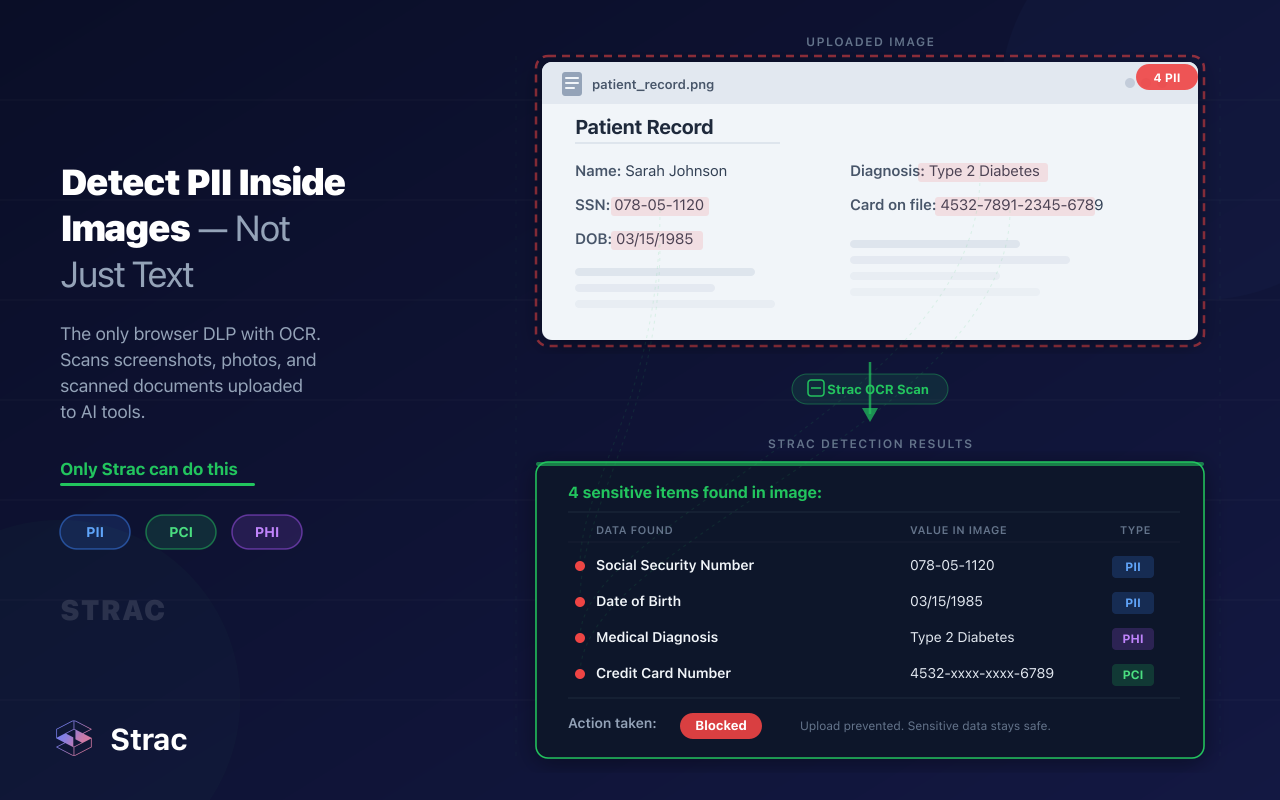
That includes text, files, documents, attachments, screenshots, images, cloud repositories, SaaS records, and other data sources.
Organizations should be able to identify standard categories such as PII, PHI, and PCI as well as proprietary data specific to their business.
Strac combines this discovery capability with DSPM, helping organizations identify where sensitive data exists before applying protection and remediation policies.
Regex alone is increasingly inadequate for modern enterprise data.
Sensitive information can appear inside PDFs, Word documents, Excel files, ZIP files, images, screenshots, support conversations, AI prompts, and other unstructured formats.
Modern detection therefore needs multiple techniques, including machine learning, OCR, document inspection, pattern recognition, and contextual classification.
Strac uses ML/OCR-based content inspection to identify sensitive information across structured and unstructured content rather than relying solely on static pattern matching.
An alert that arrives after sensitive information has already been exposed is useful for investigation.
It is not prevention.
Modern DLP should be capable of taking action when sensitive data violates policy.
Depending on the workflow, remediation can include:
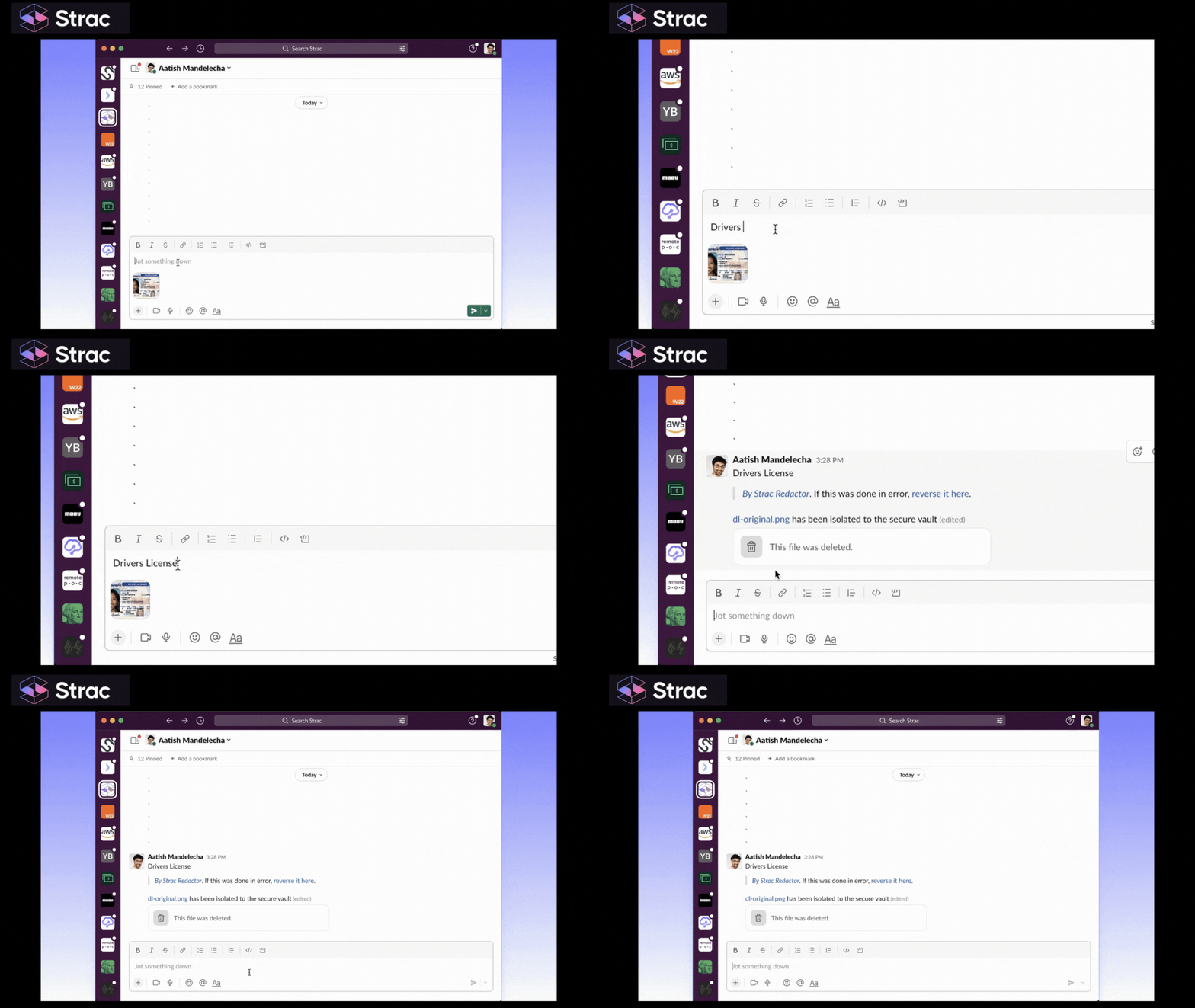
Strac emphasizes inline remediation, including redaction, masking, blocking, and deletion, so sensitive data can be acted upon rather than merely discovered.
Some of the most sensitive enterprise information now lives inside SaaS applications.
Think about what appears every day inside Slack, Salesforce, Zendesk, Google Workspace, Microsoft 365, Jira, and similar systems.
Customer information, contracts, credentials, screenshots, financial records, healthcare information, and internal company data regularly pass through these platforms.
Modern SaaS DLP needs to inspect both messages and files while supporting remediation directly inside these workflows.
For example, Strac can apply sensitive data protection to environments such as Slack and Zendesk, including content and attachments.
Cloud security cannot stop at identifying public buckets or incorrect permissions.
Security teams need to understand what sensitive data actually exists inside cloud environments.
DSPM discovers and classifies that information. DLP provides the enforcement layer around it.
Together, they answer two different questions:
DSPM: Where is our sensitive data, who can access it, and what is its security posture?
DLP: What happens when someone attempts to expose, move, or misuse it?
Combining the two creates a much stronger data security architecture than operating either capability in isolation.
Endpoints remain an important part of DLP because employees still download, copy, upload, print, and move sensitive information from their devices.
But endpoint protection needs more context than simply identifying that a file contains sensitive information.
Modern Endpoint DLP increasingly needs data lineage.
Security teams should be able to understand where sensitive information came from and how it moved.
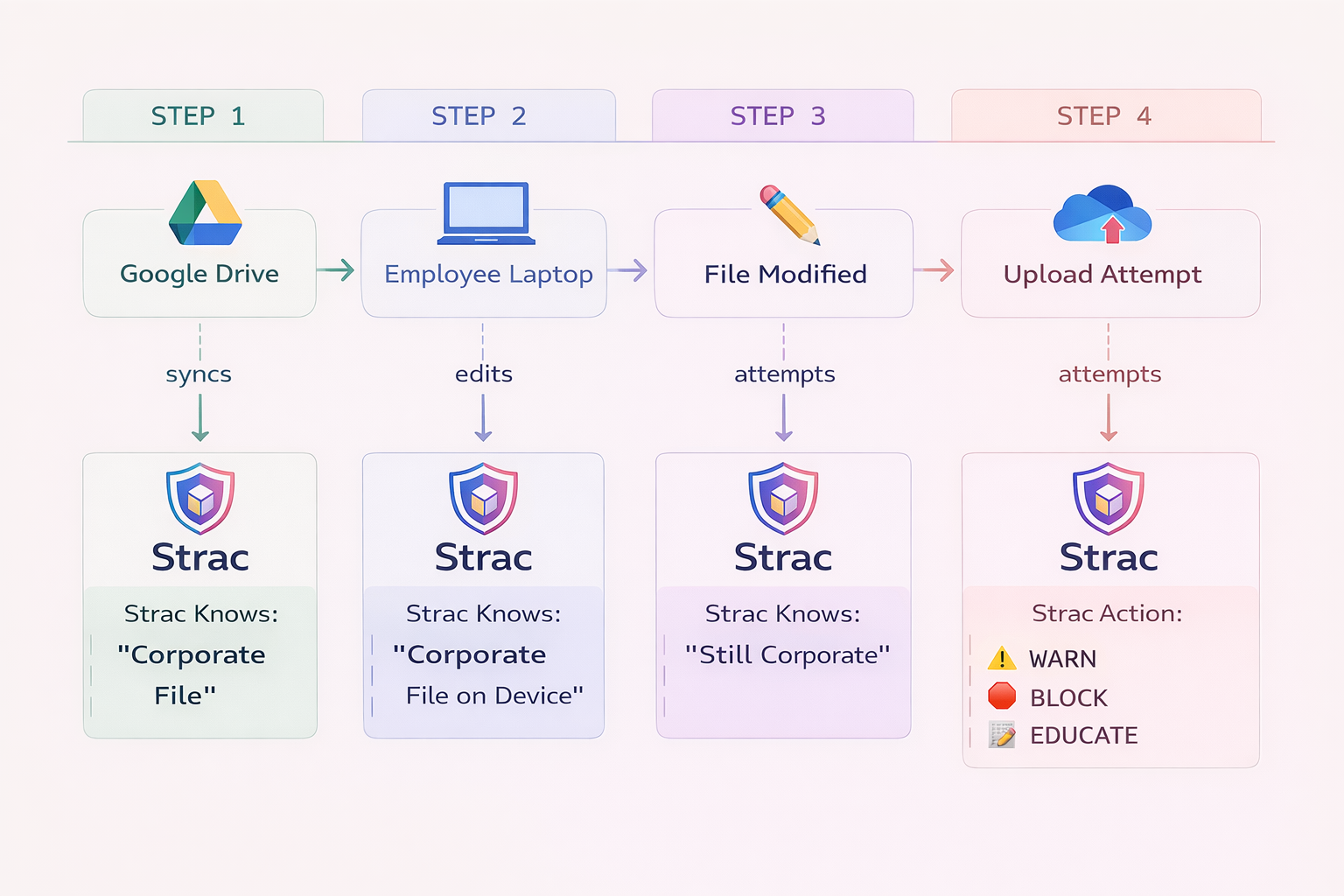
For example, if a sensitive file originated in Google Drive, was downloaded to a laptop, and then uploaded somewhere else, lineage provides valuable context for determining whether that action represents normal business activity or risky data movement.
This turns endpoint monitoring into something much closer to continuous data-flow visibility.
The browser has become one of the most important enterprise data security boundaries.
Employees access SaaS platforms, AI applications, cloud tools, file-sharing services, and personal applications through the same interface.
Browser DLP can inspect risky actions such as:
This is especially important for organizations trying to control Shadow SaaS and Shadow AI without blocking every new productivity tool.
Generative AI has created an entirely new data loss channel.
Employees can now paste thousands of lines of source code, customer records, contracts, healthcare information, internal documents, credentials, or financial data into an AI application in seconds.
Traditional network DLP was not designed around this interaction model.
AI DLP needs to inspect prompts, uploads, and potentially model responses while applying policies before sensitive information reaches an unauthorized AI service.
The goal is not necessarily to block AI.
The goal is to make AI usable without turning every prompt box into a potential data exfiltration channel.
Blocking a handful of known AI applications does not solve the AI governance problem.
New AI tools appear constantly, and employees can begin using them without security approval.
That creates Shadow AI.
Security teams therefore need visibility into which AI applications employees are using and what sensitive information is being sent to them.
This changes AI governance from:
"Which AI tools have we approved?"
to:
"Where is company data actually going?"
That second question is much more important.
Model Context Protocol introduces another significant change to enterprise data security.
MCP allows AI models and agents to connect with external tools and enterprise data sources. That makes AI dramatically more useful, but it also creates new pathways through which sensitive information can be retrieved, transmitted, or exposed.
An AI agent might access internal documents, customer records, cloud applications, databases, or development systems through MCP.
The security problem is no longer limited to what an employee types into a prompt.
It also includes what the AI can retrieve and what connected tools can receive.
MCP DLP provides a security enforcement layer around these interactions, inspecting sensitive data moving between models, MCP servers, and connected tools and applying appropriate policies before exposure occurs.
As agentic AI adoption grows, this will become an increasingly important extension of enterprise DLP.
One of the biggest shifts in data security is the convergence of DLP and DSPM.
Traditional DLP focuses on preventing sensitive information from leaving authorized environments.
DSPM focuses on discovering sensitive data and understanding its security posture.
But those problems are increasingly inseparable.
Imagine DSPM discovers thousands of customer records inside an incorrectly shared cloud repository.
Great. You found the problem.
What happens next?
Someone still needs to restrict access, remove unnecessary copies, redact sensitive information, or enforce policies preventing the data from spreading elsewhere.
That is where DLP becomes the enforcement layer.
The strongest architecture therefore looks something like:
Discover → Classify → Understand → Monitor → Enforce → Remediate
Strac brings these capabilities together rather than treating data discovery and data loss prevention as disconnected security projects.
Strac is designed around a simple reality: sensitive data does not live in one security boundary anymore.
It moves between people, applications, endpoints, cloud systems, AI models, and increasingly autonomous agents.
Strac therefore combines DSPM + DLP to discover sensitive information and enforce policies around how that information is stored, accessed, and moved.
Its coverage spans modern enterprise surfaces including:
SaaS DLP: Protect sensitive information across collaboration, support, CRM, productivity, and cloud applications.
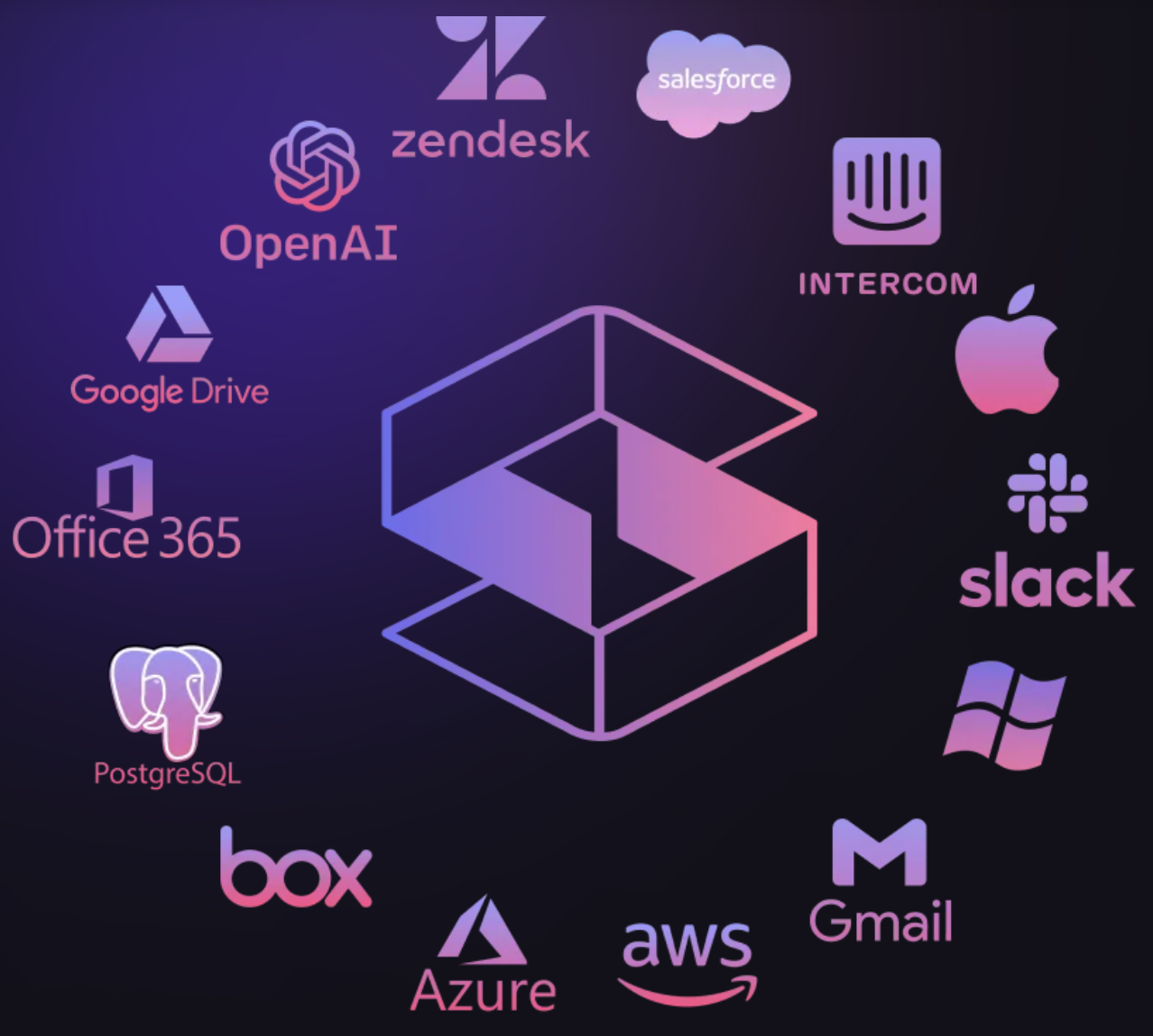
Cloud DSPM + DLP: Discover and classify sensitive information in cloud environments and apply security controls around it.
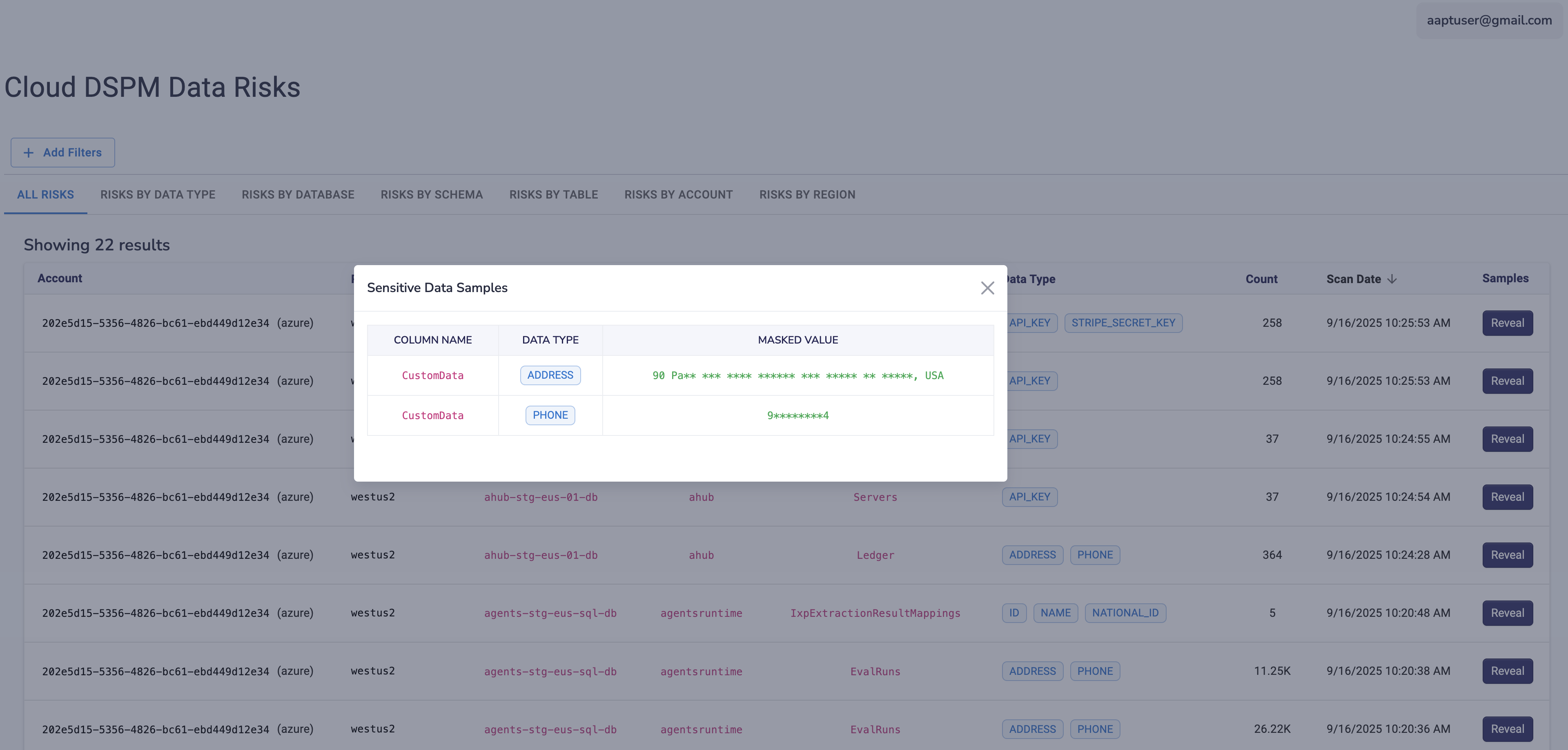
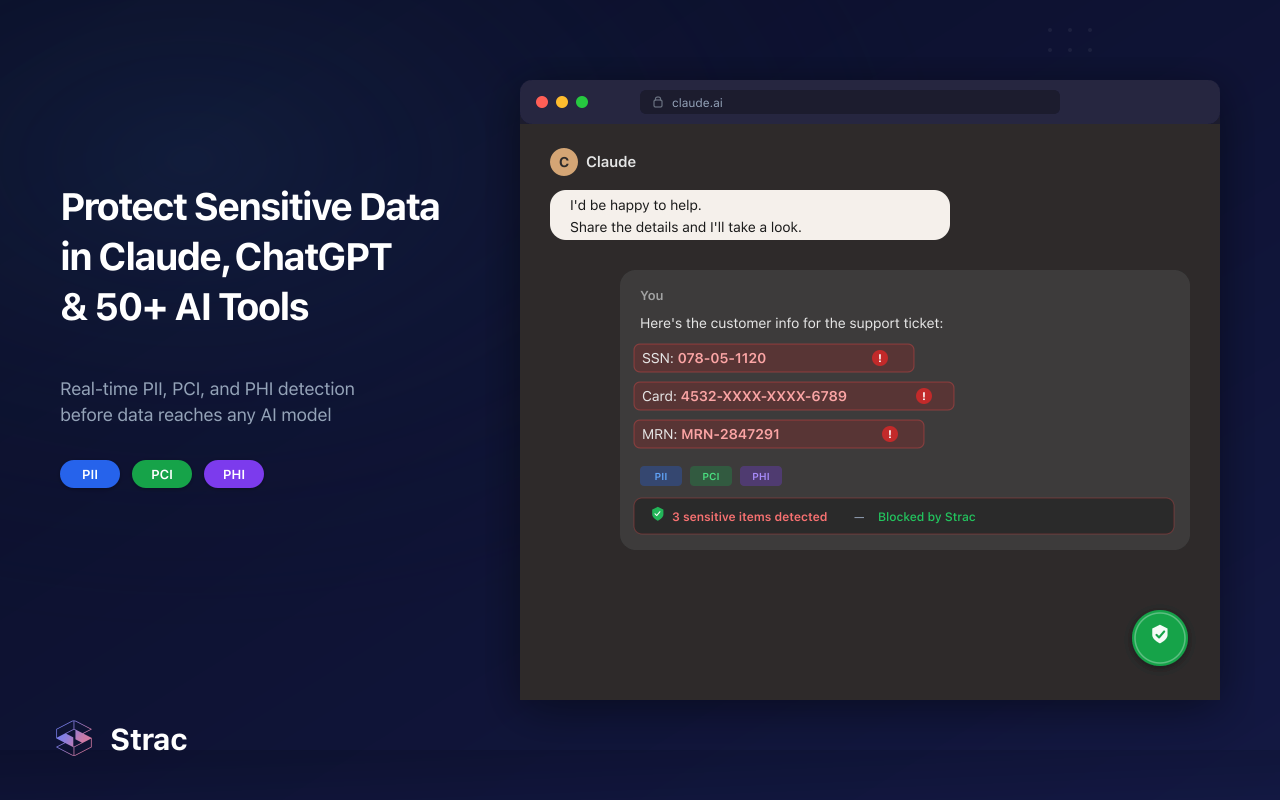
GenAI DLP: Inspect AI interactions to prevent sensitive information from being exposed through prompts and uploads.
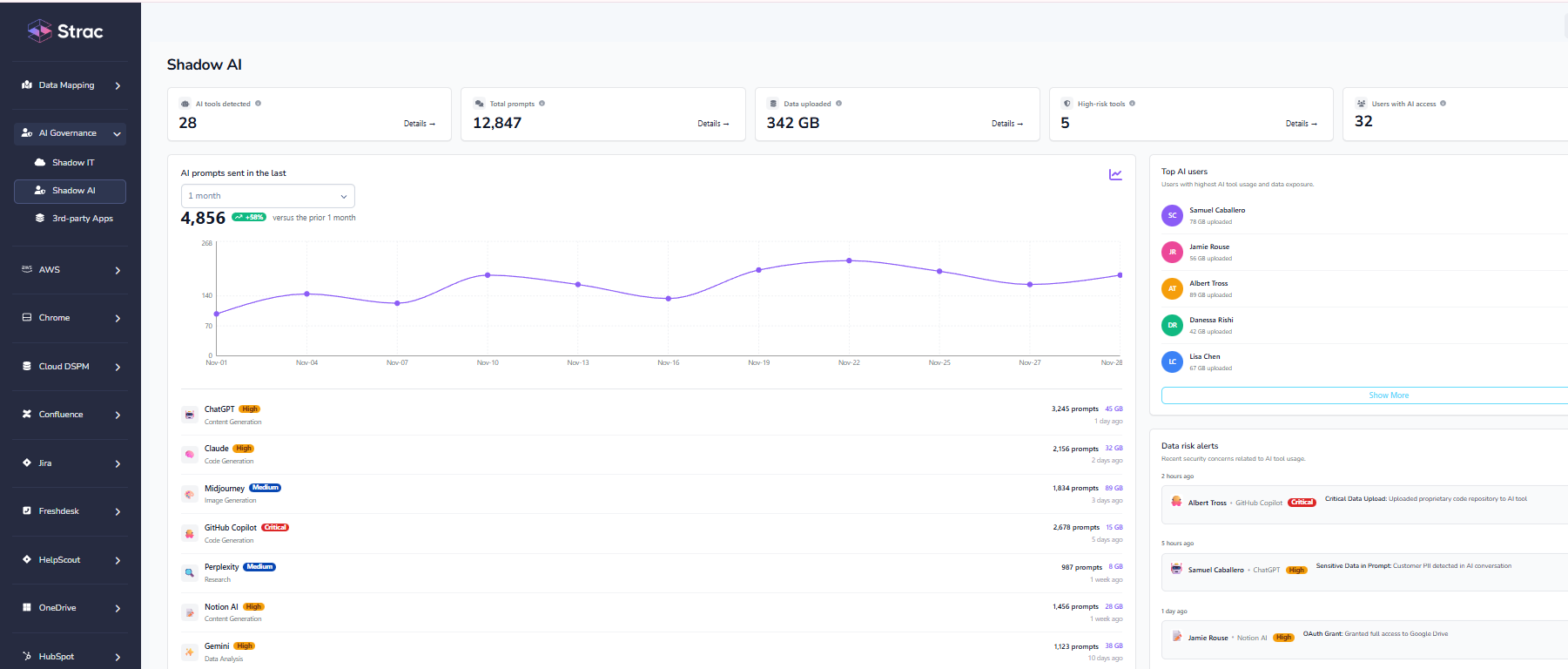
Shadow AI: Gain visibility into unsanctioned AI usage and control sensitive data movement into AI applications.
Browser DLP: Apply data protection policies where employees interact with SaaS and web applications.
.gif)
Endpoint DLP: Protect sensitive information moving through employee devices while adding context through Endpoint Data Lineage.
MCP DLP: Apply data protection policies to emerging model-to-tool and agentic AI workflows.
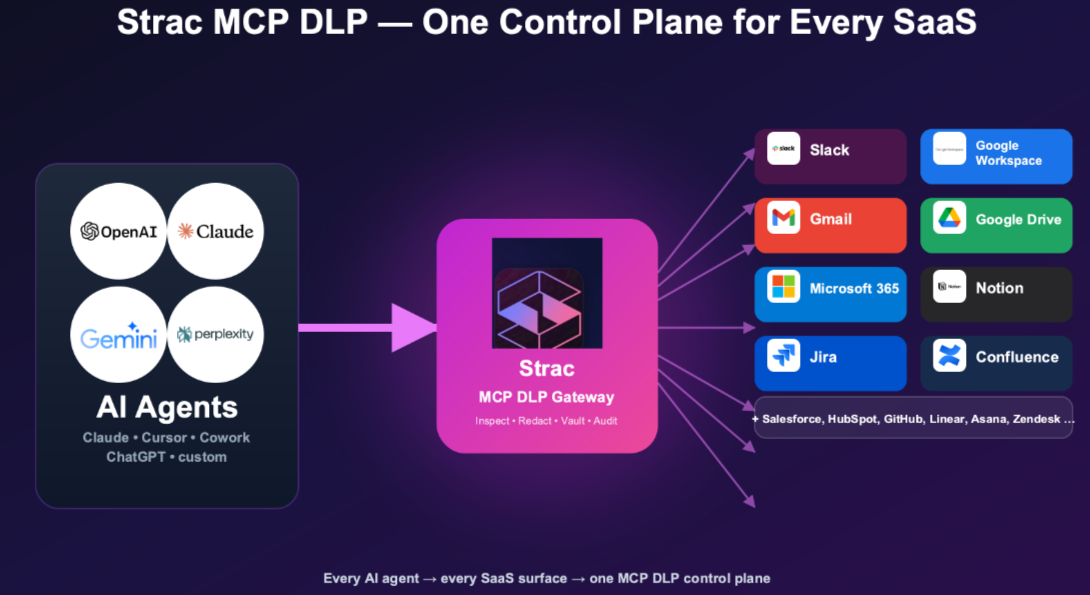
Image and document inspection: Detect sensitive information beyond plain text, including content embedded in documents, attachments, screenshots, and images.
Inline remediation: Move beyond alerts with actions such as redaction, masking, blocking, and deletion.
Strac's positioning has consistently emphasized broader SaaS and API coverage, real-time redaction, and lower-friction deployment as key reasons organizations evaluate it against traditional DLP platforms.
The biggest distinction between old and modern DLP may not be detection.
It is action.
Imagine a customer accidentally submits a credit card number inside a support ticket.
An alert-based system detects it and tells security:
PCI detected in Zendesk.
Now someone has another ticket to investigate.
An enforcement-oriented system can detect the PCI data, redact the sensitive information, preserve the usable portion of the conversation, record what happened, and enforce the organization's policy.
That is a very different security outcome.
The first system tells you something went wrong.
The second helps prevent the sensitive information from remaining exposed.
AI is rapidly changing the DLP category itself.
When employees were the primary actors moving information, security teams could focus primarily on human actions.
AI agents change that assumption.
Agents can retrieve information, summarize it, transform it, send it to another application, call an API, and execute actions across connected systems.
That means future DLP policies increasingly need to govern both:
Human → Data → Application
and
AI → Data → Tool
This is why GenAI DLP, Shadow AI discovery, browser controls, and MCP security are becoming increasingly connected.
The security question is no longer simply:
"Can we stop employees from leaking data?"
It is becoming:
"Can we control how sensitive data moves between humans, SaaS applications, endpoints, AI models, agents, and tools?"
That is the modern DLP problem.
Data Loss Prevention in 2026 is no longer just an endpoint agent watching files or a rule engine scanning outbound email.
Sensitive data now moves through SaaS, cloud infrastructure, browsers, endpoints, APIs, GenAI applications, Shadow AI tools, and MCP-connected agents. Organizations need security controls capable of following that data across the entire journey.
Modern DLP therefore requires three things working together: visibility, context, and enforcement.
Strac's approach brings DSPM and DLP together across these modern data surfaces, allowing organizations to discover sensitive information, understand where it exists, monitor how it moves, and automatically take action when that movement creates risk.
Not obsolete, but traditional DLP by itself is no longer enough. Email, network, and endpoint controls still matter, but sensitive data now moves through SaaS apps, browsers, GenAI tools, cloud platforms, APIs, and MCP-connected AI agents. Modern DLP needs to follow the data across these environments instead of assuming the corporate network is still the security boundary.
That is the uncomfortable question. Detection tells security teams that sensitive data was exposed; inline remediation can actually do something about it. Modern DLP should be able to redact, mask, block, quarantine, delete, encrypt, or otherwise remediate sensitive information based on policy. Strac specifically differentiates around real-time remediation rather than detection-only workflows.
Yes. AI prompt boxes and file-upload interfaces have effectively become new data egress points. Employees can accidentally send customer records, source code, credentials, financial information, PHI, or proprietary documents into AI applications in seconds. GenAI DLP adds controls around these interactions so organizations can adopt AI without giving sensitive data a free pass.
That is exactly why MCP DLP and AI-aware data controls are becoming important. MCP-connected agents can retrieve enterprise information and pass it to external tools without the traditional copy-paste behavior DLP products were built to monitor. Security teams increasingly need policies governing both human-to-application and AI-to-tool data movement.
They solve different halves of the same problem. DSPM tells you where sensitive data exists and its security posture; DLP controls what happens when that data is accessed, shared, or moved. Strac combines DSPM and DLP so discovery can lead directly to enforcement and remediation instead of creating another dashboard for security teams to monitor.
.avif)


.gif)


.webp)