October 1, 2026

7
min read
GDPR Data Discovery Software: 5 Best Tools for Compliance (2026)
Compare the top GDPR compliance software for data discovery in 2026 - how each tool finds, classifies, and remediates personal data to keep you audit-ready.
GDPR data discovery has become a foundational requirement for any organization that processes personal data across SaaS, cloud, endpoints, and AI-driven tools. As businesses expand their digital footprint, personal data frequently spreads across emails, chats, documents, support systems, and unstructured content. Without continuous GDPR data discovery, companies face blind spots that increase compliance risk and make audits significantly harder. Modern teams need real-time visibility, automated classification, and instant remediation; all in one solution designed for today’s fast-moving environments.
GDPR data discovery software helps organizations identify where personal data lives across their SaaS apps, cloud platforms, endpoints, and internal systems. GDPR requires businesses to maintain full visibility into personal data; without that visibility, no company can meet its compliance obligations. As businesses adopt more tools and generate more unstructured data, discovery becomes the foundation of any GDPR program.
GDPR is the European Union’s privacy regulation that reshaped how companies manage data globally. It applies to any organization that processes personal data of EU residents, regardless of where the business is located. This means U.S., UK, APAC, LATAM, and global companies must comply if they handle EU user or customer data.
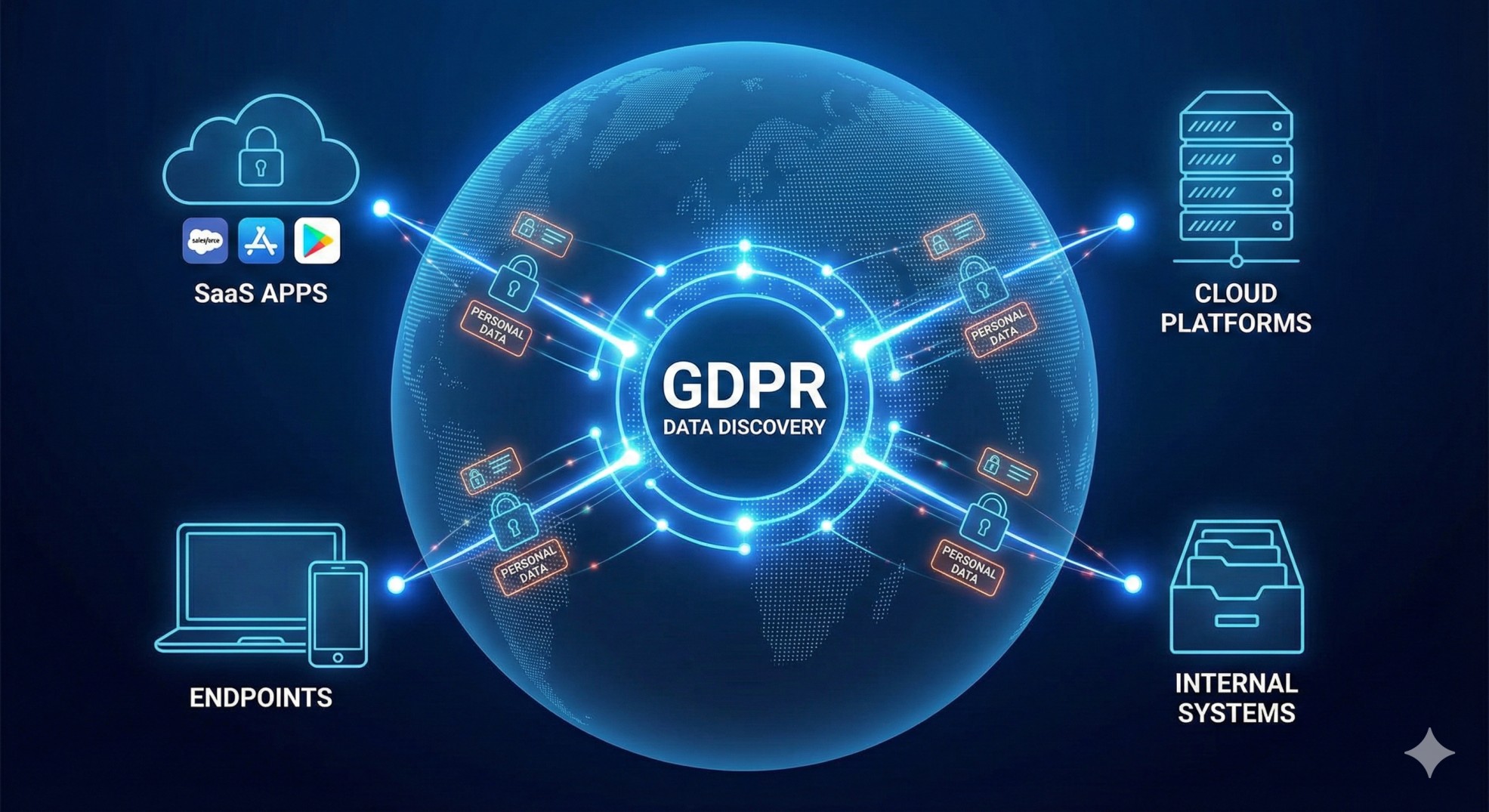
Data discovery software takes the manual work out of finding personal data. It continuously scans your systems and flags where PII and other regulated data show up.
Most platforms help you:
It makes GDPR requirements like RoPA, DSARs, retention, and breach reporting much more manageable.
Data discovery keeps small problems from turning into big ones. It helps you spot overshared files, outdated records, or risky access before they become violations.
It also means you’re not scrambling during an audit or incident. You know where your data is. You can prove how it’s handled.
At the end of the day, that’s what GDPR is about; being able to show you’re in control.

You can’t protect personal data if you don’t know where it lives. That’s the core of GDPR compliance.
In modern companies, personal data is scattered across SaaS apps, cloud storage, Slack threads, support tickets, CRMs, spreadsheets, and even AI prompts. Without continuous data discovery, those become blind spots; and under GDPR, blind spots mean risk.
Data discovery makes key GDPR obligations possible:
Data discovery isn’t optional. It’s the visibility layer that turns GDPR from policy into execution. Without it, compliance is guesswork. With it, compliance becomes controlled and defensible.
Choosing the right GDPR data discovery software is not just a technical decision; it is a compliance and risk decision that shapes how confidently you handle personal data. The best GDPR data discovery tools help you automatically find, classify, and protect sensitive data across SaaS, cloud, on-premise systems, and increasingly across AI workflows. Below are five leading tools, starting with Strac as the recommended option for modern, cloud-first teams, followed by other established platforms that many enterprises already rely on. Each solution takes a slightly different approach to discovery, automation, and governance, which means the right choice depends on your stack, budget, and maturity.
| Tool | Best for | Coverage (SaaS / Cloud / Gen AI / Endpoint) | No-code | GDPR strengths |
|---|---|---|---|---|
| Strac | Modern, cloud-first teams needing discovery + remediation everywhere | SaaS, Cloud, Gen AI/MCP, and Endpoints | Yes | Auto-discovery and classification of personal data, redaction/masking, DSAR support, audit trail |
| OneTrust | Enterprise privacy program management | Broad, privacy-led | Partial | RoPA, DSAR automation, consent and preference management |
| Spirion | Persistent data classification on endpoints and on-prem | Endpoint, On-prem, Cloud | Partial | High-accuracy classification and persistent labels for personal data |
| Varonis | File and data-access governance | On-prem, M365, Cloud | No | Access governance, activity monitoring, exposure reduction |
| IBM Guardium | Databases and structured data at scale | Databases, On-prem, Cloud | No | Database discovery, activity monitoring, and reporting |
The rest of this guide breaks down each of these GDPR data discovery tools in detail, starting with Strac.
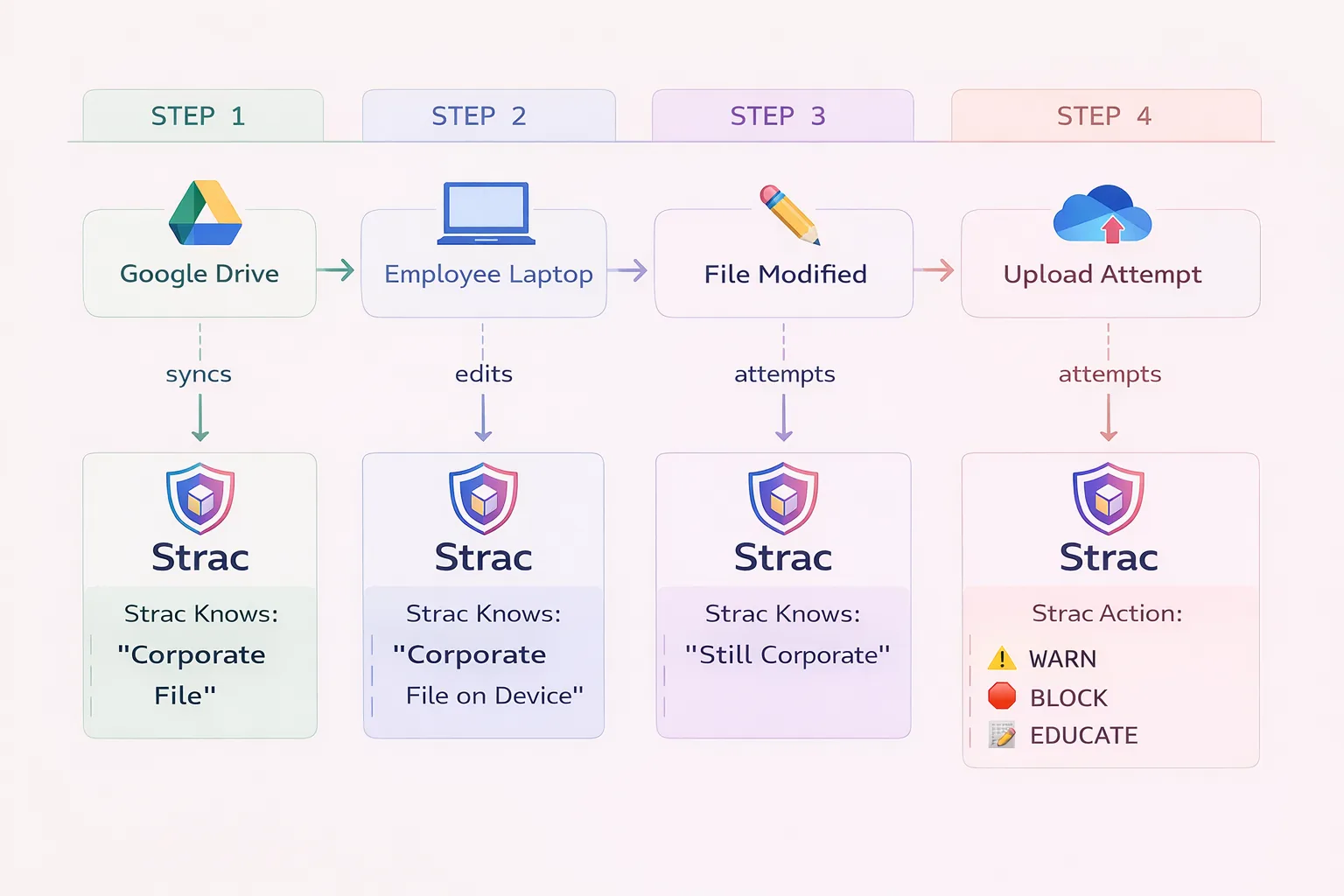
Strac is built for modern, cloud-first teams that need fast, accurate GDPR data discovery across SaaS, cloud storage, endpoints, MCP, and AI applications. It automatically identifies personal data, classifies it, and offers real-time remediation without heavy deployment or complex rule-building.
Key Features:



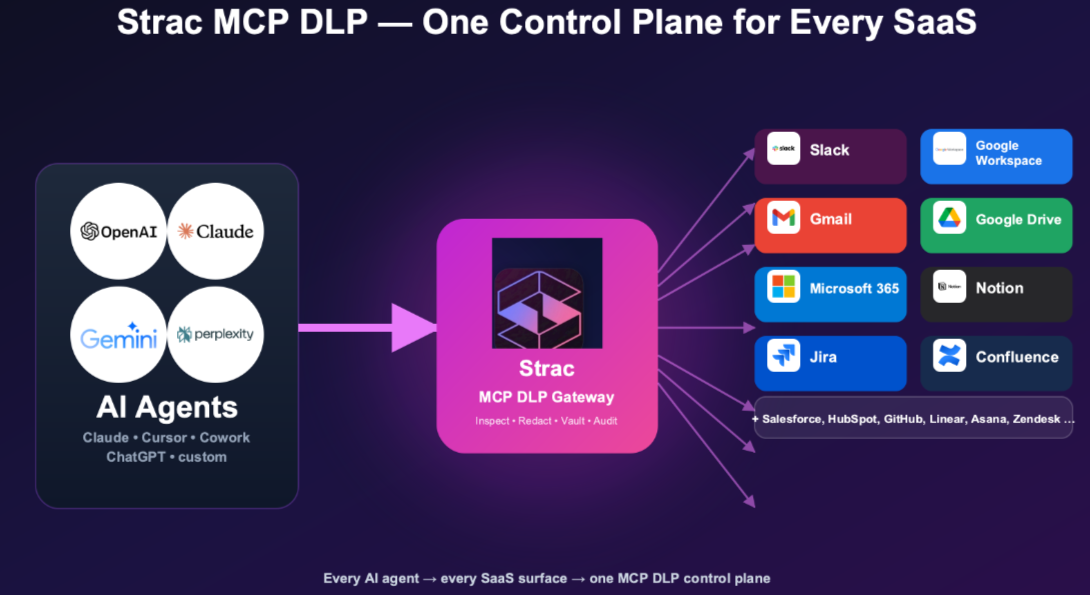
👉 Read our blog on MCP DLP: How to Prevent Data Loss in Model Context Protocol Deployments
Strengths:
Weaknesses:
Best For:
Teams needing a single platform for GDPR discovery, classification, and remediation across SaaS, cloud, endpoints, and Gen-AI.
OneTrust is one of the largest platforms in the privacy and compliance space, offering wide-ranging modules that include GDPR discovery, RoPA management, DSAR handling, consent management, vendor risk, and more.
Key Features:
Strengths:
Weaknesses:
Best For:
Enterprises building a centralized, formal GDPR governance program.
Spirion focuses heavily on finding sensitive data buried in unstructured content and legacy systems. It is often used by companies that need deep scanning across file servers, email archives, and on-premise systems.
Key Features:
Strengths:
Weaknesses:
Best For:
Organizations with large inherited data estates, file servers, or unstructured legacy data.

Varonis is a data security and analytics platform focused on understanding where sensitive data lives and how it is accessed. It provides detailed monitoring and helps organizations reduce exposure and insider risk.
Key Features:
Strengths:
Weaknesses:
Best For:
Enterprises prioritizing access governance, insider threat monitoring, and file system security.

IBM Guardium is an enterprise-grade platform designed for large organizations with complex hybrid environments, including cloud, on-premise, and mainframe systems.
Key Features:
Strengths:
Weaknesses:
Best For:
Global enterprises with extensive data infrastructure and strict regulatory obligations.

GDPR compliance isn’t about paperwork; it’s about control. You need to know where personal data lives, who has access to it, and how it moves across your systems. Data discovery tools make that visible.
First, they keep your data map accurate. Instead of chasing departments for spreadsheets, you get automated visibility across SaaS apps, cloud storage, databases, and endpoints. That makes maintaining Article 30 records realistic; not a one-time exercise that goes stale.
Second, they reduce risk. When you can see where sensitive data sits; overshared folders, old backups, duplicate files; you can fix it. That supports data minimization, retention, and access control without guesswork.
Third, they speed up breach response. If something goes wrong, you can quickly identify what data was involved and where. That’s critical when GDPR gives you 72 hours to report.
Finally, they give you proof. Dashboards and reports show regulators that you’re not just compliant on paper; you’re monitoring and managing data continuously.
In short, data discovery turns GDPR from a legal burden into a manageable, operational process.
Implementing GDPR data discovery often reveals how fragmented, unstructured, and globally distributed personal data has become. Many organizations struggle to gain complete visibility across SaaS tools, cloud platforms, email systems, legacy data stores, and the growing use of AI applications. These challenges can slow down compliance efforts, but each one can be solved with the right approach and technology. Below are the most common obstacles and how businesses can overcome them with clarity and control.
Unstructured data remains one of the hardest problems to solve. Personal data hides inside emails, PDF documents, chat threads, spreadsheets, scanned images, and support tickets, making traditional keyword or regex-based discovery unreliable. The solution is adopting ML and OCR-driven discovery; tools that can read, interpret, and classify unstructured content accurately. This ensures sensitive data inside documents and attachments is discovered, not overlooked.
SaaS sprawl and shadow IT introduce significant blind spots. Modern companies rely on dozens of apps across multiple departments, and many of these tools store or process personal data without formal oversight. As a result, organizations lose track of where GDPR-regulated information is actually stored. The best path forward is implementing discovery platforms that connect easily to multiple SaaS apps, identify unmanaged tools, and unify data visibility under one dashboard. Regular SaaS inventories and automatic scanning reduce the risk of hidden data exposure.
Data sovereignty challenges increase as companies expand globally. GDPR places strict requirements on controlling where personal data is stored, including whether it sits inside or outside the EU. When data moves across regions or is stored in third-country clouds, compliance becomes harder to maintain. The fix is using discovery tools that support region-aware scanning; provide insights on data residency; and allow configurable policies that restrict data storage to EU-approved regions. This ensures that businesses meet GDPR’s expectations for lawful transfer and geographic control.
Balancing security and productivity is another recurring challenge. Too much blocking can disrupt workflows, frustrate employees, and lead teams to circumvent security controls. Too little enforcement increases the risk of data leaks and noncompliance. Organizations can solve this by using tools with flexible policies that allow:
This approach protects personal data without slowing down collaboration or daily operations.
By addressing these challenges with the right technologies and well-designed policies, organizations can build a strong GDPR discovery foundation. Instead of reacting to compliance gaps, they gain proactive visibility, reduce risk, and protect personal data consistently across their entire digital ecosystem.

Strac is built for modern organizations that need fast, accurate, and continuous GDPR data discovery across SaaS tools, cloud environments, endpoints, and AI workflows. Instead of relying on slow scans or agent-heavy deployments, Strac provides real-time visibility and automated protection, helping companies stay compliant without adding operational friction. Its design is simple, powerful, and built to handle the unstructured data where most personal information hides.
Strac’s real-time discovery is one of its biggest advantages. Personal data appears everywhere; in Slack threads, email conversations, Salesforce cases, Google Drive documents, PDFs, screenshots, and AI prompts. Strac identifies these data points the moment they surface, giving organizations instant visibility across their entire environment. This continuous approach ensures GDPR-regulated data never slips through unnoticed.
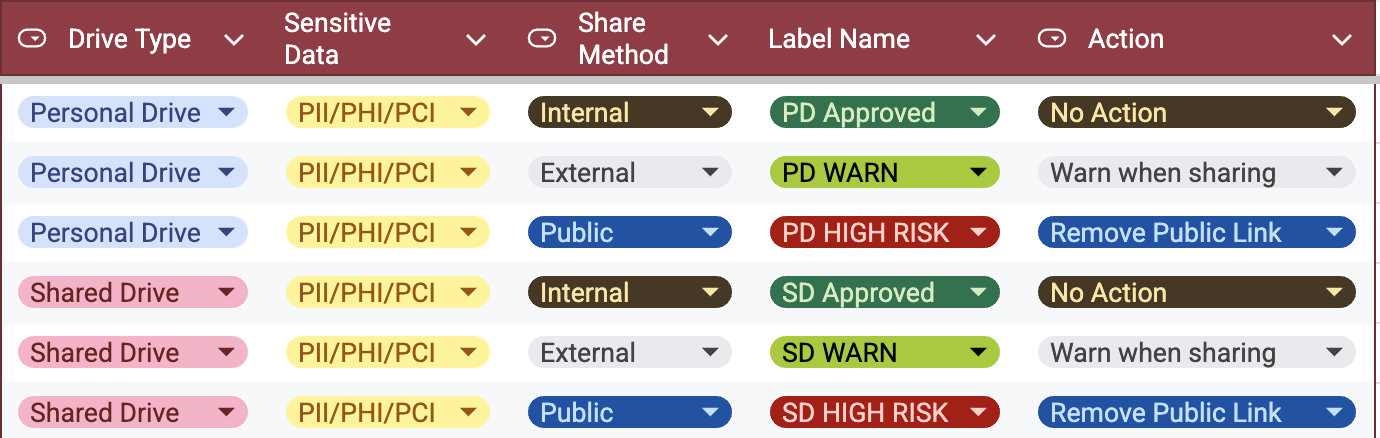
Strac also offers strong automated remediation capabilities that directly support GDPR compliance. When sensitive data is detected, Strac can apply:
These automated actions prevent exposures before they escalate, reducing manual work and helping teams maintain consistent data protection standards.
Deployment is another area where Strac excels. Unlike legacy tools that require agents, scripts, or long setup cycles, Strac is fully no-code and connects to SaaS apps and cloud platforms in minutes. This means organizations can:
This ease of use makes Strac ideal for growing teams, distributed companies, and organizations replacing outdated, complex discovery tools.
With real-time visibility, automated remediation, and effortless deployment, Strac provides a GDPR-ready foundation that scales with the business. It helps organizations stay compliant, reduce risk, and protect personal data wherever it lives.
Strac GDPR Data Discovery Software
Strong GDPR data discovery is no longer optional; it is the core of every effective compliance program. Organizations that invest in accurate, continuous discovery gain better visibility, stronger data protection, faster incident response, and easier audit readiness. With the right platform, GDPR data discovery becomes a proactive, automated process that reduces risk while supporting business productivity.
Related reading:
What is the best GDPR data discovery software? For teams whose data lives in SaaS, cloud, Gen AI tools, and on endpoints, Strac is the strongest fit: it discovers and classifies personal data automatically and can redact or mask it in place, with a full audit trail for GDPR. OneTrust suits privacy-program management, while Varonis and IBM Guardium fit on-prem and database-heavy estates.
What are the best data discovery tools for GDPR compliance? The leading GDPR data discovery tools in 2026 are Strac, OneTrust, Spirion, Varonis, and IBM Guardium. Strac stands out for no-code coverage across modern SaaS, cloud, and AI workflows plus endpoints — and for remediating the personal data it finds, not just reporting on it.
Data discovery in the GDPR context refers to the process of automatically identifying where personal data lives across an organization’s systems. This includes SaaS tools, cloud storage, email, endpoints, databases, and even AI applications. GDPR requires companies to know what personal data they process, where it is stored, and who can access it. Data discovery provides that foundational visibility so organizations can comply with Article 30 records, DSARs, breach reporting, and data minimization requirements.
Yes. Modern GDPR data discovery tools can classify unstructured data with high accuracy. Advanced platforms use:
This matters because most personal data today hides inside unstructured content. Without ML/OCR-based discovery, companies would miss large portions of their GDPR-regulated data.
Selecting the right tool depends on your data environment, risk profile, and operational needs. A strong GDPR data discovery solution should offer:
Teams that rely heavily on SaaS or AI workflows benefit from modern, agentless tools. Large enterprises with legacy systems may prioritize deep on-prem scanning.
The ROI is significant because discovery directly reduces legal, operational, and security risk. Organizations see returns through:
In most cases, discovery tools replace hours of manual work per week and prevent costly incidents, creating both immediate and long-term ROI.
Implementation time varies based on the tool’s architecture. Modern no-code, agentless solutions can be deployed in minutes or hours because they connect directly to SaaS platforms and cloud tools. Platforms that require endpoint agents, custom scripts, or heavy configuration may take weeks or months. Most organizations see initial discovery insights on the same day they connect their systems, with full coverage typically achieved shortly after.
.avif)


.gif)


.webp)