September 14, 2026

5
min read
Google Drive Block Sharing: A Comprehensive Guide
Learn why it is necessary to block sharing of files externally on Google Drive and how to achieve it.
· Google Drive block sharing restricts externalaccess to files and folders, through domain-level sharing settings, targetaudiences, link expiry, and per-file permissions.
· Blocking is easy to turn on and hard to livewith. A blanket restriction stops a vendor contract and a customer exportalike, so teams grant exceptions until the exceptions are the policy.
· Google's native controls decide who canreceive a file. They do not decide what is inside it, which is why aspreadsheet of Social Security numbers and a lunch menu are governed the sameway.
· Strac inspects the content of every file inDrive, redacts the sensitive fields, revokes public and external links, andapplies the same policy in the browser, on the endpoint, and across SaaS apps and AI agents.
· This is the Drive slice of Google Workspace DLP.Start from that guide.
Google Drive block sharing is any control that prevents a file from being shared beyond an approved set of people. It covers three distinct layers: the Workspace admin setting that governs external sharing for an organizational unit, the link setting on an individual file — Restricted, or Anyone with the link — and the editor permissions that decide whether a recipient can download, print, copy, or reshare.
Sharing is what makes Drive useful. It is also the fastest way a customer record leaves the company: one link, one paste into an email, and the file is outside every control you own. Blocking is the blunt answer to that. Google Drive DLP is the precise one.
The distinction matters because the two are not interchangeable. Blocking is a permission decision made before anyone knows what the file holds; DLP is a data decision made after the file is read.
Four reasons come up in every Drive review, and all four are about the file leaving rather than the file existing.
Regulated data is the first. A Drive that holds PII, PHI, or cardholder data inherits HIPAA, PCI DSS, GDPR, and SOC 2 obligations the moment that data becomes externally reachable. Intellectual property is the second: designs, pricing models, and source code move as files long before they move as code. Privacy is the third — an HR folder shared to "Anyone with the link" is a disclosure whether or not anyone opens it. And loss of oversight is the fourth. A file shared onward twice is a file you no longer know the location of.
Each of those is a real reason to restrict sharing. None of them is a reason to restrict all sharing, which is the trap most Drive programs fall into.
Google gives you real controls, and they are worth setting correctly before any tool is added.
At the admin level, Apps → Google Workspace → Drive and Docs → Sharing settings turns external sharing off for an organizational unit, restricts it to allowlisted domains, or warns users when a recipient sits outside the domain. Target audiences narrow the default "Anyone with the link" scope to a named group. Link expiry puts a clock on temporary access.
At the file level, open Share, set General access to Restricted, and remove individual collaborators who no longer need access. Under the gear icon, clear "Viewers and commenters can download, print, and copy" and "Editors can change permissions and share."
These settings work. Their limits are structural, not cosmetic. They are applied per organizational unit rather than per data type, so one policy covers every file a department owns. They are point-in-time, so a file that becomes sensitive after it is shared stays shared. They depend on someone auditing the back catalog of links already granted. And they treat blocking as the only remediation, which pushes users toward personal accounts and unmanaged tools — the shadow AI problem, arriving through Drive. A closer walkthrough of the permission model lives in the guide to Google Drive sharing permissions.
A permission is metadata about a file. It says nothing about the contents.
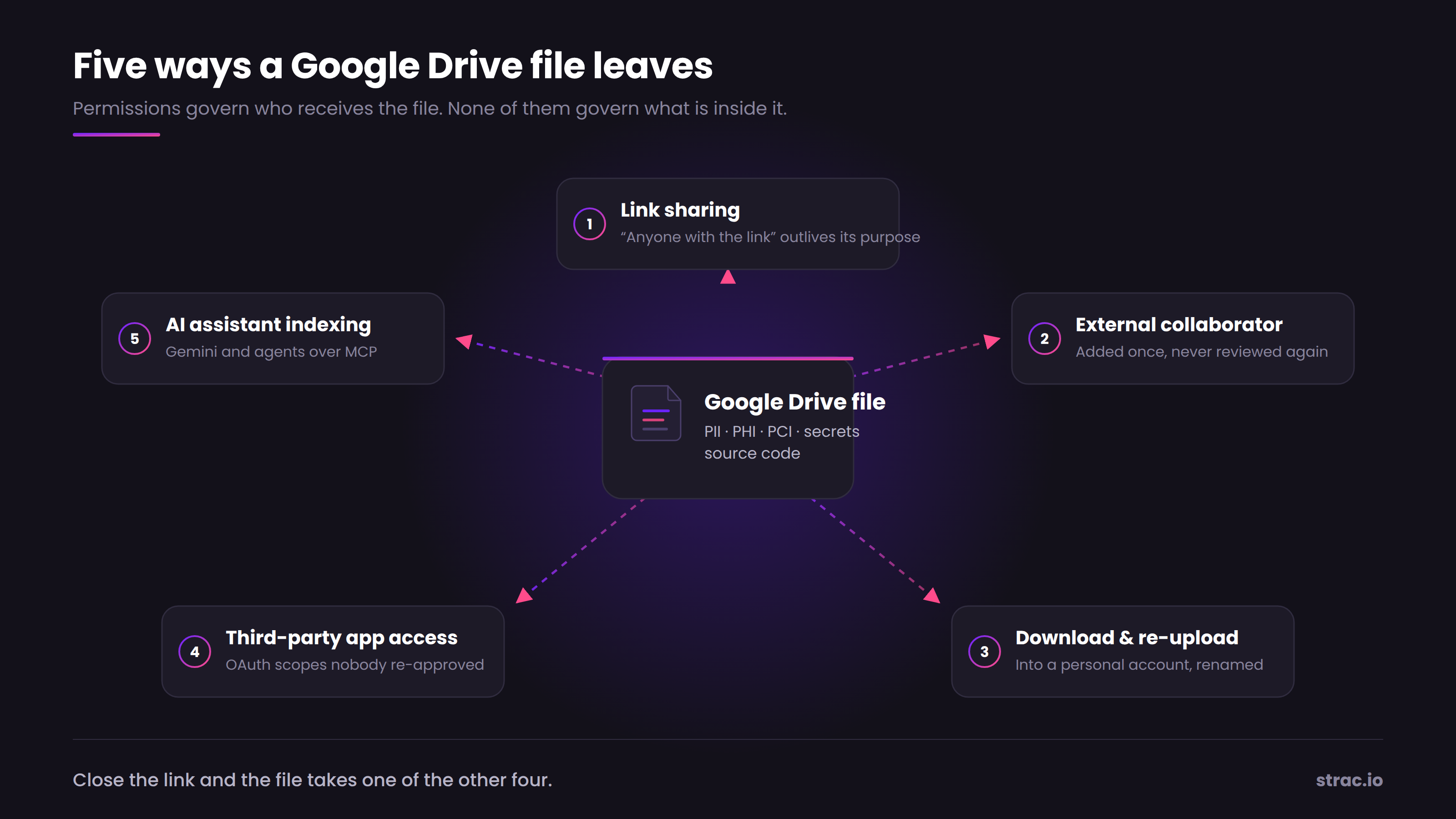
That gap shows up in ordinary situations. A finance analyst shares a quarterly deck externally, and slide 14 holds a live customer export. A support engineer shares a screenshot folder with a partner, and one PNG shows a full card number — text that only OCR will find. A contractor's access is removed, but the file they downloaded last month has already been re-uploaded to a personal Drive. And Gemini indexes a folder nobody reclassified, then surfaces the wrong file to the wrong employee, which is the failure mode covered in AI readiness meets Google Drive DLP.
Blocking tells you a file cannot leave. Inspection tells you whether it ever should have been shareable. The first is a rule; the second is the evidence the rule was right.
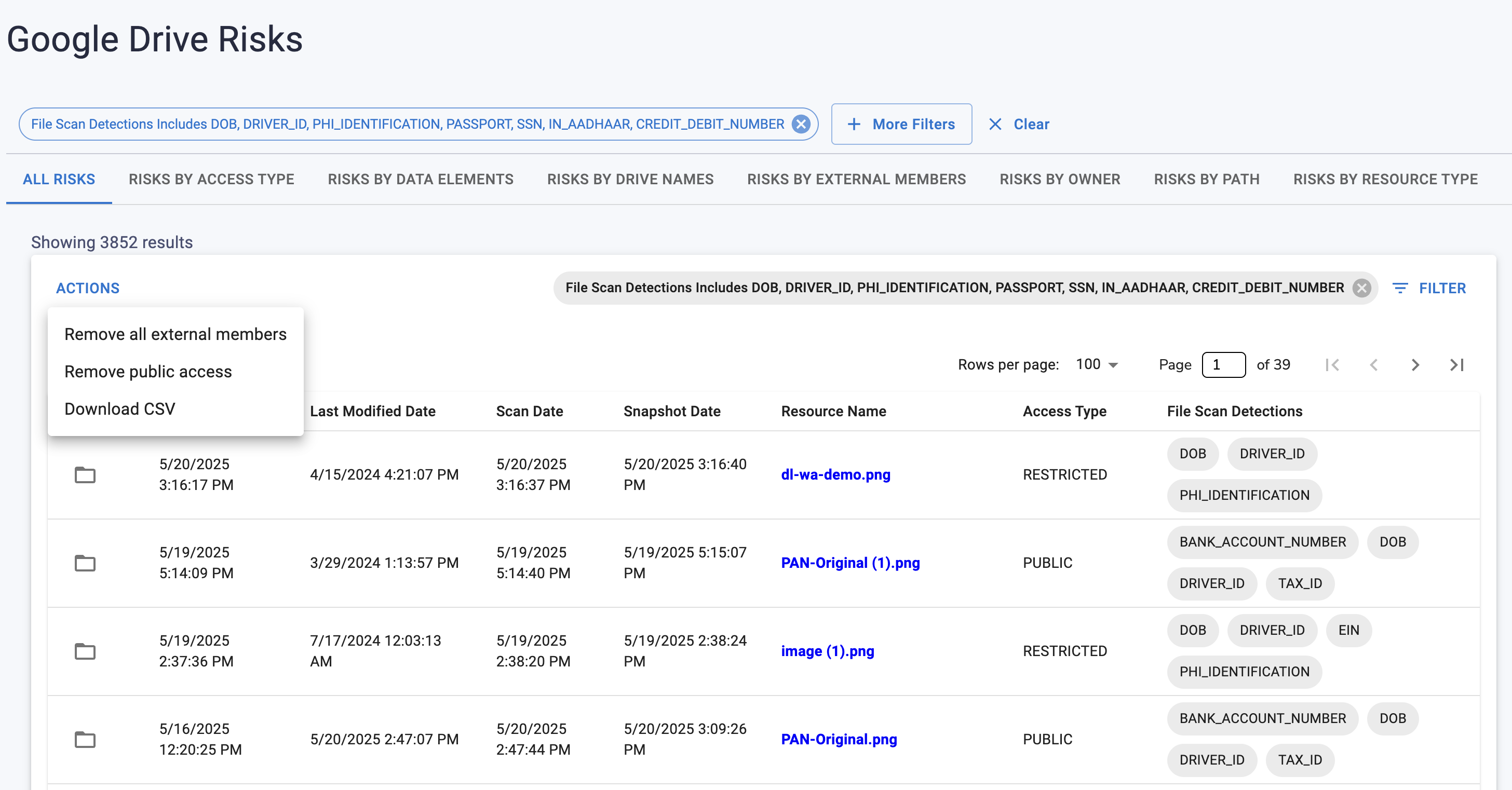
Strac connects to Drive through the Google Drive DLP integration with API-based access — no proxy, no agent on the file, no change to how people work. It scans every file, historical and new, with detectors for PII, PHI, PCI, credentials, and source code, including OCR for images and full inspection of PDF, DOCX, XLSX, and ZIP contents.
When a file matches a policy, Strac acts on the data and the permission together:
A Drive-only control is a Drive-shaped hole. The same file leaves through five other doors, and Strac covers each with the same detectors and the same policy.
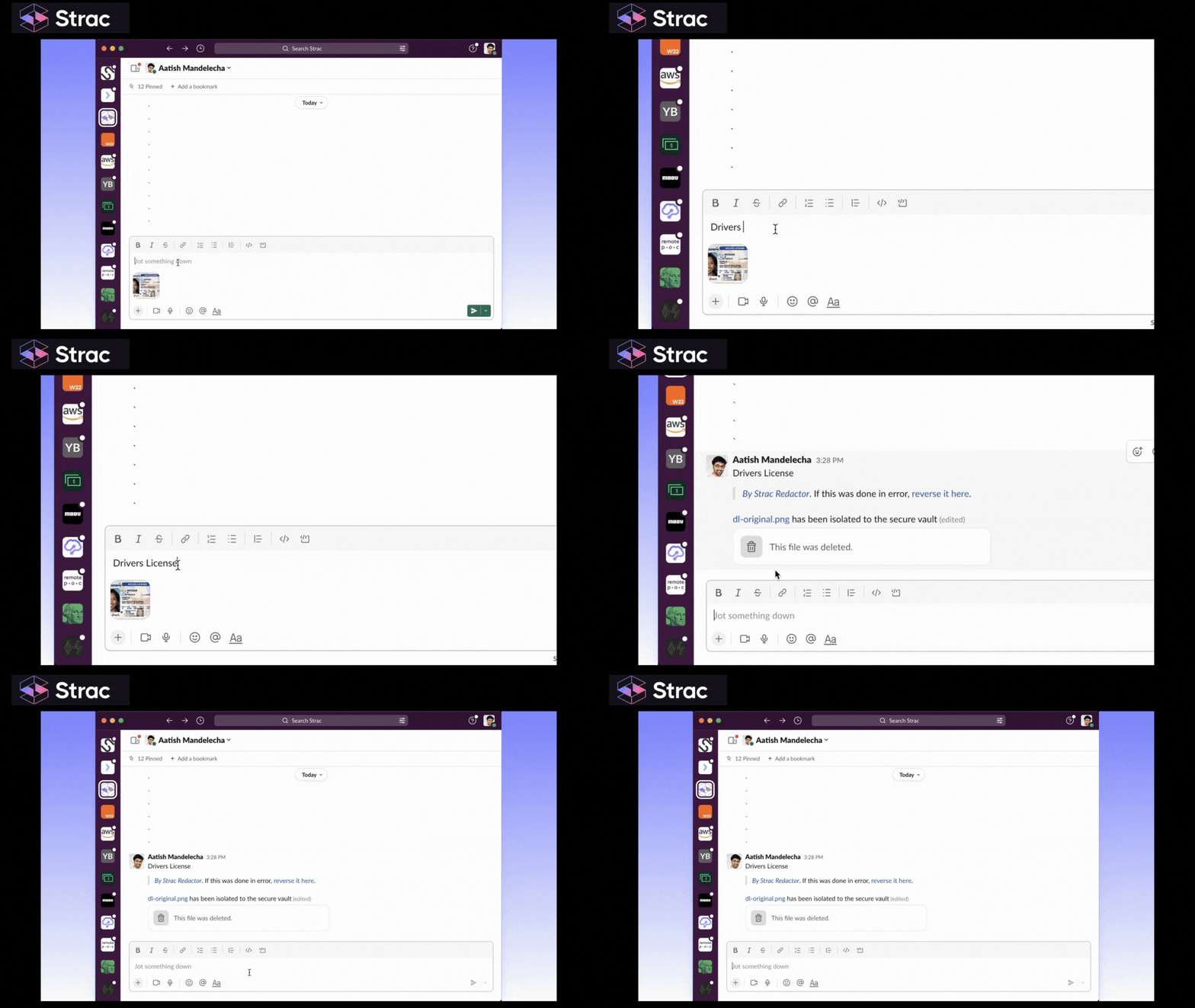
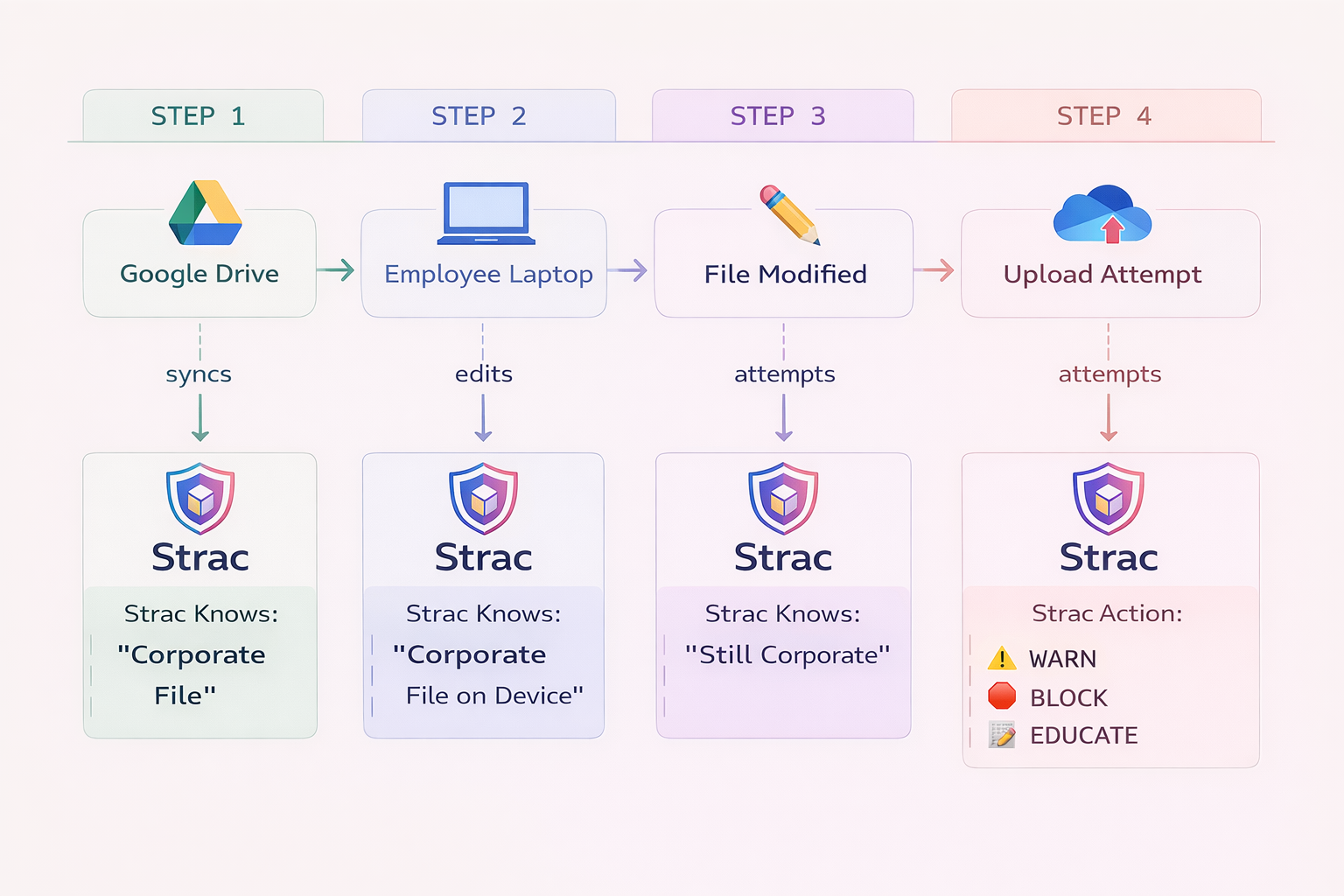
.gif)
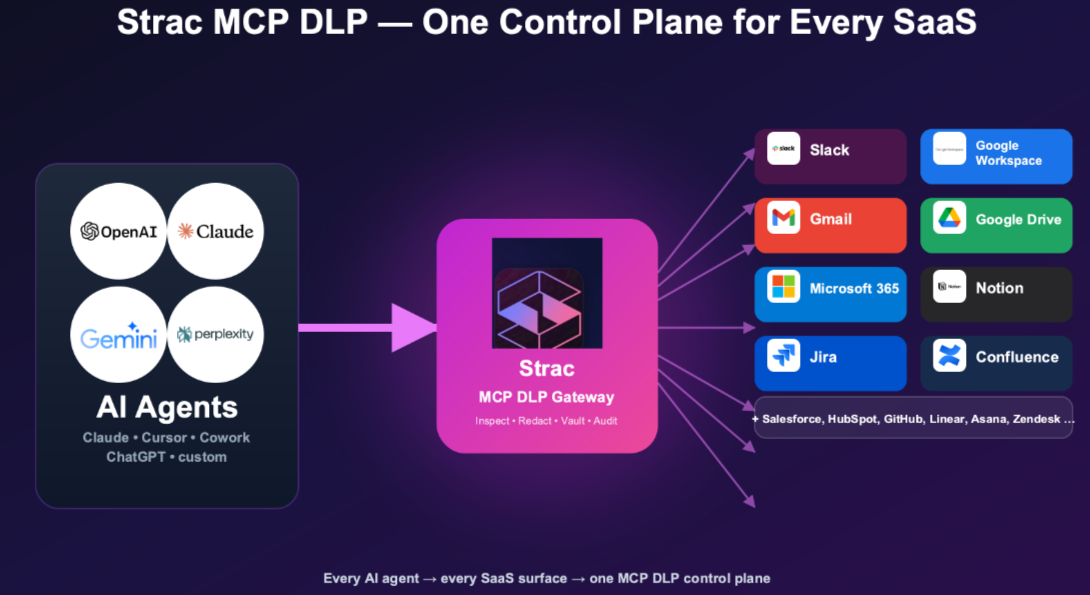
That last door is the newest and the least governed. Every surface above shares one detection engine — standard and custom detectors for PII, PHI, PCI, credentials, and source code, with OCR for images and full inspection of PDF, DOCX, XLSX, and ZIP files.
[IMAGE 3 · drive-sharing-90-day.png]Alt: Three-phase rollout — Days 0–30 discover sensitive files and existing external shares, Days 30–60 redact and revoke, Days 60–90 prove and scale across Workspace.Discover what is already shared before you decide what to block. Most programs do it in the wrong order.
If you can leave external sharing on because the sensitive fields are already redacted, you are running data protection. If external sharing has to stay off, you are running a lockdown — and lockdowns leak around the edges.
Strac closes the gap behind both. Start at Google Workspace DLP, or read Google Drive security and how to prevent downloads in Google Drive.
Sharing controls, admin settings, and access reviews all fail eventually — a link outlives its purpose, an exception becomes permanent, an AI agent reads a folder nobody reclassified. The data layer is the backstop. Redact the sensitive fields, revoke the links that should not exist, and apply the same policy everywhere the file can travel, and a bad share never becomes a breach. Book a demo to see Strac protect the data in your Google Drive.
No. Blocking is a permission control — it decides who may receive a file. Google Drive DLP inspects what is inside the file and acts on the data itself, redacting sensitive fields so the file can still be shared safely.
Because it applies per organizational unit, not per data type, and it is point-in-time. It cannot tell a customer export from a meeting agenda, and it does not revisit the links already granted before the policy existed.
Yes, by redacting rather than blocking. Strac removes the regulated fields from the file and lets the share proceed, with a short explanation to the user. Collaboration continues; the SSN does not travel with it.
Not entirely — a camera pointed at a screen defeats any software control. What Strac does is reduce what is on screen: sensitive fields are masked in Drive and in agent results, and endpoint DLP governs screenshots and printing on managed devices.
It is one surface of a Workspace-wide program, not a standalone project. The same detectors should cover Drive, Gmail, Slack, endpoints, and AI agents. See Google Workspace DLP and SaaS DLP for the full picture.
Related reading:
.avif)


.gif)


.webp)
.webp)