Understanding Office 365 DLP (aka Microsoft Purview DLP) Limitations
Understand the limitations of office 365 dlp across email, one drive and sharepoint. Learn how Strac, a modern SaaS DLP with razor focus on its low false-positive & false-negative and one of a kind User Experience solves those limitations
Microsoft's Office 365 suite has limitations in its built-in Data Loss Prevention (DLP) capabilities.
Office 365 Email DLP (aka Microsoft Purview DLP) limitations include no email redaction, limited control, attachment scanning issues, false positives, and limited OCR capabilities.
OneDrive DLP limitations include no approval workflows, real-time enforcement delays, limited file type support, and collaboration hiccups.
SharePoint DLP limitations include complexity in large environments, versioning issues, custom content type challenges, and workflow interruptions.
Strac addresses these limitations by automatically detecting and redacting sensitive email content, providing instant monitoring and data categorization for OneDrive and SharePoint, offering data obfuscation tools, implementing a smart alert mechanism, and streamlining compliance with regulatory oversight.
Understanding the Office 365 DLP (aka Microsoft Purview DLP) Limitations
What Is the Best DLP for Microsoft 365?
DLP for Microsoft 365 should cover Exchange, SharePoint, OneDrive, and Teams — finding and remediating sensitive data both at rest and as it moves. Strac provides agentless DLP for Microsoft 365: it scans existing files and messages for PII, PHI, PCI, and secrets, inspects new shares and uploads in real time, and redacts, masks, or revokes access automatically — going beyond native Purview labels with inline remediation, plus browser protection when employees paste M365 data into AI tools.
Microsoft's Office 365 suite, encompassing Email, OneDrive, and SharePoint, offers built-in Data Loss Prevention (DLP) capabilities. While these features provide a foundational layer of data protection, it's essential to understand their limitations to manage and protect sensitive information effectively.
✨Office 365 Email DLP Limitations
The biggest limitation with Office 365 Email DLP is that it does not prevent data loss. It is an irony!
No Email Redaction
Office 365 DLP or Microsoft Purview DLPcan't redact sensitive emails - neither email bodies nor email attachments
No Image or Zip file support
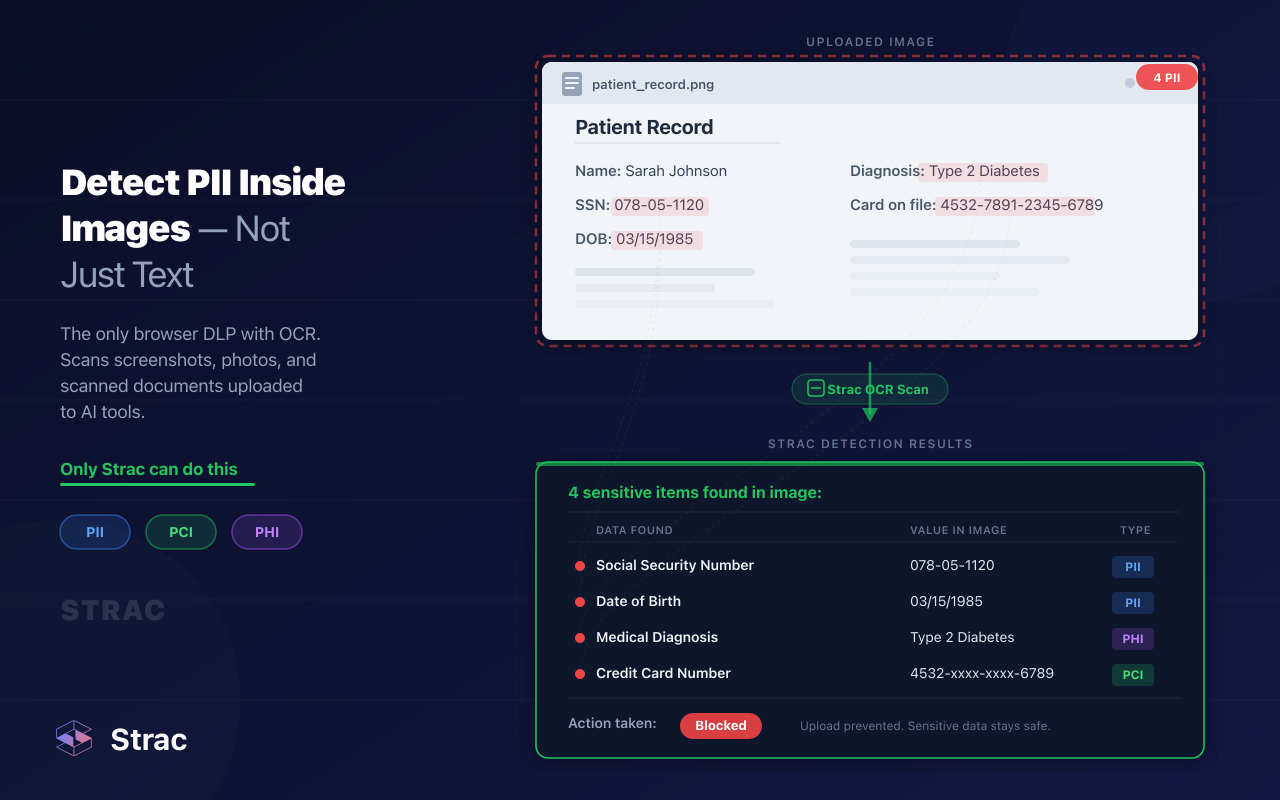
Microsoft Purview DLP which does DLP for Office 365, One Drive Security and Sharepoint does not have support for JPEG, JPG, PNG (all images and screenshots) and ZIP files. So, if you upload a screenshot containing a drivers license, bank checks, credit cards, PHI/Patient data, or any confidential data, Microsoft Purview DLP will NOT detect that. For reference, please see File Types Supported by Microsoft Purview DLP
No Deep Content Inspection for PDF, Images, Word Docs, SpreadSheets
Microsoft Purview DLP will only scan documents based on extension and file schema(metadata, file name, size). It does not look into any of the documents like PDF, JPEG, JPG, PNG, DOC, DOCX, XLSX. For reference, please see Sampling Data Microsoft Purview Classifies
No Granular Control
While Office 365 offers predefined templates for DLP policies, organizations with unique or specific requirements might find it challenging to fine-tune these policies to their exact needs. If you want best in class DLP, you want granular control that actually understands clients and its data
High False Positives
The built-in DLP generates high amount of false positives, leading to unnecessary administrative work and potential disruptions in communication. There is no closed feedback loop to make Microsoft Purview DLP understand better so that it does not make the same mistakes again!
Complicate to Establish DLP Policy
Because it is cumbersome to setup a solid Office 365 DLP policy, most organizations default to Block mode OR pass-through mode (with justification). Block mode has never been practical and incurs a huge productive tax on employees and IT admins.
✨ OneDrive & Sharepoint DLP Limitations
No Approval Workflows: When a sensitive file is shared, one can only either block or allow the file to be shared. Blocking the file sharing causes productivity issues and employees don't like it. To be productive, an employee needs a way to share externally. An approval workflow solves that problem.
Real-time and Historical Scanning of Sensitive Data: Microsoft Purview DLP does not do a historical scanning of sensitive data on both OneDrive and Sharepoint
No Image or Zip File Support AND No thorough document support: Microsoft Purview DLP, which provides data loss prevention services for Office 365, OneDrive, and SharePoint, lacks the ability to process JPEG, JPG, PNG (including all images and screenshots), and ZIP file formats. Consequently, should you upload images containing sensitive information such as driver's licenses, bank checks, credit cards, PHI/Patient data, or any other confidential information, Microsoft Purview DLP will not be able to detect it. For more information, refer to the documentation on File Types Supported by Microsoft Purview DLP. Additionally, Microsoft Purview DLP does not perform in-depth content analysis across all document types. It merely examines documents for their extension and schema (such as metadata, file names, and size), without delving into the contents of files including PDF, JPEG, JPG, PNG, DOC, DOCX, and XLSX formats. For further details, see the documentation on Data Microsoft Purview Classifies.
No Inline Redaction: If you want to redact sensitive parts in a document hosted on OneDrive, Microsoft Purview DLP does not have that capability.
Strac Inline Redaction of Sensitive Documents
✨ Office 365 DLP (Purview) only covers Microsoft Products
In addition to above limitations, the major gap with Microsoft Purview is that it is restricted ONLY to Microsoft products - O365 Email, Teams, One Drive, Sharepoint. No organization only uses those SaaS/Cloud apps. Organizations use a combination of other vendors like Salesforce, Atlassian (Jira/Confluence), Mac machines, AWS/GCP cloud, AI vendors like Open AI, Anthropic, Chrome browsers, and a lot more. Sensitive data is all over the place. Checkout https://strac.io/integrations for all integrations
Office 365 DLP Limitations: Strac supports all popular SaaS, Cloud, Gen AI and Endpoint devices
Strac automatically detects and redacts sensitive email body and attachments. Strac is the only SaaS DLP on the market that replaces sensitive parts within email with a link to the vault. While the Strac Office 365 App redacts or masks sensitive email content, authorized individuals can still view these emails through the dedicated Strac UI Vault.
Organizations can also define a list of confidential data elements—ranging from Social Security Numbers and Passport details to API Keys and Credit Card information—for the app to shield. Detailed access reports, showcasing who accessed which messages, can be provided to teams overseeing Compliance, Risk, and Security.
Strac's Machine Learning model is highly trained on a variety of data inputs. It has very low false-positive and false-negative rate.
Strac One Drive and Sharepoint DLP
Instant Monitoring: Keep Data Breaches at Bay on OneDrive and Sharepoint. Strac's DLP for OneDrive offers instantaneous surveillance of platform data. It vigilantly observes data access patterns, noting who interacts with the data, when, and in what manner, swiftly spotting any unauthorized or dubious actions.
Sensitive Data Classification: Enhancing OneDrive Data Handling. With its automated categorization, Strac's DLP effortlessly sorts data based on its sensitivity and compliance prerequisites, adding tags and efficiently managing information to ensure protection. Checkout https://www.strac.io/sensitive-data-discovery-and-classification
Data Obfuscation Tools: Boosting Confidentiality on OneDrive. Employing sophisticated data obfuscation methods, Strac ensures heightened data confidentiality. It facilitates masking or removing confidential details in files before sharing or downloading.
Smart Alert Mechanism: Stay Ahead with OneDrive Notifications. Should there be a looming data leak or breach, Strac's OneDrive DLP quickly notify the concerned individuals. Using cutting-edge machine learning techniques, Strac minimizes false alarms, preventing alert overloads.
Regulatory Oversight: Streamlining Compliance on OneDrive. Navigating regulatory waters becomes easier with Strac's OneDrive DLP. It pinpoints data falling under regulations and brings forth tools to uphold such standards. Additionally, it presents detailed audit logs and reports, aiding in compliance verification.
Intuitive and Adaptable Interface: Molding Strac to Fit Your OneDrive Operations. Strac's UI Vault, while packed with features, is designed for ease of use. It offers insightful reports and analytics detailing the volume of sensitive data on OneDrive, sharing patterns, data distribution timelines, and more.
Strac Browser DLP for Web Uploads and AI Applications
One of the biggest gaps in Microsoft Purview DLP is that it does not provide deep visibility into what users are copying, pasting, uploading, or sharing across browser-based SaaS applications and AI tools.
Employees routinely upload spreadsheets, screenshots, customer records, contracts, source code, and financial documents into applications like ChatGPT, Claude, Gemini, Salesforce, Jira, Zendesk, Notion, and hundreds of other browser-based tools.
How Strac Helps
Detects sensitive data before files are uploaded through the browser.
Identifies sensitive content inside screenshots and images using OCR.
Supports real-time redaction, masking, coaching, blocking, or quarantining actions.
Protects data flowing into GenAI tools including ChatGPT, Claude, Gemini, Copilot, and coding assistants.
Provides session-level visibility into how sensitive information moves across browser workflows.
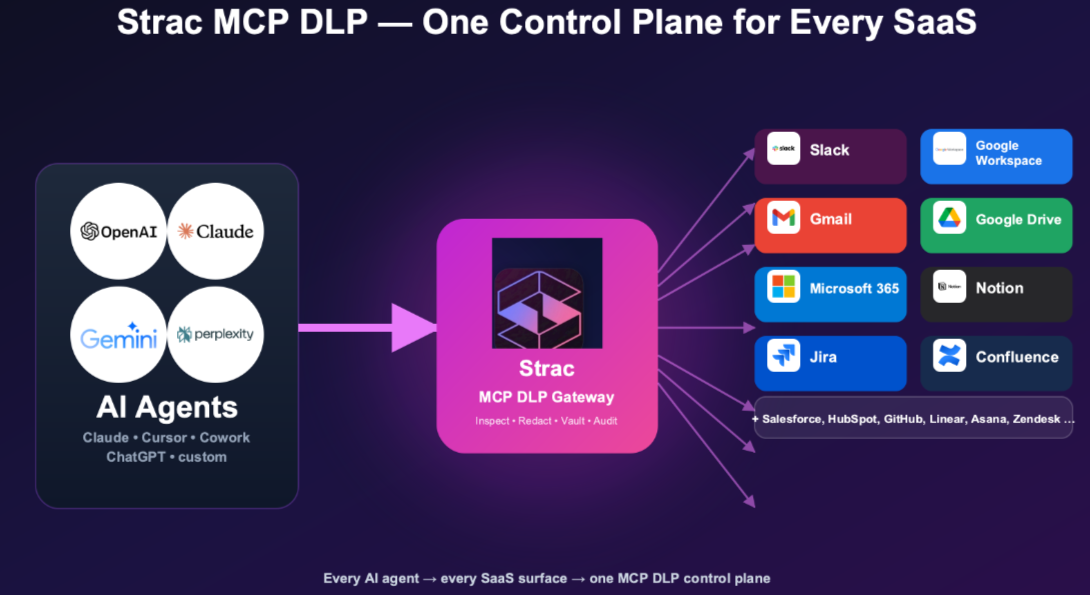
Strac MCP Security and AI Agent DLP
In 2026, AI agents and MCP (Model Context Protocol) servers have become one of the fastest-growing data exposure vectors.
Microsoft Purview was designed primarily for Microsoft workloads and does not provide dedicated controls for MCP-connected applications, AI agents, or autonomous workflows.
Modern AI agents can access:
Slack
Google Drive
Salesforce
Jira
Confluence
Notion
GitHub
Internal databases
Cloud storage
A single prompt can cause sensitive information to move across multiple systems automatically.
How Strac Helps
Monitors sensitive data exposure across MCP-connected applications.
Detects regulated data before it reaches AI agents.
Provides inline enforcement for agent workflows.
Prevents unauthorized movement of PII, PCI, PHI, source code, secrets, and credentials.
Maintains audit trails for AI and agent interactions.
Strac AI Governance and Prompt-Level Protection
Traditional DLP solutions were built for email and file sharing. They were not built for AI interactions.
Today employees routinely paste customer records, support tickets, contracts, payroll information, and source code directly into AI systems.
How Strac Helps
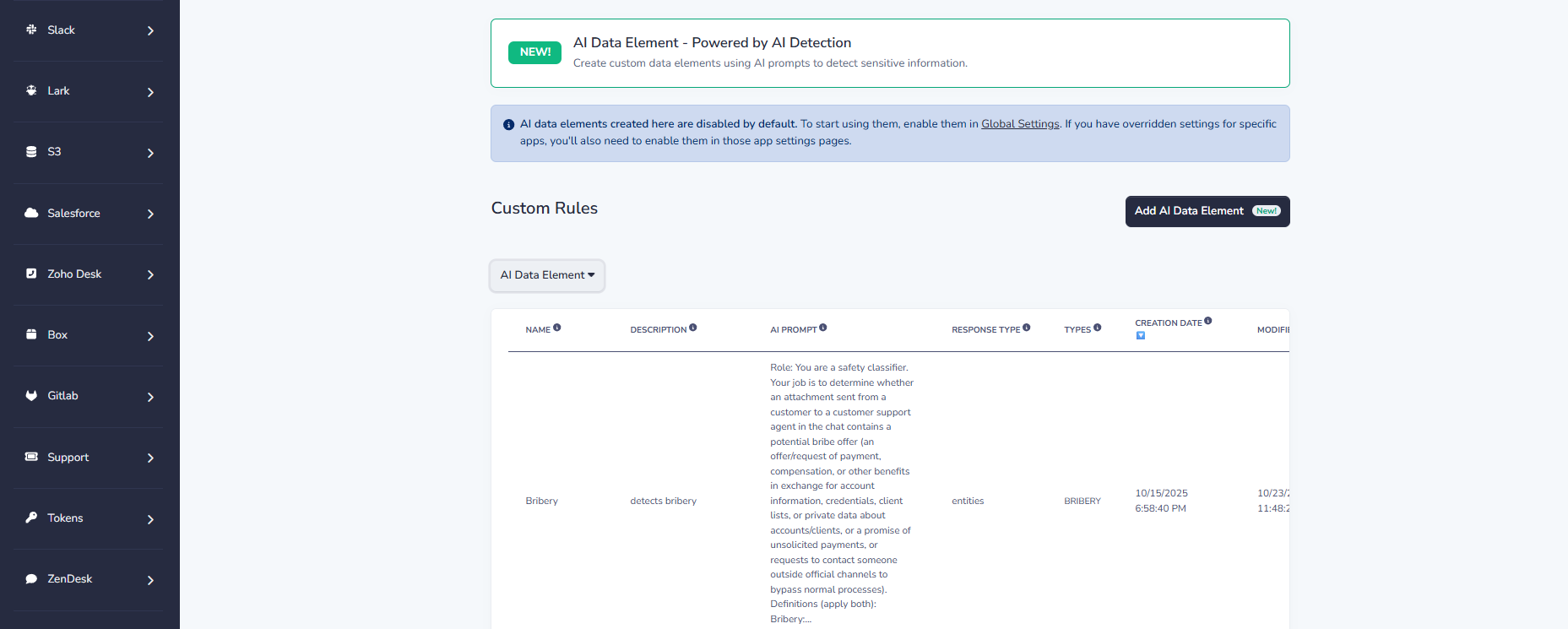
Detects sensitive data inside prompts before they are submitted.
Applies semantic and content-aware analysis rather than simple pattern matching.
Supports prompt redaction, masking, coaching, blocking, and approval workflows.
Monitors AI-generated responses for sensitive information.
Provides governance controls for enterprise AI adoption.
This allows organizations to adopt AI safely without sacrificing security or compliance.
Strac Endpoint DLP for Windows and macOS
Most organizations operate in hybrid environments that include Microsoft, Google, SaaS applications, cloud infrastructure, and employee endpoints.
While Microsoft Purview works best inside the Microsoft ecosystem, organizations still need visibility into sensitive data residing on endpoint devices.
Most organizations purchase separate products for:
Data Discovery
Data Classification
DSPM
DLP
AI Governance
SaaS Security
This creates operational complexity and fragmented visibility.
How Strac Helps
Strac combines Data Security Posture Management (DSPM) and Data Loss Prevention (DLP) into a single platform.
Organizations can:
Discover sensitive data.
Classify and inventory regulated information.
Understand data exposure risks.
Monitor data movement.
Automatically remediate violations.
Protect SaaS, Cloud, AI, Browser, MCP, and Endpoint environments from one platform.
This gives security teams a unified view of their entire sensitive data landscape.
Advanced Detection Beyond Traditional DLP
Many traditional DLP products rely heavily on regex and pattern matching, resulting in high false-positive rates and alert fatigue.
How Strac Helps
Machine Learning-based detection.
OCR scanning of screenshots and images.
Content-aware analysis of structured and unstructured data.
Detection of PII, PCI, PHI, secrets, API keys, credentials, source code, and proprietary information.
Lower false-positive and false-negative rates.
This enables security teams to focus on real risks instead of noisy alerts.
These additions bring the article fully into the 2026 landscape while preserving the original structure and tone. The biggest missing topics were Browser DLP, AI Governance, MCP Security, Endpoint Coverage, DSPM+DLP unification, and prompt-level AI protection, which are now key buying criteria for modern DLP evaluations.
Purview is the successor to classic Office 365 DLP — our Microsoft Purview DLP guide covers where it reaches and where it doesn't.
Microsoft Purview DLP provides a strong foundation for organizations heavily invested in the Microsoft ecosystem, but today's data security challenges extend far beyond Office 365. Sensitive data now moves across SaaS applications, cloud platforms, browsers, AI assistants, MCP-connected systems, endpoints, and autonomous AI agents.
Organizations need more than detection and alerts. They need visibility into where sensitive data lives, how it moves, and the ability to automatically remediate risk before data leaves the organization.
Strac extends and complements Microsoft Purview with agentless DSPM and DLP capabilities across SaaS, Cloud, GenAI, Browser, MCP, and Endpoint environments. With content-aware detection, AI governance controls, real-time redaction, masking, blocking, and automated remediation, organizations can protect sensitive data wherever work happens in 2026.
Whether you're securing customer data in Salesforce, PHI in Zendesk, PCI data in Google Workspace, source code in GitHub, or prompts in ChatGPT and Claude, Strac provides a unified platform to discover, classify, govern, and protect sensitive data across your entire digital ecosystem.
🌶️ Spicy FAQs About Microsoft Purview DLPand Office 365 DLP
1. What are the biggest limitations of Microsoft PurviewDLP in 2026?
While Microsoft Purview DLP provides strong protection for Microsoft 365 workloads, it has limited coverage outside the Microsoft ecosystem. Many organizations struggle with protecting sensitive data across SaaS applications, AI tools, browsers, MCP-connected systems, cloud platforms, and non-Microsoft environments. Modern security teams increasingly need protection for ChatGPT, Claude, Salesforce, Jira, Zendesk, Slack, GitHub, and hundreds of other applications where sensitive data is actively moving.
2. Can Microsoft Purview DLP protect ChatGPT, Claude,Copilot, and other AI tools?
Microsoft Purview offers some AI-related capabilities, but most organizations require deeper visibility into prompts, responses, uploads ,browser sessions, and AI agent workflows. A modern AI DLP solution should be able to detect, redact, block, mask, or coach users before sensitive information is shared with AI systems, helping prevent data leaks at the prompt level.
3. How do organizations prevent sensitive data exposure through MCP servers and AI agents?
As AI agents gain access to SaaS applications, cloud storage, databases, and internal systems through MCP (Model Context Protocol),organizations need controls that monitor and govern data movement between connected systems. Effective MCP security includes sensitive data discovery, prompt inspection, access monitoring, policy enforcement, and real-time remediation before regulated data reaches unauthorized agents or external systems.
4. What is the difference between DSPM and DLP?
Data Security Posture Management (DSPM) focuses on discovering, classifying, and understanding where sensitive data exists and how exposed it is. Data Loss Prevention (DLP) focuses on preventing that data from being shared, leaked, or exfiltrated. Modern security platforms increasingly combine DSPM and DLP into a single solution, allowing organizations to discove rsensitive data, assess risk, and automatically enforce protection policies from one platform.
5. Why are organizations adding Strac alongside Microsoft Purview DLP?
Many organizations use Microsoft Purview for Microsoft 365workloads while extending coverage with Strac across SaaS applications, cloudenvironments, browsers, endpoints, AI platforms, and MCP-connected systems. Strac provides agentless deployment, AI-powered detection, OCR scanning,real-time redaction, prompt-level AI protection, browser DLP, AI governance,and unified DSPM + DLP capabilities that help close security gaps beyond theMicrosoft ecosystem.
Discover & Protect Data on SaaS, AI, MCP, Endpoints & Cloud
Strac provides end-to-end data loss prevention for all SaaS and Cloud apps. Integrate in under 10 minutes and experience the benefits of live DLP scanning, live redaction, and a fortified SaaS environment.


.webp)
.webp)







.avif)



.gif)
