Comprehensive Guide to Data Loss Prevention Policies
Learn how to build a modern Data Loss Prevention (DLP) policy for 2026. Discover best practices for protecting sensitive data across SaaS, cloud, AI, browsers, endpoints, and MCP while simplifying compliance with PCI DSS, HIPAA, GDPR, and more.
· A modern Data Loss Prevention (DLP) policyshould protect sensitive data across SaaS applications, cloud storage, AItools, browsers, endpoints, and MCP-connected systems—not just email and fileservers.
· Effective DLP policies combine data discovery,classification, continuous monitoring, and automated remediation to preventdata leaks before they become security incidents.
· AI adoption introduces new risks that requirepolicies covering prompt protection, AI governance, and sensitive data controlsfor tools like ChatGPT, Claude, Microsoft Copilot, and Gemini.
· Compliance frameworks such as PCI DSS 4.0,HIPAA, GDPR, SOC 2, ISO 27001, and CCPA increasingly expect organizations todemonstrate continuous protection of sensitive data.
· Modern platforms like Strac combine DSPM and DLPto automatically discover, classify, monitor, and remediate sensitive dataacross your entire SaaS and AI ecosystem.
Every organization has security policies.
Unfortunately, many of them were written for a world that no longer exists.
Five years ago, protecting sensitive data mostly meant securing laptops, email servers, and shared network drives. Today, employees work across dozens of SaaS applications, collaborate in Slack and Microsoft Teams, upload files to Google Drive and Box, interact with AI assistants like ChatGPT and Claude, and increasingly connect business systems through Model Context Protocol (MCP) servers.
Sensitive information is no longer stored in one place. It moves continuously between people, applications, AI models, browsers, cloud platforms, and endpoints.
That's why a modern Data Loss Prevention (DLP) policy needs to be more than a compliance document. It should define how your organization continuously discovers, classifies, monitors, and automatically protects sensitive information wherever it lives.
In this guide, you'll learn what a modern DLP policy should include, why traditional approaches fall short, and the best practices organizations are adopting in 2026 to reduce security risks and simplify compliance.
What Is a Data Loss Prevention (DLP) Policy?
A Data Loss Prevention (DLP) policy is a set of security rules, processes, and technical controls that define how an organization protects sensitive information from unauthorized access, exposure, or misuse.
The goal is simple: ensure confidential data only reaches the people and systems that are authorized to access it.
A strong DLP policy typically defines:
What types of sensitive data exist
Where that data is allowed to be stored
Who can access it
How it can be shared
What happens when policy violations occur
How incidents are detected and remediated
Unlike traditional security policies that focused mainly on endpoints or network traffic, modern DDLP policies extend protection across every environment where business data flows, including:
SaaS applications
Cloud storage
Customer support platforms
CRM systems
Collaboration tools
Developer environments
Browsers
AI assistants
MCP-connected applications
Endpoints and servers
Without a comprehensive policy, organizations often rely on manual reviews, employee training, or reactive investigations after sensitive data has already been exposed.
Why Traditional DLP Policies No Longer Work
Many organizations still rely on DLP policies designed around perimeter security.
These policies assume that data stays inside corporate networks, employees primarily use email, and IT teams have visibility into every system containing sensitive information.
None of those assumptions hold true today.
Employees routinely move data between applications throughout the workday. A customer support representative may copy personal information from Salesforce into Slack. A developer might accidentally upload API keys into GitHub. A marketing employee could paste customer information into ChatGPT to generate personalized content.
None of these actions are necessarily malicious—but each introduces risk.
Modern organizations also face an explosion of disconnected SaaS applications. Finance teams use NetSuite. Sales teams work in Salesforce. Support teams rely on Zendesk or Intercom. HR stores employee records in Workday. Engineering collaborates in Jira and GitHub.
Each platform becomes another location where sensitive information can accumulate.
Traditional DLP solutions often focus on detection alone, generating alerts after data has already been exposed. Security teams quickly become overwhelmed by false positives and manual investigations.
Today's DLP policies must shift from reactive detection to proactive protection through continuous visibility and automated remediation.
✨ What Every Modern DLP Policy Should Include
A DLP policy is only as effective as the controls behind it.
Rather than relying on manual processes or static rules, modern organizations combine governance with automation to reduce risk while allowing employees to work efficiently.
Here are the essential components every modern DLP policy should include.
1. Continuous Sensitive Data Discovery
You can't protect data you don't know exists.
The first objective of any DLP policy should be continuously discovering sensitive information across the organization's entire technology stack.
This includes identifying regulated and business-critical data such as:
Personally Identifiable Information (PII)
Protected Health Information (PHI)
Payment Card Information (PCI)
Financial records
Customer databases
API keys and secrets
Source code
Intellectual property
Contracts
Legal documents
Discovery should extend beyond traditional storage systems into SaaS applications, cloud platforms, file repositories, AI conversations, browsers, endpoints, and collaboration tools.
Continuous discovery also helps security teams understand where sensitive information is accumulating and whether it exists in locations where it shouldn't.
2. Intelligent Data Classification
Once sensitive information is discovered, it should be classified according to business impact and regulatory requirements.
Traditional labels like "Confidential" or "Internal Use Only" are no longer sufficient.
Modern classification policies identify data according to regulatory frameworks and business context, including:
PCI DSS payment data
HIPAA health information
GDPR personal data
CCPA consumer information
Financial documents
Intellectual property
Authentication secrets
AI training data
Source code
Customer records
Accurate classification enables organizations to apply different protection rules depending on the sensitivity of the information rather than applying the same controls to every file or message.
3. Real-Time Monitoring Across Every Data Flow
Modern DLP policies should monitor sensitive information wherever it moves—not just where it's stored.
That includes monitoring data:
Shared through Slack or Microsoft Teams
Uploaded into Google Drive, Box, Dropbox, or SharePoint
Added to Salesforce, Zendesk, Jira, or ServiceNow
Sent through email
Uploaded through web browsers
Shared with AI assistants
Attached to support tickets
Stored in cloud databases
Transferred through APIs
Continuous monitoring allows organizations to detect risky behavior as it happens instead of discovering it days or weeks later during an audit.
The objective isn't to monitor employees. It's to identify sensitive data before it leaves approved environments or becomes exposed to unauthorized users.
4. Automated Remediation Instead of Manual Response
One of the biggest shortcomings of traditional DLP programs is that they generate alerts without preventing the actual data leak.
By the time a security analyst investigates the alert, the sensitive information has often already been copied, shared, or downloaded.
Modern DLP policies should define automated remediation actions that immediately reduce risk.
Depending on the situation, those actions may include:
Automatically redacting sensitive information
Masking confidential fields
Blocking unauthorized sharing
Encrypting sensitive content
Quarantining files
Removing exposed secrets
Deleting unauthorized copies
Coaching users before they submit sensitive information
Alerting security teams when human review is required
Automated remediation dramatically reduces incident response time while minimizing the operational burden placed on security teams.
Rather than asking analysts to manually clean up every policy violation, organizations can automatically enforce protection at the moment sensitive data is detected.
5. AI & MCP Protection Must Be Part of Every Modern DLP Policy
Generative AI has fundamentally changed how sensitive information moves inside organizations.
Employees now use ChatGPT, Claude, Microsoft Copilot, Gemini, Cursor, GitHub Copilot, and other AI assistants to summarize documents, write code, analyze customer information, and automate everyday work. At the same time, Model Context Protocol (MCP) is enabling AI agents to connect directly to business systems such as CRMs, ticketing platforms, cloud storage, and databases.
While these technologies improve productivity, they also introduce entirely new data leakage risks.
A customer record pasted into ChatGPT, an API key shared with an AI coding assistant, or an MCP server exposing sensitive database records can all create compliance and security issues if proper controls are not in place.
A modern DLP policy should clearly define:
Which AI tools employees are permitted to use
What types of data can never be shared with AI models
Rules for protecting prompts and AI-generated responses
Monitoring requirements for AI conversations
Governance for MCP-connected applications and AI agents
Automated remediation when sensitive information is detected
Rather than blocking AI adoption, organizations should build policies that enable employees to safely use AI while preventing accidental exposure of regulated or confidential data.
Common Data Loss Risks Your DLP Policy Should Address
Every organization has unique workflows, but the most common causes of data loss are surprisingly similar.
A modern DLP policy should anticipate these risks before they become security incidents.
Sensitive Data Shared in Collaboration Platforms
Employees frequently exchange customer information through Slack, Microsoft Teams, or other messaging platforms.
Examples include:
Customer addresses
Passport numbers
Social Security Numbers
Payment card details
Medical information
Without automated protection, this information can remain accessible to hundreds of users long after the conversation ends.
Customer Data Uploaded to AI Assistants
Generative AI has become one of the fastest-growing sources of accidental data exposure.
Common examples include:
Uploading spreadsheets containing customer information
Pasting contracts into AI chatbots
Sharing financial reports for summarization
Using proprietary source code for debugging
Asking AI to rewrite documents containing regulated data
Policies should clearly define acceptable AI usage while automatically detecting and removing sensitive information before it reaches external models.
Misconfigured Cloud Storage
Cloud storage platforms such as Google Drive, Microsoft SharePoint, Dropbox, Box, and OneDrive make collaboration simple, but they also increase the risk of accidental oversharing.
Examples include:
Public file-sharing links
Excessive user permissions
Storing regulated data in unsecured folders
Forgotten archives containing customer information
Continuous discovery helps identify these risks before attackers or unauthorized users find them.
Customer Support Platforms
Support teams often receive sensitive information they never intended to collect.
Customers routinely send:
Credit card numbers
Medical records
Identity documents
Tax forms
Passwords
Authentication codes
Rather than simply alerting security teams, modern DLP platforms can automatically redact sensitive information inside tickets while preserving the rest of the conversation.
Secrets and Credentials
API keys, authentication tokens, certificates, passwords, and cloud credentials remain one of the leading causes of modern security incidents.
These secrets frequently appear in:
Slack messages
Jira tickets
GitHub repositories
Documentation
AI conversations
Configuration files
A modern DLP policy should include controls for discovering, monitoring, and automatically remediating exposed secrets before they can be exploited.
🎥 Why Organizations Choose Strac for Modern DLP
Modern organizations need more than a traditional DLP solution that simply generates alerts after sensitive data has already been exposed.
Strac combines Data Security Posture Management (DSPM) and Data Loss Prevention (DLP) into a single platform that continuously discovers, classifies, monitors, and remediates sensitive information across modern business environments.
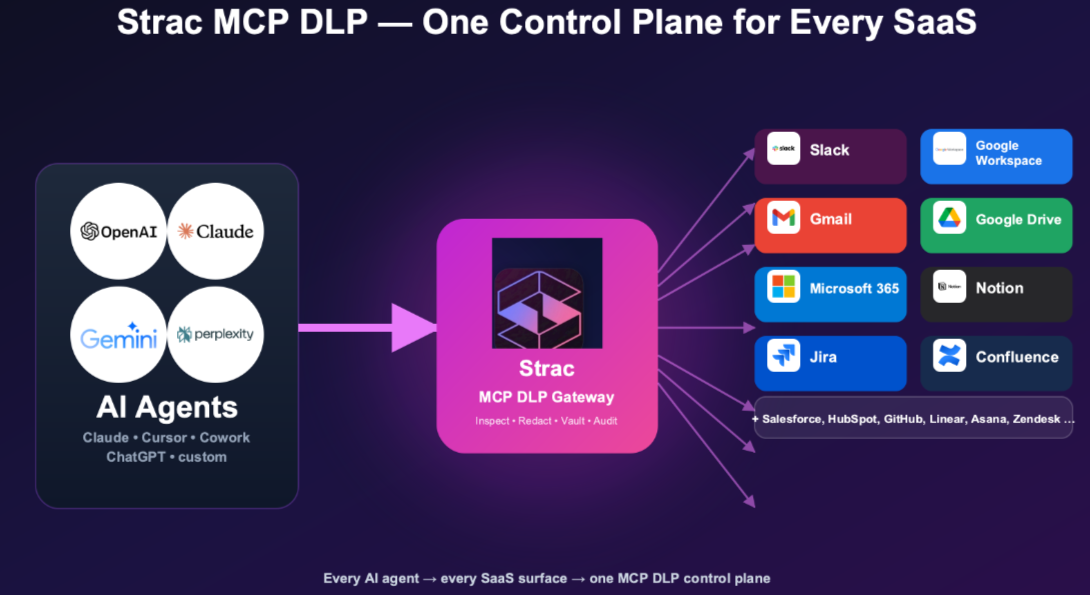
With support for SaaS applications, cloud platforms, endpoints, browsers, AI tools, APIs, and MCP-connected systems, Strac helps organizations secure sensitive data wherever it lives.
Key capabilities include:
Continuous sensitive data discovery across SaaS, cloud, AI, browsers, and endpoints
Agentless deployment with fast implementation
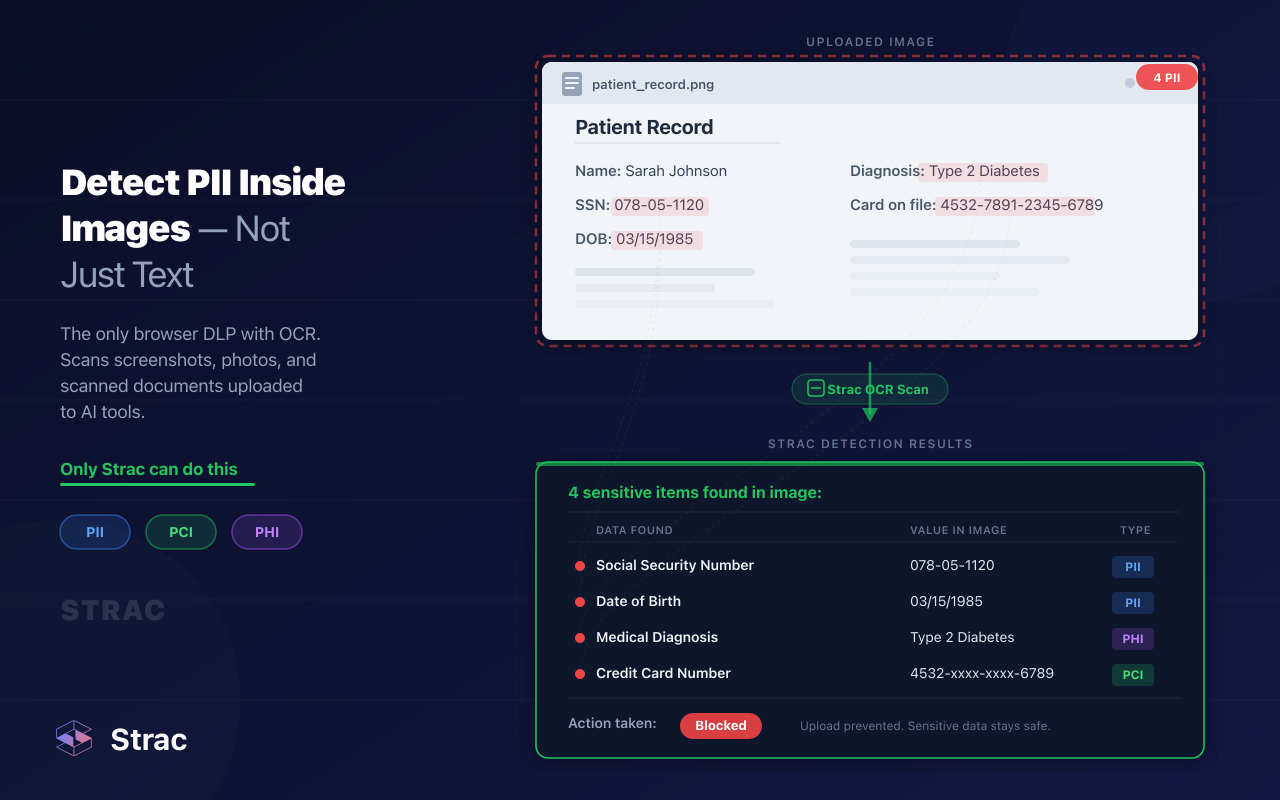
ML and OCR-powered detection for structured and unstructured data
Inline remediation through automatic redaction, masking, blocking, encryption, quarantine, and deletion
Built-in detection for PII, PHI, PCI, secrets, financial information, and intellectual property
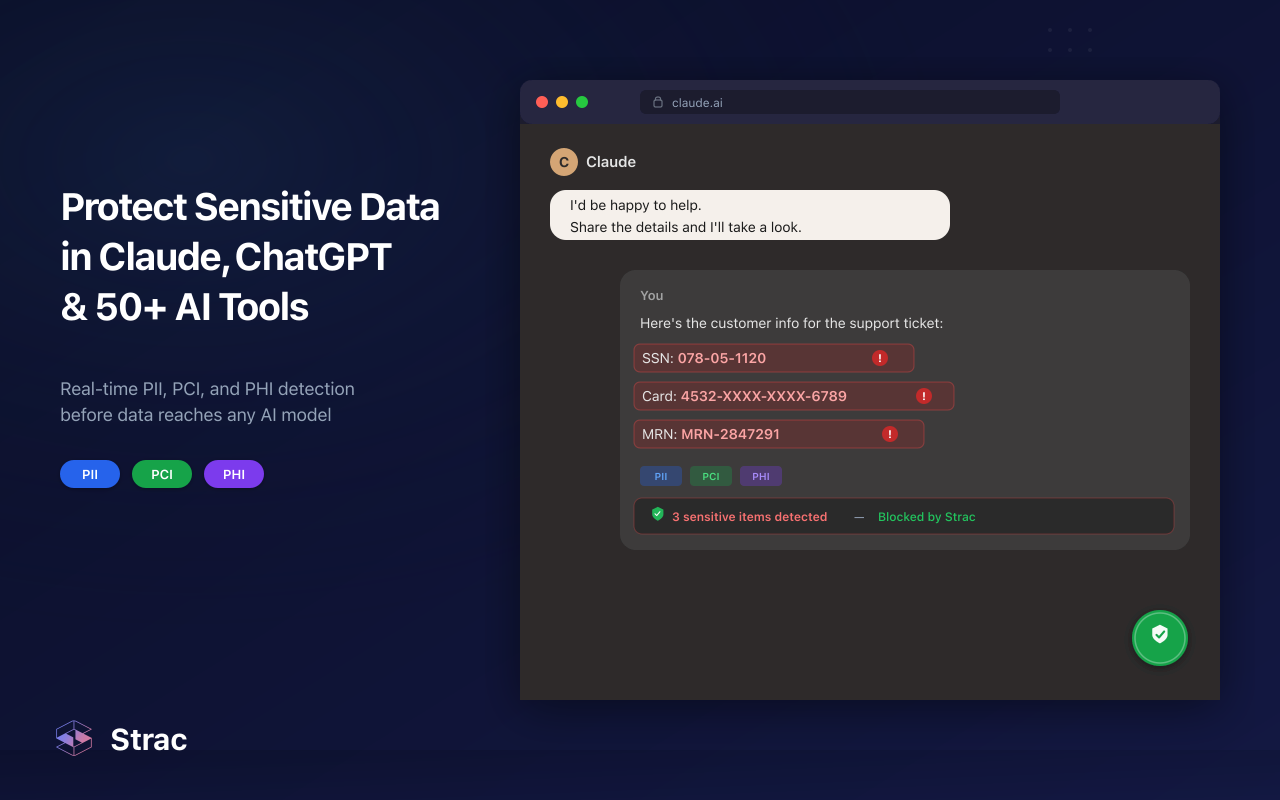
AI governance for ChatGPT, Claude, Microsoft Copilot, Gemini, and other AI applications
Compliance-ready controls supporting PCI DSS, HIPAA, GDPR, SOC 2, ISO 27001, CCPA, and NIST
Unified visibility across your entire data estate from a single platform
Rather than adding another disconnected security tool, Strac helps organizations simplify their data protection strategy while reducing compliance risk and operational complexity.
Bottom Line
A Data Loss Prevention policy is no longer just a document written for auditors.
It is the foundation for protecting sensitive information across today's distributed business environments, where data constantly moves between SaaS applications, cloud platforms, browsers, AI assistants, endpoints, and connected systems.
The organizations that succeed are those that combine clear governance with continuous data discovery, intelligent classification, real-time monitoring, and automated remediation.
By adopting a modern DLP strategy, businesses can reduce the risk of data breaches, simplify compliance, and confidently embrace AI and cloud technologies without compromising security.
🌶️ Spicy FAQs on DLP Poicies
1. What should a modern Data Loss Prevention (DLP) policy include?
A modern DLP policy should go beyond defining security rules. It should establish how sensitive data is continuously discovered, classified, monitored, and automatically remediated across SaaS applications, cloud storage, endpoints, browsers, AI tools, APIs, and MCP-connected systems. It should also define user responsibilities, approved storage locations, incident response procedures, and compliance requirements for regulations like PCI DSS, HIPAA, GDPR, and SOC 2.
2. How is a modern DLP policy different from a traditional one?
Traditional DLP policies were designed for on-premises networks, email, and file servers. Modern organizations operate across dozens of SaaS applications, AI assistants, cloud platforms, and remote devices where data is constantly moving.
A modern DLP policy focuses on continuous visibility, real-time monitoring, automated remediation, and AI governance rather than relying solely on manual reviews and security alerts.
3. Why should AI tools be included in a Data Loss Prevention policy?
Employees increasingly use AI tools such as ChatGPT, Claude, Microsoft Copilot, Gemini, and coding assistants to improve productivity. Without proper governance, they may accidentally expose customer information, financial records, source code, or regulated data.
A modern DLP policy should define which AI applications are approved, what data can be shared with AI models, and implement automated controls that detect and prevent sensitive information from being exposed.
4. What is the difference between DLP and DSPM?
Data Loss Prevention (DLP) focuses on preventing sensitive information from being exposed, shared, or leaked through monitoring and automated remediation.
Data Security Posture Management (DSPM) focuses on discovering, classifying, and assessing sensitive data across cloud environments, SaaS applications, and data stores.
Modern security platforms combine both capabilities, allowing organizations to discover sensitive information, understand their data exposure, and automatically protect it from unauthorized access.
5. How does Strac help organizations implement a modern DLP policy?
Strac combines DSPM and DLP into a single platform that continuously discovers, classifies, monitors, and remediates sensitive information across SaaS applications, cloud platforms, browsers, endpoints, AI tools, APIs, and MCP-connected systems.
Using ML and OCR-powered detection with automated actions like redaction, masking, blocking, encryption, quarantine, and deletion, Strac helps organizations reduce data leakage risks while simplifying compliance with PCI DSS, HIPAA, GDPR, SOC 2, ISO 27001, CCPA, and other security frameworks.
Discover & Protect Data on SaaS, AI, MCP, Endpoints & Cloud
Strac provides end-to-end data loss prevention for all SaaS and Cloud apps. Integrate in under 10 minutes and experience the benefits of live DLP scanning, live redaction, and a fortified SaaS environment.


.webp)









.avif)



.gif)
