SendGrid doesn't detect or redact sensitive data and won't sign a BAA. Add a DLP step to your send pipeline — detect and redact PII/PHI/PCI/secrets before sgMail.send(), with code examples.
SendGrid DLP means scanning and redacting sensitive data — PII, PHI, PCI, and secrets — out of transactional emails before they are sent through SendGrid.
SendGrid is a send API, not a data-protection tool: it does not detect or redact sensitive data, may store it long-term, and does not sign a BAA — so PHI in a SendGrid email is a HIPAA violation.
The fix is a DLP step in your send pipeline: call a redaction API on the email body and attachments beforesgMail.send().
Strac adds that step in a few lines — detecting 191 data element types and redacting, masking, or tokenizing them, with OCR on attachments and an option to vault-and-detokenize later.
✨ What Is SendGrid DLP?
SendGrid DLP (data loss prevention) is the practice of detecting and remediating sensitive data in the transactional emails your application sends through Twilio SendGrid — order confirmations, password resets, receipts, invoices, and support replies — so that regulated data never leaves your systems unprotected. SendGrid moves your email reliably, but it treats the content as opaque: it will happily transmit an SSN, a full credit card number, or a customer’s medical detail, store it in logs and event data, and expose it to anyone with access to your SendGrid account. DLP is the layer that inspects and cleans that content first.
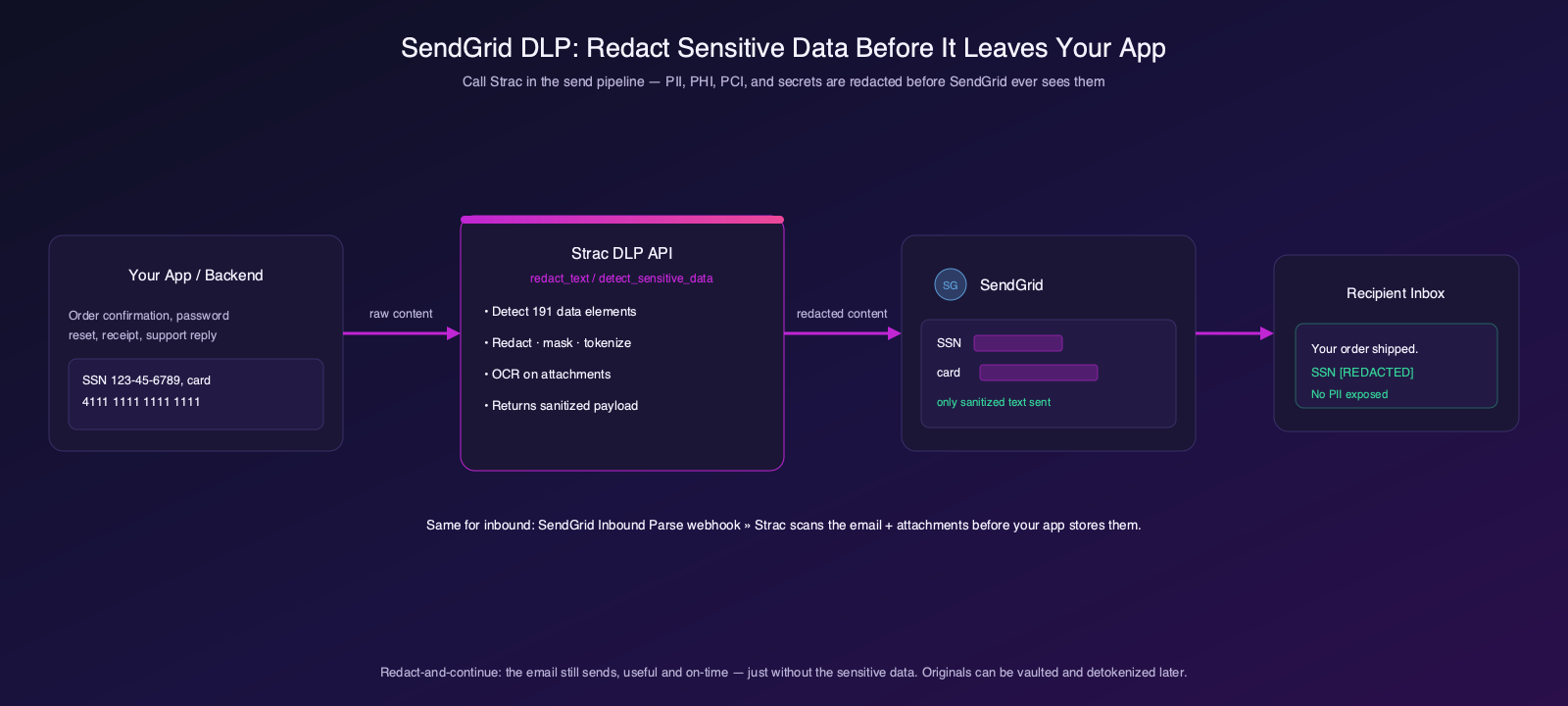
SendGrid DLP with Strac: your app calls the redaction API in the send pipeline, so PII, PHI, PCI, and secrets are redacted before SendGrid ever sees them.
Where Sensitive Data Leaks Through SendGrid
Transactional email is deceptively risky because the content is generated from user and account data. Common leak points:
Leak point
What ends up exposed
Email body
Order line items, account numbers, one-time reset tokens, SSNs or MRNs pasted into support replies
Attachments
Uploaded ID photos, invoices, statements, lab results — often unredacted images and PDFs
Custom args / substitutions
Names, emails, tokens SendGrid treats as non-PII, stores long-term, and cannot redact
Event & activity data
Recipient addresses and metadata retained and visible to SendGrid personnel
Inbound Parse
Replies and forwarded attachments that flow back into your app with fresh sensitive data
And the compliance floor is low: SendGrid will not sign a BAA and is not HIPAA compliant, so any PHI in a transactional email is a violation. PCI DSS requires you to render stored PAN unreadable — a card number in an email body fails that. This is exactly the gap a DLP step closes.
💻 The Fix: A DLP Step in Your Send Pipeline
The pattern is simple and battle-tested: before you hand content to SendGrid, pass it through a redaction API. If sensitive data is found, you send the sanitized version (and optionally vault the original). The email still goes out on time — just without the regulated data. Strac’s API does the detection and remediation; here is what that looks like in practice.
SendGrid DLP in Node.js with Strac
Add one call to Strac’s redact_text before sgMail.send(). Get your API key and endpoint from docs.strac.io.
import sgMail from "@sendgrid/mail";

sgMail.setApiKey(process.env.SENDGRID_API_KEY);

// Redact sensitive data with Strac before sending
async function stracRedact(text) {
  const res = await fetch(`${process.env.STRAC_API_BASE}/redact_text`, {
    method: "POST",
    headers: {
      "X-Api-Key": process.env.STRAC_API_KEY,   // sk_live_... or sk_test_...
      "Content-Type": "application/json",
    },
    body: JSON.stringify({ text, redact_field_mode: "REDACTED" }),
  });
  return res.json(); // { redacted_text, detection_count, data_element_types, detections }
}

async function sendSafeEmail(to, subject, rawHtml) {
  const { redacted_text, detection_count, data_element_types } = await stracRedact(rawHtml);

  if (detection_count > 0) {
    console.log(`Strac redacted ${detection_count} items: ${data_element_types.join(", ")}`);
  }

  await sgMail.send({
    to,
    from: "noreply@yourapp.com",
    subject,
    html: redacted_text, // sanitized content only
  });
}
SendGrid DLP in Python
import os, requests
from sendgrid import SendGridAPIClient
from sendgrid.helpers.mail import Mail

def strac_redact(text: str) -> dict:
    r = requests.post(
        f"{os.environ['STRAC_API_BASE']}/redact_text",
        headers={"X-Api-Key": os.environ["STRAC_API_KEY"]},
        json={"text": text, "redact_field_mode": "REDACTED"},
        timeout=30,
    )
    r.raise_for_status()
    return r.json()

def send_safe_email(to, subject, raw_html):
    result = strac_redact(raw_html)
    if result["detection_count"]:
        print("Redacted:", result["data_element_types"])
    message = Mail(
        from_email="noreply@yourapp.com",
        to_emails=to,
        subject=subject,
        html_content=result["redacted_text"],  # sanitized
    )
    SendGridAPIClient(os.environ["SENDGRID_API_KEY"]).send(message)
That is the whole outbound pattern. Strac detects 191 built-in data element types — SSNs, PAN, CVV, bank accounts, driver licenses and passports for ~60 countries, API keys and tokens, and more — so you are not maintaining regex.
✨ Don’t Forget Attachments (OCR)
The riskiest transactional emails carry files: a customer uploads a driver’s license, you email a PDF invoice, support attaches a screenshot with an account number. Text redaction alone misses these. Strac’s detect_file / redact_file run OCR on images and PDFs and return a redacted copy — scan an attachment before you attach it.
# Scan/redact an attachment before sending it via SendGrid
result = requests.post(
    f"{os.environ['STRAC_API_BASE']}/detect_file",
    headers={"X-Api-Key": os.environ["STRAC_API_KEY"]},
    files={"file": open("uploaded_id.png", "rb")},
    timeout=60,
).json()

if result["detection_count"]:
    # block the attachment, or send a Strac-redacted copy instead
    raise ValueError(f"Attachment contains {result['data_element_types']} - not sending")
Strac’s redaction engine in action — the same detection and remediation that runs on your SendGrid content and attachments.
Redact vs. Tokenize: Keep the Email Useful
Sometimes you need the value later — a receipt should show the last four of a card, or support needs to resolve the full value on an authorized screen. Strac supports several remediation modes so the email stays useful without exposing raw data:
Mode
Output
Use it for
REDACTED
[REDACTED]
Default — strip the value entirely
MASK_SEVEN_X
XXXXXXX
Show a masked placeholder
BLANK
(removed)
Silently drop the value
TOKEN_LINK_PLAINTEXT
vault token
Tokenize now, detokenize later for authorized users
With tokenization, the email carries a safe token instead of the PAN or SSN; your authorized internal tools call detokenize to resolve it. That is how you keep transactional emails functional and still pass a PCI or HIPAA review.
Inbound Email: Scan the SendGrid Parse Webhook
Sensitive data also arrives inbound. If you use SendGrid’s Inbound Parse webhook to receive replies and forwarded attachments, run the same detection on the parsed payload before your app stores it — so a customer emailing you their SSN or a scanned document does not silently land in your database, help desk, or logs unprotected.
✨ Why Strac for SendGrid DLP
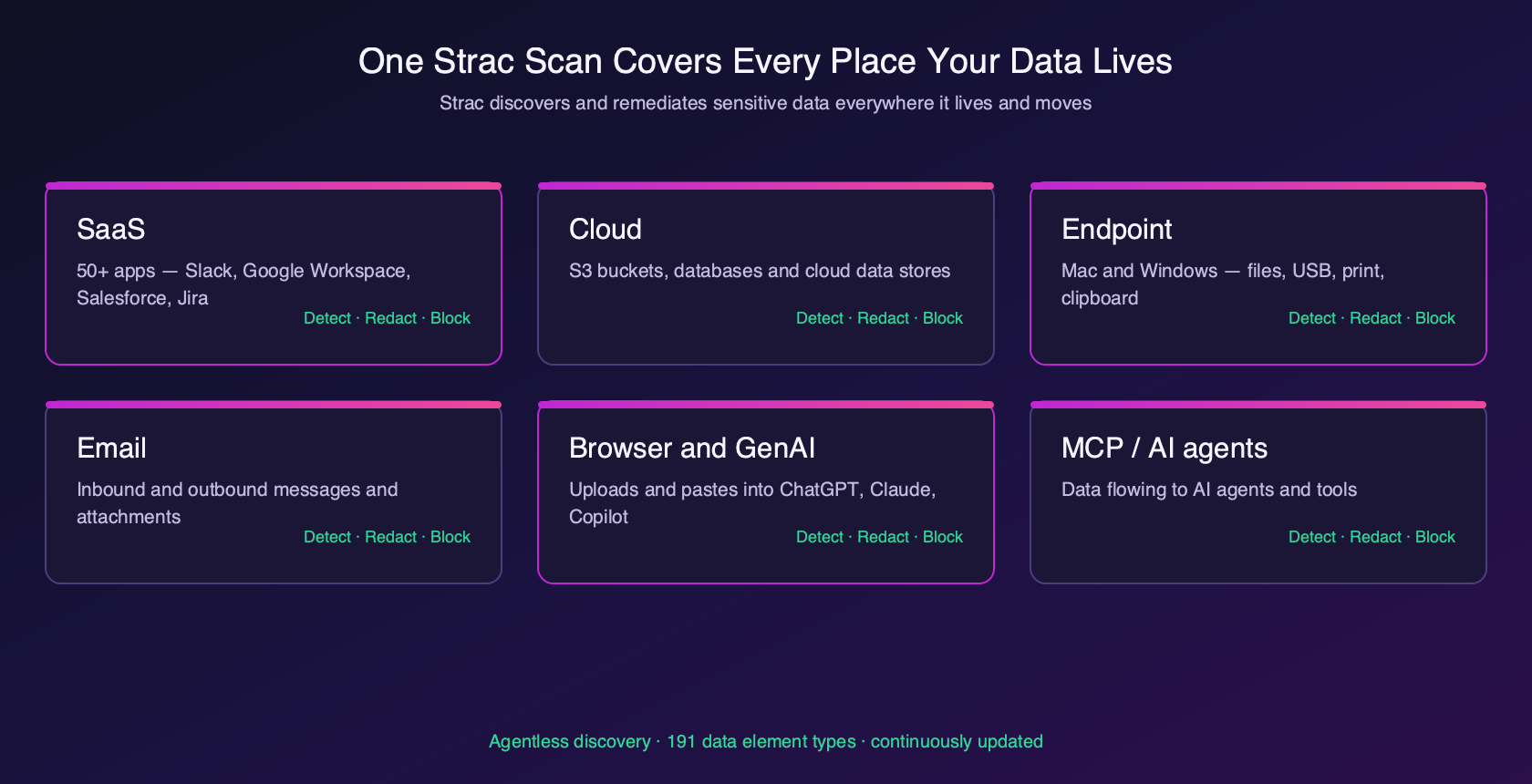
Detection alone is not enough — you have to act before the email sends. Strac remediates (redact, mask, block, tokenize), runs OCR on attachments, covers 191 data element types out of the box, and vaults originals for authorized retrieval. And the same API is one part of a platform that also covers email DLP, SaaS, cloud, browser/GenAI, and MCP DLP — so one policy protects data everywhere it moves, not just in SendGrid. Prefer to see the integration first? The open-source Strac MCP DLP server shows the exact API calls, built entirely on these endpoints.
Strac covers SendGrid and email alongside SaaS, cloud, endpoint, browser/GenAI, and MCP — one policy, one classifier.
How to Add SendGrid DLP: Checklist
Get a Strac API key and endpoint from docs.strac.io (use sk_test_ in staging).
Wrap sgMail.send() with a redact_text call on the HTML/text body.
Run detect_file / redact_file on every attachment before it is attached.
Choose a remediation mode — redact for most content, tokenize where you need the value back.
Add the same scan to your Inbound Parse webhook handler.
Keep the audit log of detections and remediations as PCI/HIPAA/GDPR evidence.
🌶️ Spicy FAQs for SendGrid DLP
Does SendGrid have built-in DLP?
No. SendGrid is a delivery API — it does not detect, redact, or block sensitive data in your email content or attachments. It can even store personal data you put in custom args long-term. DLP has to happen in your pipeline before you call SendGrid.
Is SendGrid HIPAA compliant?
No — Twilio SendGrid does not sign a BAA and is not HIPAA compliant, so PHI in a transactional email is a violation. Redact or tokenize PHI with Strac before it reaches SendGrid, or route it to a BAA-covered channel.
Can I send credit card numbers in a SendGrid email?
You should not — PCI DSS requires stored PAN to be unreadable, and an email body fails that. Use Strac to mask (show last four) or tokenize the card before sending.
Will adding DLP slow down my emails?
Barely — it is a single API call before send, and the email still goes out immediately with the sanitized content. Redact-and-continue means you never block a legitimate email, you just clean it.
Does this work for Twilio SMS, Mailgun, or SES too?
Yes — the pattern is identical for any transactional API. Call Strac’s redact/detect endpoints on the message body (and attachments) before you hand it to the provider.
Sending PHI in transactional email? See Is SendGrid HIPAA Compliant? — the answer is no, and here is the compliant fix.
Using Twilio SMS/Voice for PHI? See Is Twilio HIPAA Compliant? — yes, with a BAA, but SendGrid is excluded.
For the complete side-by-side breakdown of these three data types, see our guide to PII vs PHI vs PCI.
SendGrid delivers your email; it does not protect what is inside it. A single DLP step in your send pipeline — detect and redact before send(), OCR your attachments, tokenize what you need back — closes the PII, PHI, PCI, and secret exposure that transactional email creates. Strac makes that step a few lines of code across 191 data types. Book a demo or grab your API key at docs.strac.io.
Does SendGrid have built-in DLP?
No. SendGrid is a delivery API — it does not detect, redact, or block sensitive data in your email content or attachments. It can even store personal data you put in custom args long-term. DLP has to happen in your pipeline before you call SendGrid.
Is SendGrid HIPAA compliant?
No — Twilio SendGrid does not sign a BAA and is not HIPAA compliant, so PHI in a transactional email is a violation. Redact or tokenize PHI with Strac before it reaches SendGrid, or route it to a BAA-covered channel.
Can I send credit card numbers in a SendGrid email?
You should not — PCI DSS requires stored PAN to be unreadable, and an email body fails that. Use Strac to mask (show last four) or tokenize the card before sending.
Will adding DLP slow down my emails?
Barely — it is a single API call before send, and the email still goes out immediately with the sanitized content. Redact-and-continue means you never block a legitimate email, you just clean it.
Does this work for Twilio SMS, Mailgun, or SES too?
Yes — the pattern is identical for any transactional API. Call Strac’s redact/detect endpoints on the message body (and attachments) before you hand it to the provider.
Discover & Protect Data on SaaS, AI, MCP, Endpoints & Cloud
Strac provides end-to-end data loss prevention for all SaaS and Cloud apps. Integrate in under 10 minutes and experience the benefits of live DLP scanning, live redaction, and a fortified SaaS environment.


.webp)








.avif)


.gif)
