Calendar Icon White
June 20, 2026
Clock Icon
5
 min read

PCI DSS Data Classification Requirements Explained

Learn what PCI DSS data classification requirements mean, what auditors expect, and how to meet them with DSPM.

PCI DSS Data Classification Requirements Explained
ChatGPT
Perplexity
Grok
Google AI
Claude
Summarize and analyze this article with:

TL;DR

  1. PCI DSS data classification requirements exist to ensure organizations can clearly identify cardholder data, define accurate PCI scope, and apply the right controls based on real data presence; not assumptions.
  2. PCI DSS does not always state “data classification” explicitly, but it repeatedly requires data identification, scoping, and protection; making PCI DSS data classification an implied and foundational requirement for compliance.
  3. PCI DSS data discovery must come before classification, because organizations cannot classify or protect cardholder data they have not first located across systems, SaaS tools, cloud storage, and workflows.
  4. Auditors expect evidence, not theory; including documented policies, identified data locations, defensible scope decisions, and time-stamped proof that PCI data classification is maintained over time.
  5. Common PCI compliance mistakes include one-time classification efforts, unnecessary over-scoping, ignoring SaaS and GenAI tools, and relying on undocumented assumptions.
  6. DSPM strengthens PCI DSS compliance by providing continuous PCI data discovery, keeping classifications current as data moves, and generating audit-ready evidence that supports scope and control decisions.
  7. Using DSPM for PCI audit preparation reduces audit friction, validates PCI scope confidently, and helps teams maintain continuous PCI evidence in dynamic, SaaS-driven environments.

PCI DSS data classification requirements are a critical but often misunderstood part of achieving and maintaining PCI compliance. Many organizations struggle not because they lack security controls, but because they lack clear, defensible PCI DSS data classification that defines where cardholder data exists and how it should be protected.

As environments expand across SaaS platforms, cloud infrastructure, and automated workflows, understanding pci dss data classification, pci dss data discovery, and pci compliance data classification becomes essential for audit readiness. Auditors increasingly expect organizations to demonstrate not just documented intent, but continuous visibility into cardholder data locations, scope decisions, and evidence-backed controls. This guide explains what PCI DSS expects in practice, how auditors interpret those expectations, and how modern approaches help teams maintain compliance over time.

Why do PCI DSS data classification requirements exist

PCI DSS data classification requirements exist because cardholder data presents a uniquely high level of financial, legal, and reputational risk. PCI DSS is designed around the principle that organizations cannot protect what they do not clearly identify; without data classification, all downstream security and compliance controls become guesswork. For auditors, data classification is not a standalone task; it is the foundation that determines whether PCI scope, controls, and evidence are logically connected and defensible.

PCI DSS enforces data classification to support a risk-based approach to protecting cardholder data. Rather than applying controls uniformly across every system, PCI expects organizations to first distinguish cardholder data from non-sensitive business data. This distinction enables security teams to focus controls where they matter most and demonstrate intentional, informed decision-making during audits.

Key reasons PCI DSS requires data classification include:

  1. Enabling a risk-based security model PCI DSS data classification requirements ensure that cardholder data is identified and treated as higher risk than other data types. By classifying data correctly, organizations can apply stronger controls such as encryption, monitoring, and restricted access only where necessary. This reduces both security gaps and unnecessary operational burden.
  2. Defining and controlling PCI scope PCI compliance data classification is the primary mechanism for determining which systems, SaaS tools, cloud services, and workflows fall into PCI scope. Auditors rely on classification evidence to validate why certain systems are in scope and others are excluded. Without accurate classification, organizations either over-scope their environment or leave critical data flows unprotected.
  3. Reducing breach impact and audit exposure Proper PCI data classification limits the spread of cardholder data across environments. When sensitive data is identified early, it can be restricted, masked, or removed from systems that do not need it. This minimizes the blast radius of a breach and reduces the number of findings during PCI DSS audits.
  4. Acting as a prerequisite for PCI security controls Nearly all PCI controls depend on knowing where cardholder data exists. Encryption, access management, logging, retention, and monitoring policies cannot be enforced consistently without reliable data classification. From an auditor’s perspective, controls applied without clear classification are considered ineffective, even if they exist on paper.
  5. Supporting continuous compliance in modern environments PCI DSS data classification requirements are no longer satisfied by one-time inventories or static diagrams. SaaS adoption, cloud storage growth, and AI-driven workflows constantly introduce new data paths. Auditors increasingly expect organizations to demonstrate ongoing PCI DSS data discovery and classification rather than periodic manual reviews.

From a PCI compliance fundamentals standpoint, data classification is not about labeling data once and moving on. It is about establishing a repeatable, auditable process that continuously identifies cardholder data as environments evolve. Organizations that treat PCI DSS data classification as a living control; rather than a documentation exercise; are far better positioned to pass audits and reduce real-world risk.

Where PCI DSS Data Classification Requirements Appear in the Standard

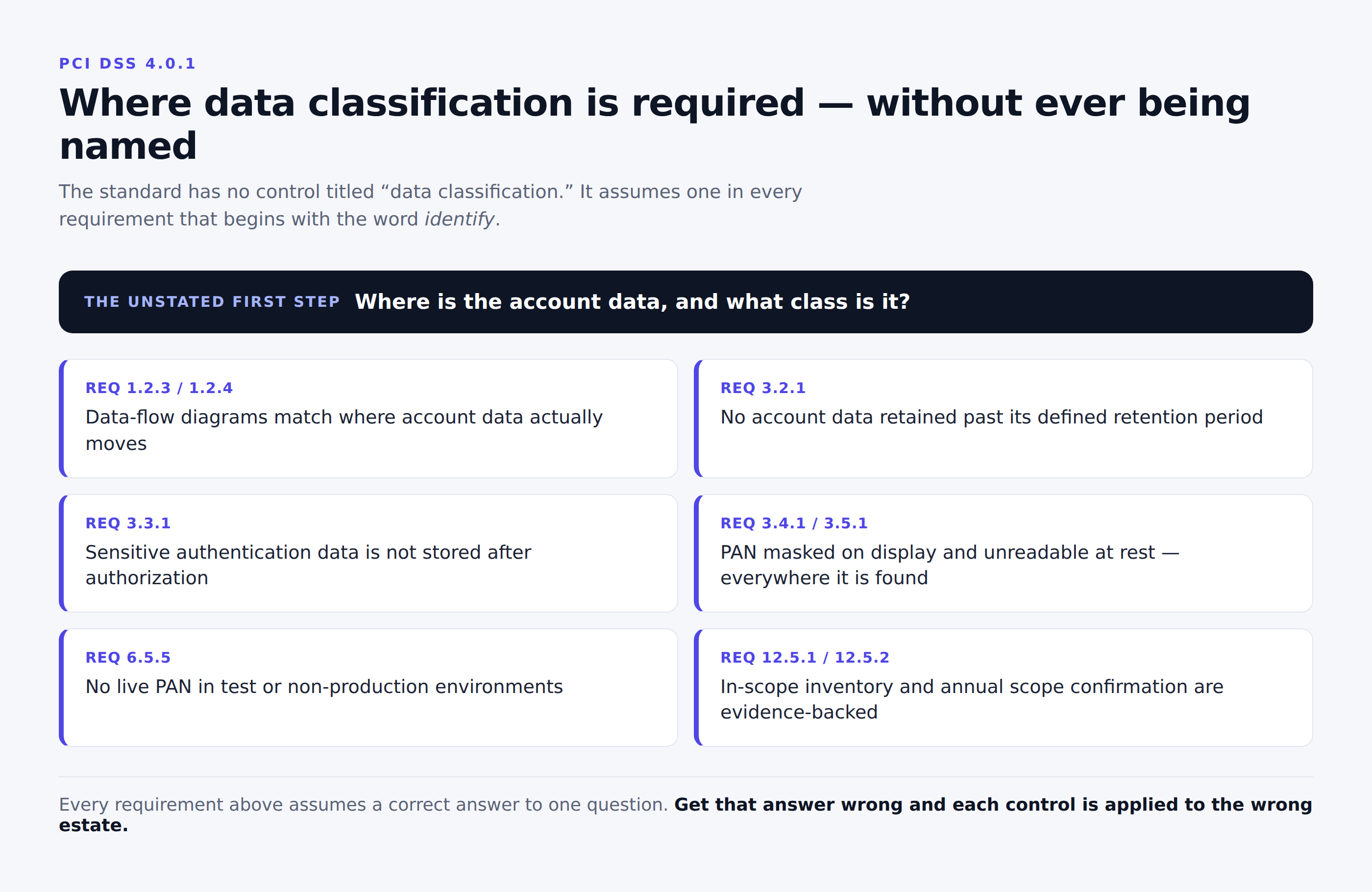
PCI DSS data classification requirements are not presented as a single standalone control with the label “data classification.” Instead, PCI DSS embeds classification expectations throughout the standard by repeatedly requiring organizations to identify, understand, and control cardholder data and its scope. Auditors interpret these references collectively; they expect organizations to demonstrate that they know where cardholder data exists, how it moves, and which systems must be protected as a result.

PCI DSS addresses data classification primarily through data identification and scoping language. The standard assumes that organizations can reliably distinguish cardholder data from non-sensitive data before applying controls. Without this distinction, PCI scope becomes arbitrary and difficult to defend during an audit.

Key ways PCI DSS data classification is addressed include:

Defining PCI scope through data presence

PCI DSS scope is determined by whether systems store, process, or transmit cardholder data. This implicitly requires organizations to classify data so they can prove which systems are in scope and which are not. Auditors often challenge scope decisions by asking how organizations verified the absence of cardholder data in excluded systems.

Requiring identification of cardholder data flows

Multiple PCI DSS requirements reference understanding how cardholder data enters, moves through, and exits the environment. Mapping these flows is impossible without PCI DSS data classification, as teams must first recognize which data elements qualify as cardholder data before documenting or validating flows.

Mandating protection of stored cardholder data

Requirements related to encryption, masking, and retention assume that organizations can identify stored cardholder data wherever it resides. PCI DSS data classification enables teams to locate sensitive data across databases, SaaS tools, file storage, and logs so that protection controls are applied consistently.

Supporting access control and monitoring requirements

PCI DSS limits access to cardholder data based on business need and requires monitoring of access to sensitive data. These controls rely on accurate classification; access rules and logs have little value if systems cannot reliably distinguish cardholder data from other information.

Validating scope reduction claims

PCI DSS allows organizations to reduce scope by eliminating or isolating cardholder data. Auditors expect classification evidence to support these claims, such as proof that certain SaaS platforms or cloud services do not contain cardholder data. Without PCI compliance data classification, scope reduction arguments are difficult to substantiate.

From an audit perspective, PCI DSS data classification is treated as an implied requirement that underpins multiple controls, rather than an optional best practice. Organizations that explicitly connect PCI DSS scope decisions to continuous data discovery and classification are far more likely to satisfy auditor scrutiny and avoid scope-related findings.

PCI DSS Data Discovery vs Data Classification

PCI DSS discovery vs classification is a distinction that matters greatly during audits, even though the standard does not explicitly separate the two. Auditors expect organizations to both find cardholder data and understand how it should be governed; treating these as the same activity often leads to gaps in scope and weak evidence. Data discovery and data classification are related, but they answer fundamentally different questions.

PCI DSS data discovery focuses on identifying where cardholder data exists across the environment. This includes databases, SaaS platforms, cloud storage, support tools, logs, and increasingly AI-driven workflows. Discovery establishes factual visibility and answers the question of presence; whether cardholder data exists in a given system at all. Without discovery, PCI scope decisions are speculative and difficult to defend.

PCI DSS data classification builds on discovery by assigning meaning and control requirements to the data that has been found. Classification determines whether discovered data qualifies as cardholder data, how sensitive it is, and which PCI controls must apply. This is what enables encryption, access restrictions, monitoring, and retention policies to be enforced consistently. From an audit perspective, classification transforms raw discovery into compliance-relevant insight.

Together, discovery and classification support audit readiness by ensuring that PCI scope is data-driven, controls are applied intentionally, and evidence is grounded in verified data locations rather than assumptions. This relationship is explored further in the PCI Data Discovery anchor topic and expanded in the PCI Data Classification anchor topic, where both are treated as continuous controls rather than static exercises.

Common PCI Data Classification Mistakes

PCI compliance mistakes related to data classification are among the most common issues uncovered during audits. These problems rarely stem from negligence; they typically arise from outdated models of how data moves in modern environments. As SaaS, cloud, and AI tools proliferate, static classification approaches quickly fall out of sync with reality.

One frequent mistake is treating PCI DSS data classification as a one-time assessment. Organizations often perform classification during an initial compliance project and assume it remains valid indefinitely. Auditors increasingly challenge this approach, especially when new tools, integrations, or workflows have been introduced since the last review.

Another common issue is over-scoping environments due to uncertainty. When teams cannot confidently prove where cardholder data does or does not exist, they default to including entire systems in PCI scope. This increases audit burden, cost, and operational complexity without materially improving security.

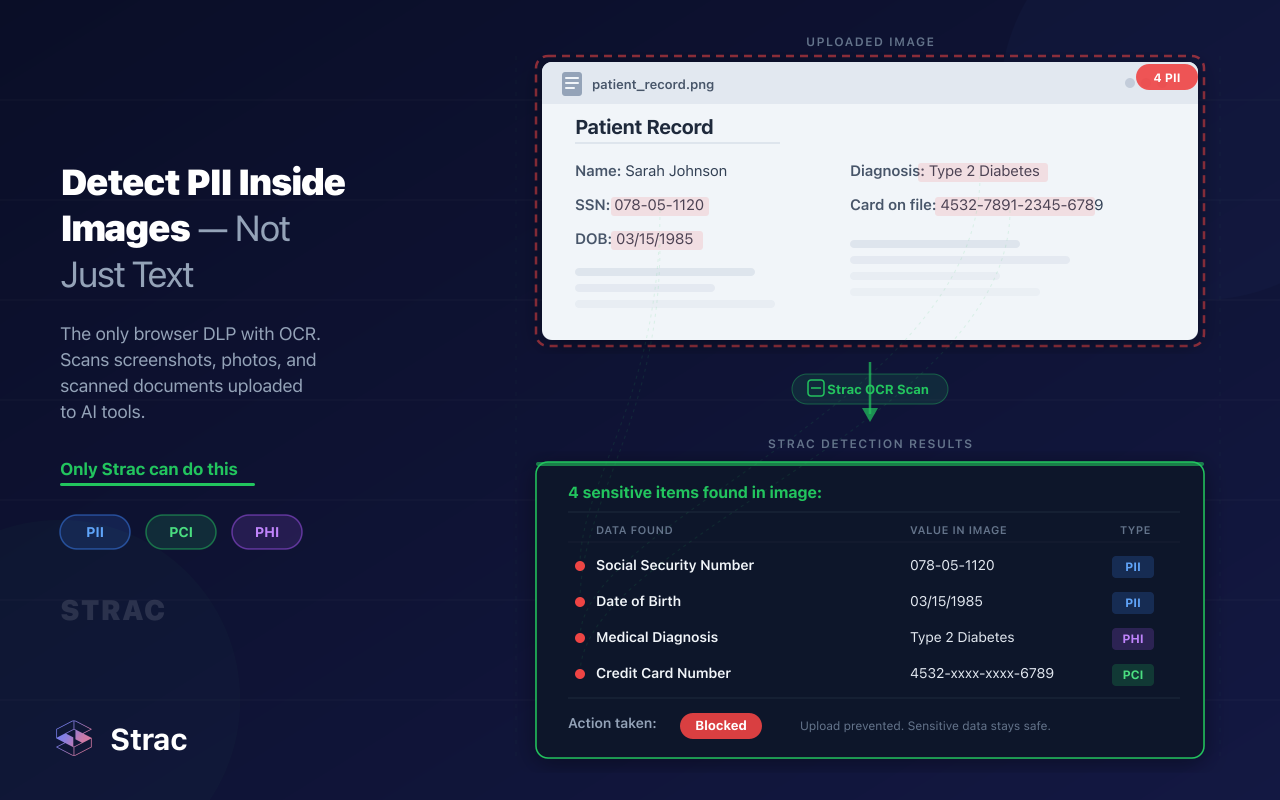
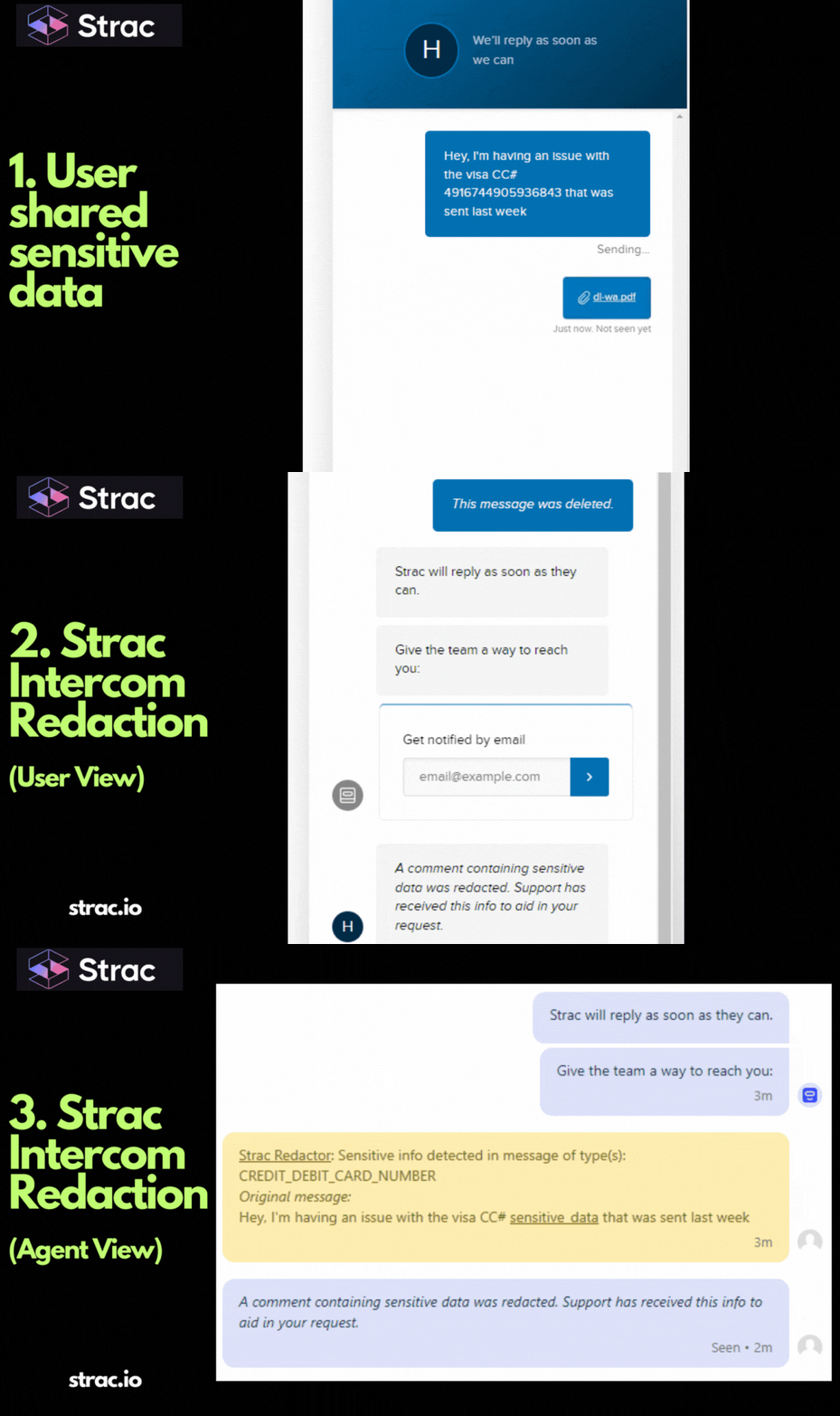
Equally problematic is underestimating how often cardholder data appears outside traditional payment systems. SaaS tools such as CRMs, ticketing platforms, collaboration apps, and file-sharing services frequently contain sensitive data through screenshots, uploads, or copy-paste behavior. Ignoring these locations creates blind spots that auditors routinely uncover.

Finally, many organizations fail to account for GenAI and automation workflows. AI tools, scripts, and integrations can process or store cardholder data unintentionally. When these paths are excluded from PCI data classification, audit findings often follow. These mistakes share a common root cause; reliance on assumptions instead of continuously validated evidence.

How DSPM Helps Meet PCI DSS Data Classification Requirements

DSPM for PCI compliance addresses the core challenge behind PCI DSS data classification requirements: maintaining accurate, up-to-date understanding of where cardholder data exists and how it is governed. Manual approaches struggle to keep pace with modern data movement, while DSPM introduces automation and consistency that auditors increasingly expect.

DSPM helps meet PCI DSS data classification requirements by:

  • Continuously discovering cardholder data across cloud, SaaS, and data stores as it appears
  • Updating classifications automatically when data moves, is copied, or enters new systems
  • Linking data classification directly to access controls, remediation, and monitoring
  • Generating time-stamped, repeatable PCI compliance evidence suitable for audits

By making classification continuous rather than periodic, DSPM reduces drift between documentation and reality and strengthens both compliance posture and real-world risk reduction.

How to Prepare for a PCI DSS Audit Using DSPM

PCI audit preparation becomes far more predictable when DSPM is embedded into the compliance workflow. Instead of assembling evidence reactively, organizations can enter audits with confidence that classification data is already current and defensible.

A DSPM-driven approach to PCI audit preparation typically includes:

  • Mapping cardholder data directly to PCI scope using verified discovery results
  • Validating that classifications align with documented policies before the audit begins
  • Producing auditor-ready reports that show data locations, classifications, and changes over time
  • Demonstrating continuous compliance maturity rather than point-in-time readiness

Using DSPM for PCI compliance automation shifts audits from a high-stress event to a structured review process; one where scope, controls, and evidence remain consistently aligned.

How PCI DSS Data Classification Requirements Are Met with Strac

PCI DSS data classification requirements go beyond policy documents and one-time assessments. Auditors expect organizations to maintain continuous visibility into where cardholder data exists, how it is classified, and how scope decisions are justified as environments change. This becomes increasingly difficult as cardholder data spreads across SaaS platforms, cloud storage, and automated workflows.

Strac is designed to align directly with how PCI DSS data classification is evaluated in practice. Its core values focus on clarity, continuity, and audit defensibility; three areas where many PCI programs struggle.

Strac supports PCI DSS data classification requirements by enabling:

  • Continuous visibility instead of static assumptions
    Cardholder data is continuously discovered and classified across SaaS, cloud, and AI-driven environments, helping teams maintain accurate PCI scope as systems evolve.
  • Clear, defensible PCI scope decisions
    By linking data presence directly to scope, Strac helps security and GRC teams confidently justify which systems are in scope and which are not during audits.
  • Audit-ready evidence by default
    Time-stamped findings and classification records provide PCI compliance evidence that auditors can review without relying on manual explanations or retroactive documentation.
  • Low operational friction
    PCI DSS data classification happens without disrupting daily workflows, reducing reliance on employee behavior or periodic clean-up exercises.

By aligning pci dss data discovery, pci dss data classification, and evidence generation into a single workflow, Strac helps organizations move away from reactive audit preparation. Instead of assembling proof at audit time, teams maintain continuous PCI evidence that reflects how data actually moves through modern environments.

This approach allows PCI DSS data classification requirements to function as a living control; not a documentation burden; and supports long-term compliance maturity with far less audit stress.

Bottom Line

PCI DSS data classification requirements are not an abstract compliance concept; they are the mechanism that makes PCI scope, controls, and audit evidence defensible. Without accurate PCI DSS data discovery and consistent PCI DSS data classification, organizations struggle to prove where cardholder data exists, why systems are in scope, and how controls are applied. This is why auditors increasingly focus on evidence of continuous visibility rather than static documentation.

By addressing PCI cardholder data classification requirements through ongoing discovery, validation, and governance, organizations reduce audit risk, avoid unnecessary over-scoping, and strengthen real-world security. Modern approaches that combine PCI compliance data classification with DSPM provide continuous PCI evidence, keep classifications current as data moves, and support repeatable PCI audit preparation. For security and compliance teams, meeting PCI DSS data classification requirements is no longer about checking a box; it is about maintaining control over sensitive data in dynamic, SaaS-driven environments.

Spicy FAQs on PCI DSS data classification requirements

What are PCI DSS data classification requirements?

PCI DSS data classification requirements refer to the practical expectation that organizations can identify cardholder data, determine where it exists, and apply the right protections based on that classification. PCI DSS does not treat cardholder data as “just another data type”; it expects stronger controls such as restricted access, encryption, monitoring, and retention practices to be applied specifically where cardholder data is stored, processed, or transmitted. In practice, pci dss data classification requirements mean you must have a defensible method to label and govern cardholder data across systems, SaaS tools, and cloud environments so PCI scope and controls remain accurate over time.

To make pci dss data classification operational, most teams align it to three outcomes: knowing what counts as cardholder data, knowing where it lives, and proving protections are enforced. That typically includes a classification policy, a data inventory tied to scope, and evidence that controls track the classified data wherever it moves. When pci data classification requirements are treated as a continuous control rather than a one-time exercise, audit readiness becomes far easier to maintain.

Does PCI DSS explicitly require data classification?

PCI DSS does not always present data classification as a single standalone requirement that says “you must classify your data.” Instead, PCI DSS embeds the expectation throughout requirements that rely on identifying where cardholder data exists and controlling access and protection accordingly. This is why many auditors treat pci dss data classification as an implied requirement; if you cannot demonstrate how cardholder data is identified and scoped, it becomes difficult to validate compliance with multiple downstream controls.

The simplest way to think about it is this: PCI scope is defined by cardholder data presence, and PCI controls must be applied to systems that handle it. That inherently requires pci dss data classification and often pci dss data discovery to ensure scope is accurate. If your program cannot prove where cardholder data exists and where it does not, auditors will usually expand sampling, challenge exclusions, and request more evidence.

What evidence do auditors expect for PCI data classification?

PCI compliance evidence for classification is typically assessed through consistency, repeatability, and traceability. Auditors want to see that your data classification is documented, applied in practice, and maintained as environments change. They also want to see that classification decisions directly support PCI scope and control enforcement; not just policies sitting in a folder.

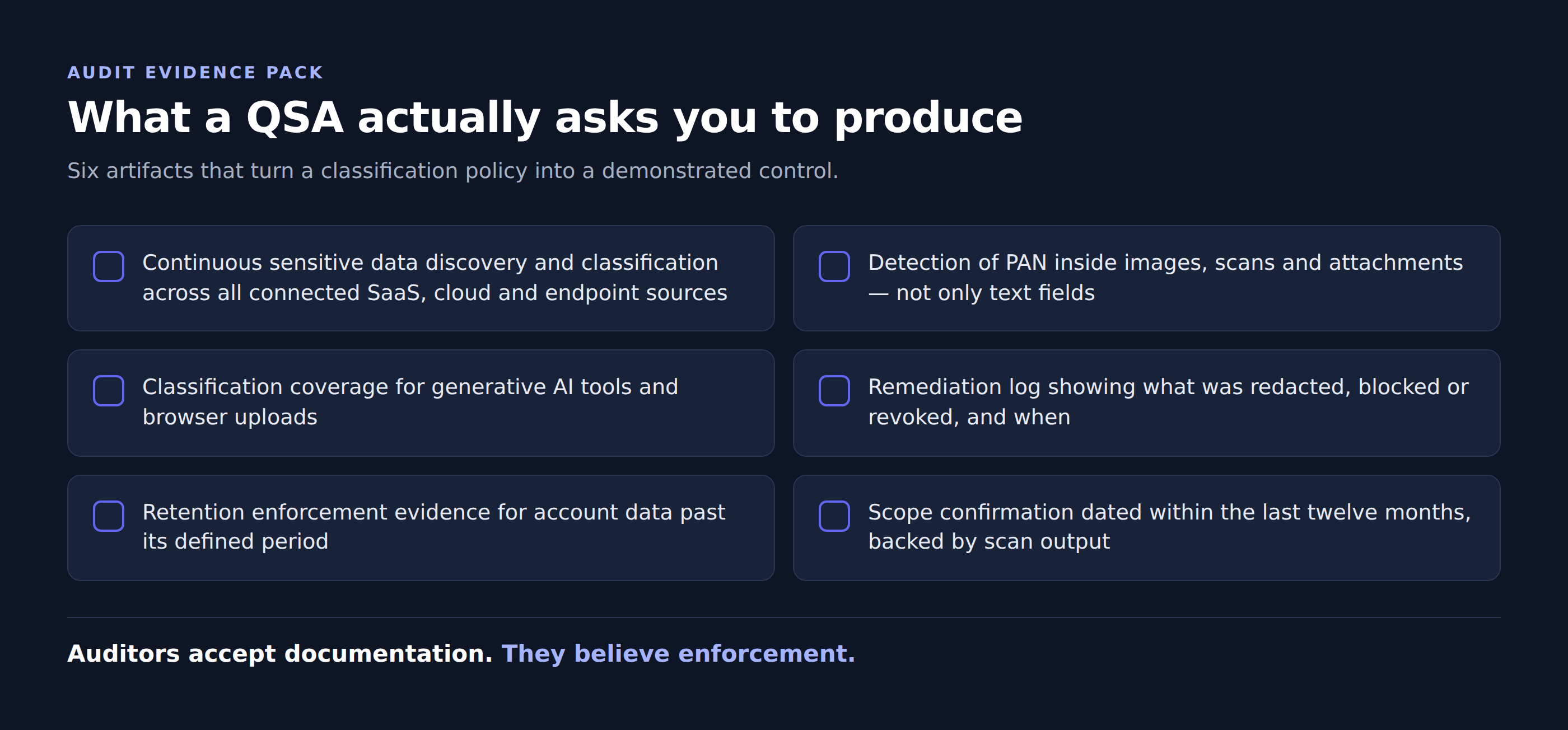
Auditors commonly expect evidence such as:

  • A documented PCI data classification policy that defines cardholder data and how it is handled
  • A data inventory or system list showing where cardholder data is stored, processed, or transmitted
  • Data flow documentation that aligns with your defined PCI scope
  • Proof of control enforcement tied to classified data, such as access restrictions, encryption coverage, and monitoring
  • Time-stamped reports or records that show discovery, classification updates, and ongoing review activity

Strong pci audit data classification evidence is not about producing a large pile of documents. It is about showing a coherent story: you can find cardholder data, classify it consistently, apply controls to it, and prove all of that with repeatable artifacts.

How does DSPM support PCI DSS compliance?

DSPM pci compliance support is valuable because it turns pci dss data classification requirements into a continuous, evidence-driven process. Instead of relying on manual reviews that quickly become outdated, DSPM improves ongoing visibility into where cardholder data exists across SaaS and cloud environments. That continuous visibility helps keep scope defensible, reduces blind spots, and makes audits less disruptive.

DSPM typically supports PCI DSS compliance by enabling:

  • Continuous sensitive data discovery across cloud, SaaS, and data stores
  • Ongoing classification updates as data moves, is copied, or appears in new locations
  • Audit-ready reporting that provides continuous PCI evidence over time
  • Faster validation of PCI scope decisions through verified data presence or absence

When used well, DSPM does not replace PCI controls; it strengthens the foundation those controls rely on. By combining pci dss data discovery and pci dss data classification into a continuous workflow, DSPM reduces audit friction and helps organizations maintain compliance in dynamic environments without relying on assumptions.

Discover & Protect Data on SaaS, Cloud, Generative AI
Strac provides end-to-end data loss prevention for all SaaS and Cloud apps. Integrate in under 10 minutes and experience the benefits of live DLP scanning, live redaction, and a fortified SaaS environment.
Users Most Likely To Recommend 2024 BadgeG2 High Performer America 2024 BadgeBest Relationship 2024 BadgeEasiest to Use 2024 Badge
Trusted by enterprises
Data Security + Compliance Automation

Latest articles

Browse all

Get Your Datasheet

Thank you! Your submission has been received!
Oops! Something went wrong while submitting the form.
Close Icon