Audio Redaction: How to Detect, Classify and Remediate Sensitive Data in Audio Files ?
Learn how to discover, classify and redact sensitive audio files shared in SaaS applications, stored in cloud and endpoints. Compare a DLP with Audio redaction software and find the compliance needs for audio redaction.
Audio files often contain PII, PCI, PHI, and confidential business data.
Traditional audio redaction tools only solve one part of the problem.
Modern businesses need protection across SaaS, cloud, endpoints, and AI tools.
Strac helps discover, classify, and remediate sensitive data across modern audio workflows.
Real-time controls reduce breach risk and support GDPR, HIPAA, PCI DSS, SOC 2, and more.
Audio files now contain some of the most sensitive data inside modern businesses. Customer support calls, sales conversations, HR interviews, healthcare recordings, legal discussions, and voice notes often include personal data, payment details, health records, internal secrets, and confidential business information.
As companies adopt remote work, SaaS collaboration tools, cloud storage, and AI transcription tools, audio data moves faster than ever. That creates a serious security and compliance gap.
Audio redaction software helps remove sensitive information from recordings before it is shared, stored, or analyzed. But in 2026, businesses need more than a standalone redaction tool. They need full visibility, classification, and remediation across their entire environment.
That is where Strac comes in.
Sources of Unsafe Audio Files
Unsafe sensitive audio files can originate from various sources, including:
1. Voice Call Recordings: Businesses often record voice calls for quality assurance, training, or legal compliance purposes. If these recordings are not properly redacted, sensitive information shared during the calls, such as financial details or personal identifiers, can be exposed.
2. Voice Messages Shared Across SaaS Apps: With the increasing use of SaaS applications like Slack, customer support tools like Zendesk, Salesforce, Intercom, HubSpot, Email, voice messages are commonly shared within teams and across different platforms. If sensitive information is shared in these voice messages, failing to redact the content can lead to data breaches or privacy violations.
3. Audio Files Shared in Endpoints: Audio files can be shared through various endpoints, such as email attachments or file-sharing platforms. If these files contain sensitive information, it is crucial to redact the data to prevent unauthorized access.
Need for Audio Redaction
Redacting voice call recordings means removing or obscuring sensitive information to protect the privacy and security of the individuals involved. This is crucial, especially when sharing recordings through customer support, email, Slack, or file-sharing platforms.
Common risky audio sources include:
Customer support call recordings
Sales calls and demos
Voice notes in Slack or Teams
Zoom or Meet recordings
Healthcare intake calls
HR interviews
Legal conversations
Audio files in cloud storage
Voice recordings uploaded into AI tools
If these files contain sensitive data and are shared without controls, the result can be data exposure, fines, and reputational damage.
✨What Sensitive Data Appears in Audio Files
Sensitive data inside recordings often includes:
Credit card numbers
Bank account information
Social Security numbers
Passport numbers
Medical information
Addresses and phone numbers
Customer account details
Payroll information
API keys and secrets
Internal business strategy
Because this data is spoken naturally, it can be harder to detect than text.
Before you move forward, scan your device for exposed PII in seconds!
Challenges of Redacting Sensitive Data in Audio Files
Sensitive data in audio files is harder to secure than text. Businesses using audio redaction software often deal with transcription errors, multiple speakers, accents, background noise, and multilingual conversations.
Audio redaction software must also understand context. A long number spoken in conversation may be harmless, or it may be a payment card.
Common challenges include:
Speech-to-text accuracy issues
Background noise
Overlapping speakers
Different accents
Multiple languages
Large recording volumes
Context confusion
Manual review bottlenecks
Modern protection requires transcription plus intelligent classification and automated remediation.
Methods for Implementing Audio Redaction
To effectively redact sensitive data in audio files, consider the following methods:
1. Manual Redaction:
Manual redaction involves listening to the audio file and manually removing or obscuring sensitive information. While this method can be accurate, it is time-consuming and prone to human error. It may not be practical for large volumes of audio files.
2. Automated Redaction:
Automated redaction utilizes advanced technologies, such as speech recognition and natural language processing, to automatically identify and redact sensitive data in audio files. This method is faster and more efficient than manual redaction, but it may still require manual review to ensure accuracy. DLP (Data Loss Prevention) solutions like Strac offer comprehensive data protection by automatically identifying and redacting sensitive data in various file types, including audio files.
DLP solutions leverage machine learning algorithms and predefined rules to detect and redact sensitive information, ensuring compliance with regulations and reducing the risk of data breaches.
🎥How Strac Protects Sensitive Audio Data in 2026
Sensitive audio files no longer stay in one place. They move across apps, cloud drives, employee devices, support systems, and AI tools.
Strac is a unified DSPM + DLP platform built for SaaS, cloud, endpoints, browsers, and GenAI environments. It helps security teams detect and remediate sensitive data across modern audio workflows.
Instead of using multiple tools, teams get one unified platform.
✨Audio Files and GenAI: The New Risk Surface
Many companies now upload customer calls and meetings into AI tools for summaries, coaching insights, and notes.
That creates a new risk surface.
Sensitive data inside recordings may include payment data, health data, customer identifiers, or internal strategy. If uploaded without controls, exposure risk increases.
Strac helps organizations monitor, block, redact, or audit sensitive data moving into AI workflows.
👉 Read our blog on AI DLP to learn how AI DLP prevents sensitive data exposure in ChatGPT, Claude, Copilot, Gemini, and other AI applications.
Real-World Example
Imagine a customer support team receives a voice recording containing:
Full credit card number
Billing address
Name
Date of birth
Without controls, that file may be stored in a ticketing platform, downloaded by multiple employees, synced into cloud storage, and later uploaded into an AI summarization tool.
With Strac, teams can automatically:
Detect the risk
Redact sensitive content
Remove external access
Quarantine the file
Encrypt the asset
Alert security teams
Preserve audit trails
Why Compliance Teams Care About Audio Security
Many regulations protect spoken personal data the same way they protect written data.
Examples include:
European Union GDPR
U.S. Department of Health and Human Services HIPAA
If sensitive customer information is exposed through recordings, regulators usually do not care whether it was text or audio.
They care that it was exposed.
✨See Strac in Action
Strac provides APIs and No-Code solutions to automatically detect and redact sensitive data in a voice call recording.
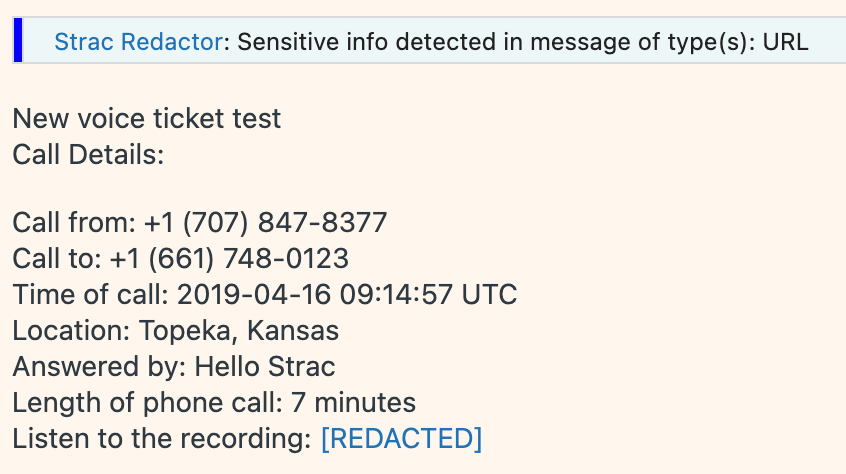
1. Remove voice call recording from SaaS apps & replace with a secure link
Let's take an example: If a customer submits a voice call recording that contains credit card details or customer PII like billing address, name, and identification details, Strac will remove the recording. Strac has built-in integrations with Slack, Zendesk, Intercom, Gmail, Office 365 ,one drive and more.
Redacted Voice Call Recording (powered by Strac)
2. Redact sensitive data elements from voice call recording
You can also configure Strac where only sensitive data elements in the voice call recording are redacted. In that case, the original voice call recording will be removed and a new voice call recording that has redacted information will be uploaded.
{ "detectedEntities": [ { "type": "SOCIAL_SECURITY_NUMBER", "token_id": "tkn_lvCJl350FVc4WMmYaPTjquum" } ], "redactedContent": "Hello, please process the user with SSN tkn_lvCJl350FVc4WMmYaPTjquum" }
If you'd like to replace tokens within redactedContent, you can use the below regular expression:
Audio Redaction Software: Why Choose a DLP over Redaction Software?
While audio redaction software may seem like a viable option for redacting sensitive data in audio files, there are some disadvantages to consider. Audio redaction software typically focuses solely on redacting audio files and may not offer the same level of comprehensive data protection as a DLP solution. Here are some reasons to choose a DLP solution over audio redaction software:
1. Comprehensive Data Protection
DLP solutions offer protection for various file types, including audio files, as part of a broader data protection strategy. They can detect and redact sensitive information in real-time, both at rest and in motion, across multiple platforms and applications.
2. Advanced Detection Capabilities
DLP solutions leverage advanced technologies, such as machine learning and natural language processing, to accurately identify sensitive data in audio files. They can adapt to new patterns and evolving threats, ensuring that sensitive information is consistently protected.
3. Integration with Existing Systems
DLP solutions can integrate with existing systems and applications, such as SaaS apps, email clients, file-sharing platforms, endpoints, cloud apps or communication tools, to provide seamless and automated data protection. This integration simplifies the implementation process and reduces the need for additional software.
✨Automated Sensitive Data Identification and Redaction
Strac is a sophisticated DLP (Data Loss Prevention) solution designed to protect data in all states: in use, in transit, or stored on endpoint devices, saas and cloud applications.
Easy-to-Use No-Code Scanner
The no-code scanner feature of Strac simplifies integration and usage. It enables quick setup and deployment without requiring deep coding skills. The scanner effectively oversees and examines data transfers to prevent accidental exposure of sensitive information.
Limiting Physical Data Exchanges
A key capability of Strac is its control over physical data exchanges, including printing and USB device usage. This is vital for blocking unauthorized physical data transfers.
All-Encompassing Data Security
Strac's all-around data security approach meets rigorous standards like PCI, HIPAA, SOC 2, GDPR, and CCPA. For organizations dealing with sensitive data, this ensures they comply with legal and ethical guidelines.
Compatibility Across Platforms
Strac boasts compatibility with various operating systems and platforms, ensuring easy integration in diverse SaaS environments.
API for PII Redaction
The PII Scanner and Redaction API in Strac automatically identifies and redacts sensitive data, safeguarding personal information during transfers. This is crucial for privacy and confidentiality, especially when handling large data sets.
Act before a security incident occurs. Schedule a demonstration to discover more.
Bottom Line
Audio files are now one of the fastest-growing sources of sensitive data risk. Most companies still protect text better than voice.
That gap is getting expensive.
Strac helps modern organizations discover, classify, and remediate sensitive data across audio, SaaS apps, cloud storage, endpoints, and GenAI environments from one unified platform.
Audio redaction software removes or obscures sensitive information from recordings such as payment data, names, health records, or personal identifiers.
Can audio files create GDPR or HIPAA risk?
Yes. If recordings contain personal or health data and are mishandled, they can create regulatory exposure.
Can AI transcription tools create data leakage risk?
Yes. Uploading recordings into AI tools without controls can expose sensitive information.
Does Strac only protect audio files?
No. Strac protects sensitive data across SaaS apps, cloud storage, endpoints, browsers, and GenAI environments.
What is better: standalone audio redaction software or unified DLP?
For most modern organizations, unified DLP + DSPM is stronger because it protects the full lifecycle of sensitive data, not just one file type.
Discover & Protect Data on SaaS, AI, MCP, Endpoints & Cloud
Strac provides end-to-end data loss prevention for all SaaS and Cloud apps. Integrate in under 10 minutes and experience the benefits of live DLP scanning, live redaction, and a fortified SaaS environment.


.webp)









.avif)



.gif)
