Learn how to prevent Google Drive data leaks in 2026 with sensitive data discovery, AI governance, external sharing controls, real-time DLP remediation, and compliance-ready security best practices.
· Most Google Drive leaks today happen throughoversharing, AI tools, contractors, and SaaS integrations—not external hackers.
· A single exposed Google Drive file can triggerGDPR, HIPAA, PCI DSS, SOC 2, or contractual compliance violations.
· Modern protection requires continuous discovery,classification, monitoring, and real-time remediation.
· Organizations need visibility into sensitivedata across files, PDFs, images, spreadsheets, shared drives, and connectedapplications.
· Strachelps prevent Google Drive leaks through agentless DSPM + DLP, sensitive datadiscovery, ML/OCR classification, real-time remediation, external sharingcontrols, and audit-ready reporting.
Google Drive has become the operating system for modern work.
Contracts live there. Customer exports live there. Financial reports, healthcare records, source code, employee information, AI training datasets, and board presentations all find their way into Google Drive.
The problem isn't that Google Drive is insecure.
The problem is that people are.
In 2026, most Google Drive leaks happen because someone accidentally shares a file, uploads sensitive content to an AI tool, grants access to the wrong contractor, or connects a third-party application that suddenly gains access to thousands of documents.
A single click can expose years of sensitive information.
And most organizations don't realize it happened until weeks or months later.
What Does a Google Drive Leak Look Like?
Many people imagine a Google Drive leak as a sophisticated cyberattack.
The reality is usually much simpler.
Scenario #1: The Public Link Disaster
A sales manager exports a spreadsheet containing customer information and generates a "Anyone with the link" share URL.
The file contains:
Customer names
Email addresses
Phone numbers
Revenue data
Contract values
The link is copied into Slack.
A contractor later forwards the message outside the company.
Within minutes, confidential customer information is accessible to people who should never have seen it.
No hacker was involved.
No malware was used.
Just one sharing setting.
Scenario #2: The AI Assistant Upload
An employee wants help analyzing customer churn trends.
They upload a Google Drive spreadsheet containing thousands of customer records into an AI platform.
The file includes:
PII
Customer support notes
Internal business metrics
Proprietary operational data
The employee is trying to work faster.
Unfortunately, sensitive information has now moved outside approved environments.
As organizations increasingly connect Google Drive to ChatGPT, Claude, Copilot, Gemini, and AI agents, this risk grows significantly.
Scenario #3: The Contractor Access Problem
A marketing agency receives temporary access to a shared Google Drive folder.
Over time, additional files get added to the folder.
Nobody reviews permissions.
Months later the agency still has access to:
Financial forecasts
HR records
Customer lists
Product roadmaps
This is one of the most common causes of SaaS data exposure.
Scenario #4: The MCP and AI Agent Risk
In 2026, many companies are connecting Google Drive to AI agents through MCP (Model Context Protocol) servers.
The goal is productivity.
The risk is data exposure at scale.
An AI agent connected to Google Drive may suddenly access:
Customer contracts
Internal documentation
Employee records
Product specifications
Financial reports
Without proper controls, organizations lose visibility into what sensitive data the agent can access, process, or send elsewhere.
This is rapidly becoming one of the biggest emerging data security challenges.
🎥 Why Google Drive Leaks Are More Dangerous Than Ever
Modern organizations have far more data than they did just a few years ago.
Sensitive information is no longer limited to structured databases.
Today it exists inside:
PDFs
Images
Screenshots
Spreadsheets
Presentations
Scanned documents
Shared folders
AI-generated content
This makes traditional keyword and regex-based security controls increasingly ineffective.
Organizations need systems capable of understanding content, context, and intent.
The Real Cost of a Google Drive Leak
The financial impact is often only part of the problem.
A Google Drive leak can result in:
Regulatory Violations
Sensitive data exposure may trigger:
GDPR violations
HIPAA violations
PCI DSS findings
SOC 2 audit issues
Customer contractual breaches
Intellectual Property Loss
Product roadmaps.
Source code.
Research documents.
Strategic plans.
Once exposed, competitive advantage can disappear overnight.
Customer Trust Damage
Customers rarely remember security successes.
They always remember security incidents.
A single exposed file can damage years of trust-building efforts.
How to Prevent Google Drive Leaks
Protecting Google Drive requires more than simply restricting sharing permissions.
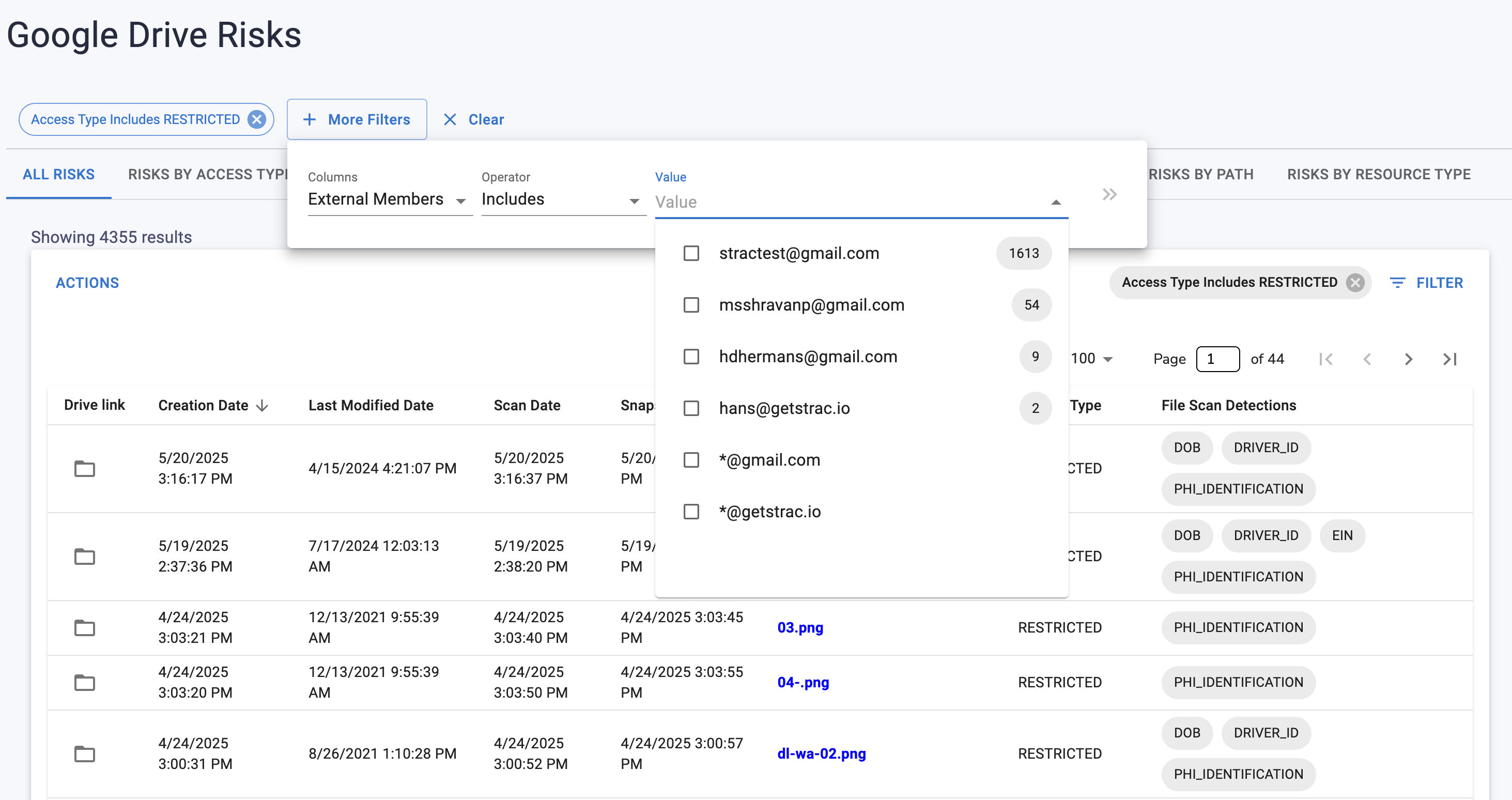
Organizations need visibility into what sensitive data exists, where it exists, who has access to it, and how it moves.
Step 1: Discover Sensitive Data Automatically
You cannot protect what you cannot find.
Most organizations are surprised when they discover how much sensitive data already exists across Google Drive.
This includes:
PII
PHI
PCI data
API keys
Credentials
Financial records
Customer information
Employee data
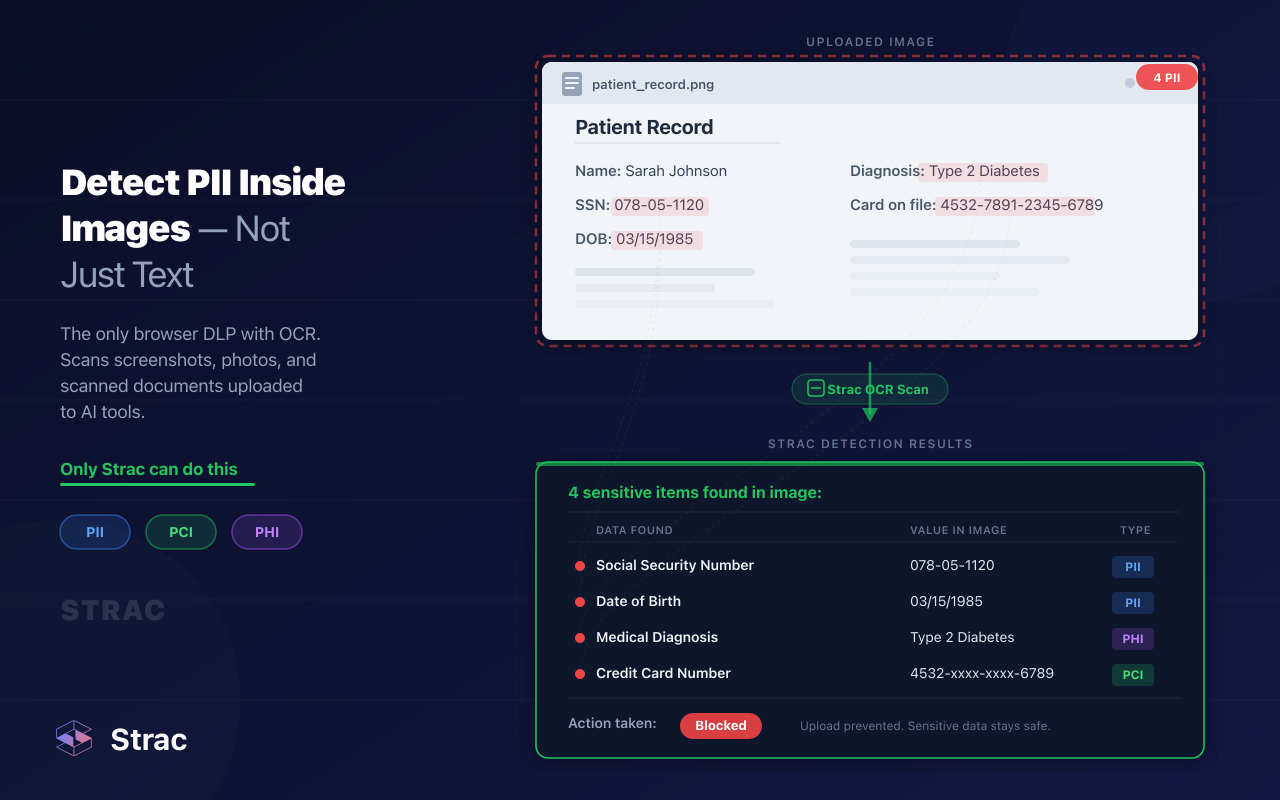
Strac continuously discovers and classifies sensitive data across Google Drive using content-aware detection, machine learning, OCR, and data classification techniques rather than relying solely on regex patterns.
Step 2: Monitor External Sharing
External sharing remains one of the leading causes of Google Drive data leaks.
Organizations should continuously monitor:
Public links
External collaborators
Vendor access
Contractor access
Newly shared files
When sensitive files are shared externally, security teams need immediate visibility and response options.
Step 3: Protect Files Before They Leave
Detection alone is not enough.
The most effective approach is preventing exposure before it occurs.
Modern DLP platforms should support actions such as:
Redaction
Masking
Blocking
Quarantine
Deletion
Encryption
User coaching
Inline remediation dramatically reduces risk because the problem is addressed immediately rather than appearing later in a security report.
Step 4: Secure Unstructured Data
Many organizations only monitor structured data like credit card numbers.
Attackers and accidental insiders don't care whether data is structured or unstructured.
Sensitive information often lives inside:
PDFs
Screenshots
Images
Scanned forms
Contracts
Presentations
Effective protection requires OCR and content-aware inspection across all file types.
Step 5: Govern AI and MCP Access
If Google Drive is connected to AI systems, organizations should know:
What data agents can access
What documents are being processed
Which prompts contain sensitive information
Where information is being sent
As AI adoption accelerates, Google Drive governance and AI governance are becoming inseparable.
Automatically discovers sensitive files across Google Drive, including documents, spreadsheets, PDFs, images, and attachments.
Content-Aware Classification
Uses machine learning and OCR to identify sensitive information across structured and unstructured content with lower false positives than traditional regex-based approaches.
Real-Time Remediation
Rather than simply generating alerts, Strac can take immediate action through redaction, masking, blocking, deletion, and other remediation workflows.
External Sharing Monitoring
Provides visibility into externally shared files and enables organizations to prevent unauthorized sharing of sensitive information.
Compliance-Ready Controls
Supports organizations working toward:
GDPR
HIPAA
PCI DSS
SOC 2
Internal security policies
Unified Coverage Beyond Google Drive
Most data doesn't stay in one application.
Strac extends protection across SaaS applications, cloud environments, GenAI platforms, endpoints, support systems, and collaboration tools through a unified platform.
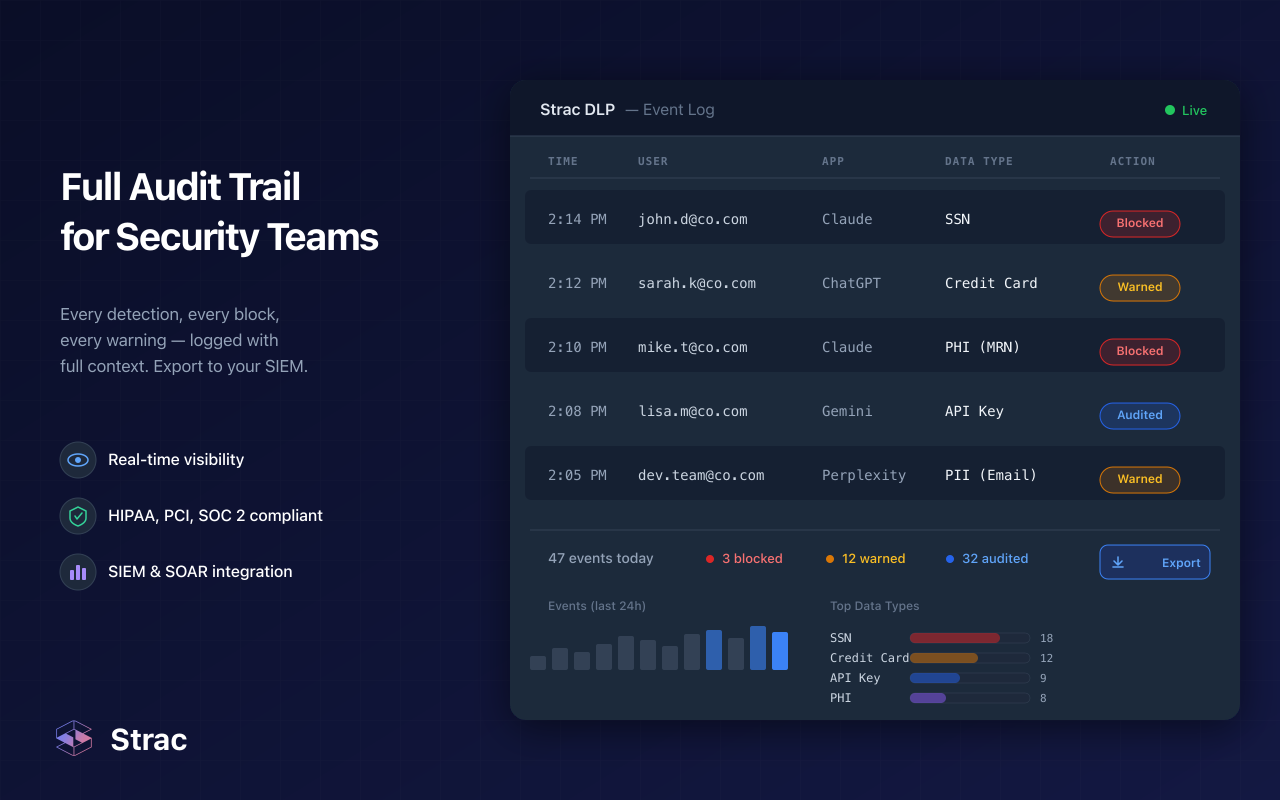
Detailed Audit Trails
Security, compliance, and risk teams receive detailed reporting showing:
Who accessed data
What data was exposed
What actions were taken
When incidents occurred
This simplifies investigations and compliance reporting.
The Bottom Line
Google Drive leaks are no longer just a file-sharing problem. In 2026, sensitive data moves constantly between employees, contractors, SaaS applications, AI tools, and MCP-connected agents. A single spreadsheet shared externally, an overlooked permission, or an AI upload can expose customer data, intellectual property, or regulated information in seconds. Organizations need more than basic sharing controls—they need continuous visibility into where sensitive data lives, who can access it, and how it moves. By combining sensitive data discovery, content-aware classification, real-time remediation, external sharing controls, and audit-ready reporting, Strac helps organizations stop Google Drive data leaks before they become security incidents, compliance violations, or headline-making breaches.
🌶️ Spicy FAQs on Preventing Google Drive Leaks
FAQ 1: What is the most common cause of Google Drive data leaks in 2026?
The most common cause of Google Drive data leaks is not hacking—it's accidental exposure. Employees frequently share files with the wrong people, create public links, grant excessive permissions to contractors, or upload sensitive Google Drive files into AI tools like ChatGPT, Claude, Gemini, and Copilot. Organizations need continuous monitoring and real-time controls to prevent these mistakes from becoming data breaches.
FAQ 2: Can Google Drive leak sensitive data to AI tools?
Yes. As organizations adopt AI, employees often connect Google Drive to AI assistants or upload files directly into GenAI platforms for analysis. Without proper AI governance and DLP controls, customer records, financial data, source code, contracts, and intellectual property can be exposed. Modern Google Drive security strategies should include AI DLP and MCP security controls alongside traditional data protection.
FAQ 3: How do companies prevent unauthorized Google Drive file sharing?
Leading organizations prevent unauthorized sharing through automated sensitive data discovery, external sharing monitoring, approval workflows, access reviews, and real-time remediation. Instead of relying on employees to manually manage permissions, modern DLP solutions can automatically detect sensitive files and redact, block, quarantine, or restrict access before data leaves the organization.
FAQ 4: Is Google Drive secure enough for HIPAA, PCI DSS, and GDPR compliance?
Google Drive can support compliance initiatives, but it is not automatically HIPAA, PCI DSS, or GDPR compliant out of the box. Organizations remain responsible for identifying sensitive data, managing permissions, monitoring sharing activity, maintaining audit trails, and preventing unauthorized access. Additional DLP and DSPM controls are typically required to meet regulatory requirements.
FAQ 5: What is the best way to prevent Google Drive data leaks?
The most effective approach combines Data Security Posture Management (DSPM) and Data Loss Prevention (DLP). Organizations should continuously discover sensitive data, classify files using ML and OCR, monitor external sharing, govern AI access, and automatically remediate risks in real time. This approach helps stop leaks before they become security incidents, compliance violations, or costly breaches.
Discover & Protect Data on SaaS, AI, MCP, Endpoints & Cloud
Strac provides end-to-end data loss prevention for all SaaS and Cloud apps. Integrate in under 10 minutes and experience the benefits of live DLP scanning, live redaction, and a fortified SaaS environment.


.webp)









.avif)



.gif)
