September 29, 2026

8
min read
Understanding Data Loss Prevention in Google Workspace
Google Workspace DLP protects sensitive data in Gmail, Drive and Sheets. Learn how Strac extends DLP across SaaS, GenAI, endpoints, browsers and MCP.
Here's the passage with links. To help the Google Workspace DLP flagship rank, most links point back into the Google cluster, and the exact phrase "Google Workspace DLP" is the anchor for the flagship post.
Google Workspace sits at the center of how modern teams communicate, collaborate, and share information. Gmail messages, Google Drive files, Docs, and Sheets can contain everything from customer PII and employee records to financial information, PHI, credentials, and confidential company data.
That makes Google Workspace a critical part of any Data Loss Prevention (DLP) strategy.
Google provides native security and DLP capabilities that can help organizations identify sensitive information and control how it is shared. But in 2026, sensitive data rarely stays inside Google Workspace. It moves between SaaS applications, browsers, endpoints, GenAI tools, support platforms, cloud environments, and increasingly AI agents and MCP-connected systems.
Modern Google Workspace DLP therefore needs to answer two questions: How do you protect sensitive data inside Google Workspace, and what happens to that data after it leaves Google?
Google Workspace DLP refers to the policies and security controls organizations use to identify sensitive information and prevent inappropriate exposure across their Google environment.
Sensitive data can include:
The goal is not simply to find sensitive information. Effective DLP determines where the data is, who is interacting with it, where it is going, and what should happen when a policy is violated.
That distinction has become increasingly important as employees move data between cloud applications throughout the workday.
.webp)
Google Workspace is highly collaborative by design. Employees can send files, create external sharing links, download documents, copy information into another application, upload files elsewhere, or paste content into an AI assistant.
Those capabilities improve productivity, but every movement of sensitive information creates another potential exposure point.
Consider a spreadsheet containing customer PII.
The file may begin in Google Drive. An employee can download it, email it to a colleague, upload it into Slack, attach it to a support ticket, copy data into ChatGPT, or move it to a USB device.
Protecting only the original Google Drive file does not protect the complete data journey.
This is why DLP strategies are increasingly moving from application-centric controls toward data-centric security.
Email remains one of the easiest ways for sensitive information to leave an organization.
Employees may accidentally send customer information to the wrong recipient, attach the wrong document, include payment information in an email, or forward confidential information outside the company.
Google Workspace security controls can help organizations identify and govern sensitive information in email workflows.
But organizations should also consider what happens to information before and after Gmail.
For example, an employee might copy information from a CRM into Gmail, download an attachment from Gmail to an endpoint, or move information from an email into another SaaS application.
Strac extends DLP across these workflows by helping organizations detect sensitive information and enforce policies across connected channels rather than treating Gmail as an isolated data environment.
Google Drive can become one of the largest repositories of sensitive information inside an organization.
Customer exports, financial reports, employee documents, spreadsheets, contracts, screenshots, PDFs, and operational files can accumulate quickly.
The challenge is visibility.
Security teams need to understand:
This is where DLP increasingly overlaps with Data Security Posture Management (DSPM).
Instead of looking only at a sharing event, DSPM helps security teams discover and classify sensitive information already sitting inside the environment.
Strac combines DSPM and DLP so organizations can discover sensitive information and enforce policies when that information is used or moved.
Google Sheets deserves particular attention because spreadsheets frequently contain large amounts of structured sensitive information.
A single spreadsheet may contain thousands of:
The risk becomes greater when Sheets are downloaded as CSV or XLSX files and moved into other systems.
Modern DLP therefore needs to inspect the actual content rather than relying only on filenames, labels, or simple sharing permissions.
Strac can inspect sensitive information inside files and documents, helping organizations identify data that might otherwise be hidden inside everyday business files.
Native Google Workspace controls can be an important part of an organization's security architecture. The limitation is not necessarily Google itself. The limitation is that modern workflows extend far beyond Google.
An employee may move information from Google Workspace into:
Once data crosses those boundaries, Google-specific controls no longer provide complete visibility into the workflow.
That creates a fundamental DLP problem: security controls are organized around applications while sensitive data moves between them.
Traditional DLP asks whether sensitive information exists in a particular application or channel.
Modern DLP asks what is happening to that information across the organization.
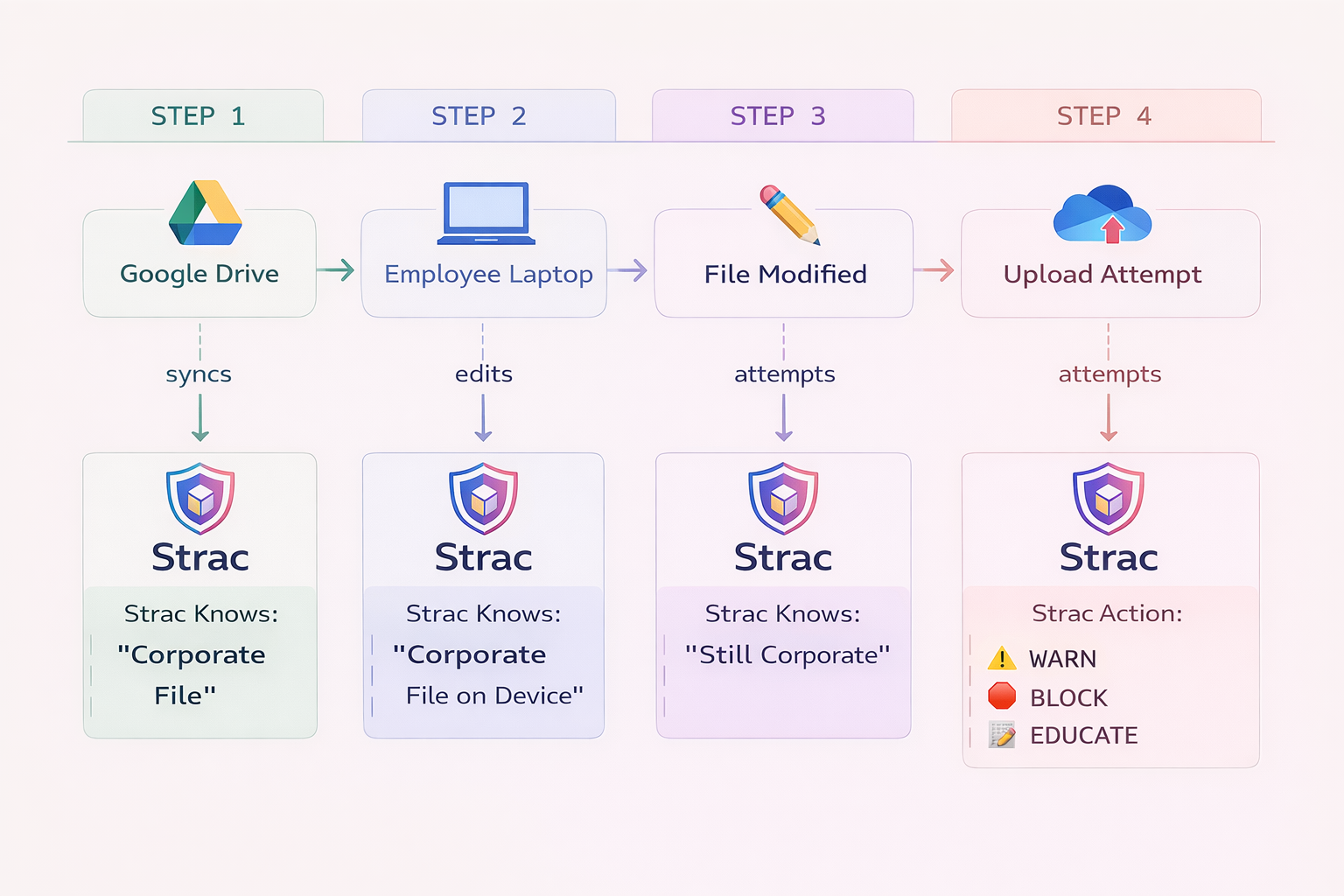
For example, imagine an employee downloads a spreadsheet containing customer PII from Google Drive.
They then:
From a data security perspective, this is one continuous journey.
A modern DLP architecture should be able to apply protection across those different channels.
That is the model behind Strac's unified approach to SaaS, Cloud, GenAI, Browser, and Endpoint DLP.
Strac is a unified DSPM and DLP platform designed to protect sensitive data across the environments where modern employees actually work.
Rather than replacing Google Workspace security controls, Strac can extend protection beyond the Google ecosystem.
Strac helps organizations discover sensitive information across connected data environments and SaaS applications.
Security teams can identify PII, PHI, PCI, credentials, financial information, confidential business data, and custom sensitive data types.
This provides visibility into sensitive information before an incident occurs.
Sensitive information is not limited to plain text.
It can appear inside:
Strac uses content inspection, ML, and OCR capabilities to identify sensitive information inside these formats rather than depending exclusively on simple pattern matching.
Finding sensitive information is useful. Preventing exposure is better.
Depending on the integration and policy, Strac can enforce actions including:
This allows security teams to move from passive detection toward active data protection.
Google Workspace is only one part of the SaaS environment.
Strac extends DLP across applications such as Slack, Salesforce, Zendesk, Intercom, and other business systems where sensitive information is created, copied, uploaded, and shared.
Security teams can therefore apply more consistent policies across applications instead of managing isolated DLP environments.
Downloading a protected Google Drive file to a laptop should not mean the protection disappears.
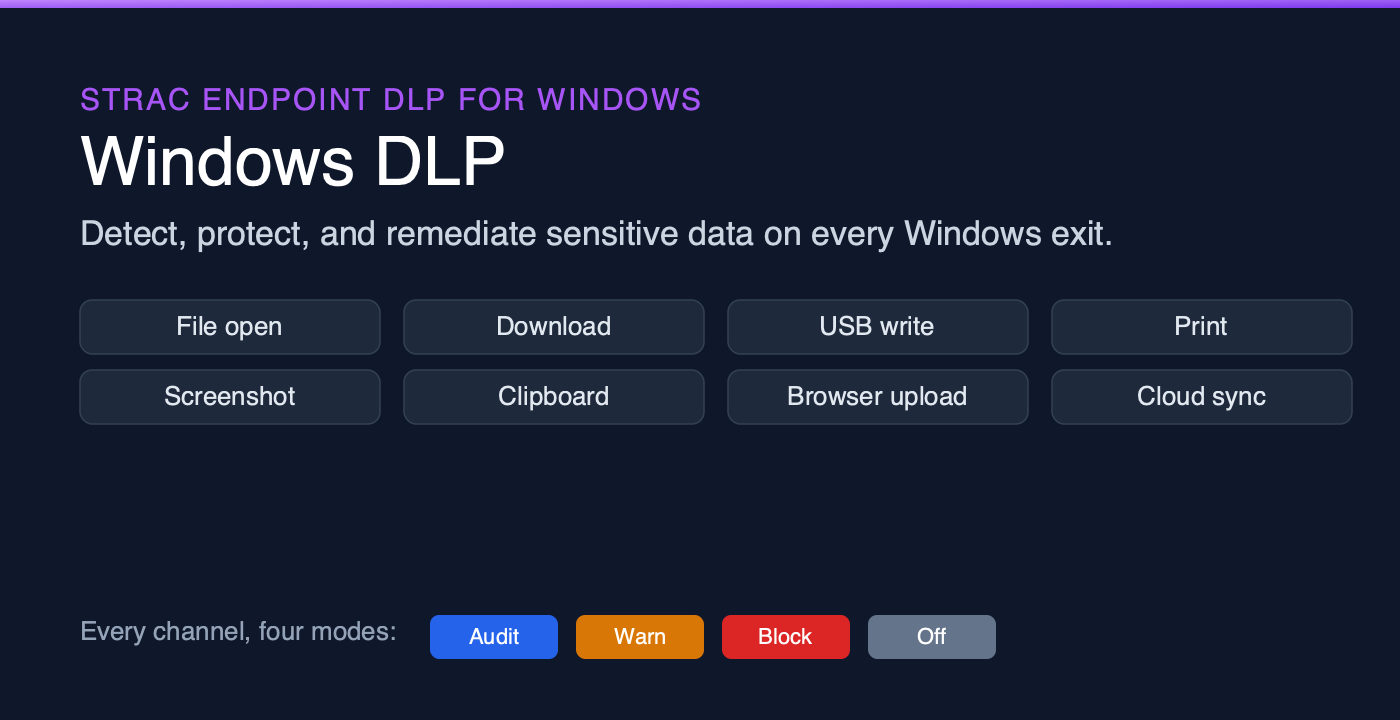
Endpoint DLP can help organizations control sensitive data when users attempt to move it through channels such as removable storage, browsers, applications, or other destinations.
Policies can be applied according to the sensitive data involved rather than simply blocking an entire device or workflow.
GenAI has created another major data movement problem.
Employees can copy information from Gmail, Google Docs, Drive, or Sheets and paste it directly into AI applications.
That information might contain:
Strac's GenAI DLP capabilities help organizations detect sensitive information entering AI workflows and enforce policies before inappropriate data exposure occurs.
This allows companies to adopt AI without relying exclusively on employee training or blanket bans.
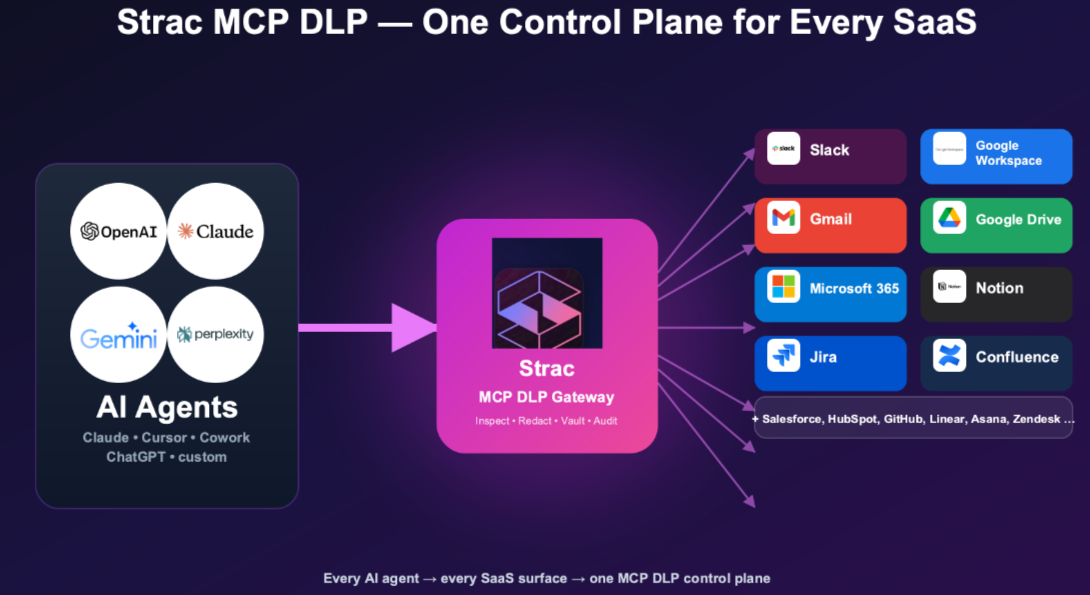
AI agents introduce an even more complex version of the same problem.
With Model Context Protocol (MCP), AI systems can connect to enterprise tools and retrieve or act on organizational data. An AI agent may interact with Google Workspace alongside CRM systems, databases, support applications, cloud storage, and internal tools.
That creates machine-to-machine data flows that traditional user-centric DLP controls were not designed to govern.
Strac's MCP DLP approach provides a security layer for these workflows by inspecting sensitive information moving through MCP-connected AI systems and applying data policies before information reaches an unauthorized model, tool, or destination.
As enterprise AI becomes more autonomous, protecting these agent-driven data flows will become an increasingly important extension of traditional Google Workspace DLP.
Knowing that sensitive information exists is only part of the problem.
Security teams increasingly need to understand its movement.
If a sensitive file begins in Google Drive and later appears on an endpoint, inside a browser, or in another application, understanding that journey can provide valuable context during investigations.
Data lineage can help security teams answer questions such as:
This context can make DLP incidents significantly easier to investigate than isolated alerts from individual applications.
Organizations operating under regulations and security frameworks such as HIPAA, PCI DSS, GDPR, CCPA, and SOC 2 need controls around sensitive information.
DLP can support those programs by helping organizations detect sensitive data, restrict inappropriate disclosure, enforce security policies, and maintain records of policy activity.
However, DLP does not automatically make an organization compliant.
Compliance depends on the organization's broader combination of technical safeguards, policies, access controls, processes, contracts, training, and governance.
The role of DLP is to make sensitive-data controls more consistent and enforceable across everyday workflows.
You cannot protect data you do not know exists.
Identify where PII, PHI, PCI, credentials, confidential information, and other sensitive data are stored across Google Workspace and connected systems.
Avoid treating every file or action as equally risky.
A public marketing image and a spreadsheet containing thousands of customer records should not receive identical treatment.
Define policies according to the sensitivity of the data and the destination.
Look beyond where sensitive information sits.
Consider how employees move information between Google Workspace, SaaS applications, endpoints, browsers, GenAI tools, and removable media.
Sensitive information often hides inside documents, spreadsheets, screenshots, PDFs, and images.
Your DLP strategy should account for those formats rather than inspecting only plain text.
Alerts alone can create large investigation queues.
Where the business workflow allows it, use automated controls such as redaction, masking, blocking, quarantine, encryption, or user coaching to reduce exposure immediately.
Employees are already using AI tools.
Define what information can and cannot be entered into GenAI applications and enforce those rules technically where possible.
AI security is moving beyond employees manually entering prompts.
Organizations adopting AI agents and MCP-connected tools should determine how sensitive information will be inspected and governed as AI systems interact directly with enterprise applications.
Google Workspace DLP remains an important layer of enterprise data security, but the security boundary has changed.
Sensitive information moves constantly between Gmail, Drive, Sheets, SaaS applications, browsers, employee endpoints, GenAI tools, and increasingly autonomous AI agents. Protecting only one application leaves gaps between those environments.
Strac brings DSPM and DLP together to help organizations discover sensitive data and enforce protection across SaaS, Cloud, GenAI, Browser, Endpoint, and emerging MCP workflows. Instead of protecting Google Workspace as an isolated environment, organizations can protect the data itself wherever it moves.
Learn more about Strac and how unified DLP and DSPM can extend sensitive data protection beyond Google Workspace.
Not for most modern environments. Google Workspace DLP can protect data inside Google's ecosystem, but sensitive data routinely moves into Slack, Salesforce, Zendesk, browsers, endpoints, GenAI tools, and other applications. A modern DLP strategy needs to protect the data after it leaves Google Workspace too.
The biggest blind spot is cross-channel data movement. A file can be protected in Google Drive, downloaded to an endpoint, uploaded to another SaaS app, or pasted into ChatGPT. Google-specific controls cannot govern every step once the data moves outside Google's security boundary.
Google Workspace controls alone do not provide universal protection for everything employees paste or upload into third-party GenAI tools. Strac extends DLP into GenAI and browser workflows to detect sensitive PII, PHI, PCI, credentials, source code, and confidential data and enforce policies before inappropriate exposure occurs.
Because an alert generated after sensitive data has already been exposed does not undo the exposure. Modern DLP should be able to take action. Depending on the channel and policy, Strac can redact, mask, block, quarantine, delete, encrypt, coach, or audit sensitive-data activity.
No, but they will make Google-only DLP increasingly incomplete. AI agents can connect Google Workspace with CRMs, databases, SaaS applications, and internal systems through MCP and other integrations. Organizations will need DLP controls that can govern sensitive data across both human-driven and agent-driven workflows
.avif)


.gif)


.webp)