Comprehensive Guide to Data Loss Prevention Audit Checklist XLS
A DLP audit checklist XLS lists every control auditors test across SaaS, endpoint, browser, AI and MCP. Get the template and see how Strac automates evidence.
· A data loss preventionaudit checklist XLS is a working spreadsheet of DLP controls, each mapped to aframework, an owner, a status, and the evidence that proves it.
· The audit scope changed in 2026. Sensitive datanow leaves through a paste into ChatGPT, a Slack message, or an AI agentcalling a tool over MCP, and most checklists still stop at email and USB.
· A spreadsheet records what you say is true. Itcannot see a leak, redact a record, or prove a control ran on the day inquestion.
· Strac fills the checklist from the data layer: sensitivedata discovery and classification, DSPM, andautomated redaction across SaaS DLP,endpoint DLP, browser, AI DLP, and MCP DLP, with every action loggedas audit evidence.
· Thisis the audit slice of data lossprevention compliance. Start from that pillar if you are preparing for SOC2, HIPAA, PCI DSS, or ISO 27001.
What Is a Data Loss Prevention Audit Checklist XLS?
A data loss prevention audit checklist XLS is a structured list of the controls that protect sensitive data, kept in Excel or Google Sheets so each row can be assigned, tracked, and exported. Each row answers one question an auditor will ask: is this control in place, and how do you know?
The data in scope is familiar: PII, PHI, payment card data, credentials and secrets, source code, and confidential business files. The catalog of sensitive data elements is a useful baseline for listing them.
A good checklist does three jobs. It defines scope, so nobody argues later about which systems count. It maps each control to SOC 2, HIPAA, PCI DSS, GDPR, or ISO 27001, so one piece of work satisfies several frameworks. And it names the evidence, so the audit becomes a retrieval exercise instead of a scramble.
Why the Traditional DLP Audit Checklist Falls Short
Most DLP audit templates were written for a network perimeter: an email gateway, file servers, and managed laptops with USB controls. That checklist still passes audits. It just no longer describes where data leaks.
Data moves through SaaS, not file shares. Customer records sit in Slack threads, Zendesk tickets, Jira comments, and shared Google Drive links. See Slack DLP and Google Workspace DLP for how those channels leak.
The fastest exfiltration leaves no file behind. A paste into a chat assistant sends a customer record out in one second, through a browser tab that legacy DLP never inspects. That is the core of shadow AI.
The actor is not always human. AI agents read databases and SaaS apps through MCP servers, with standing access no access review ever listed.
A checklist that ignores these paths is complete on paper and open in practice. The spreadsheet tells you what you planned; the data layer tells you what happened.
✨ How to Structure Your DLP Audit Checklist Spreadsheet
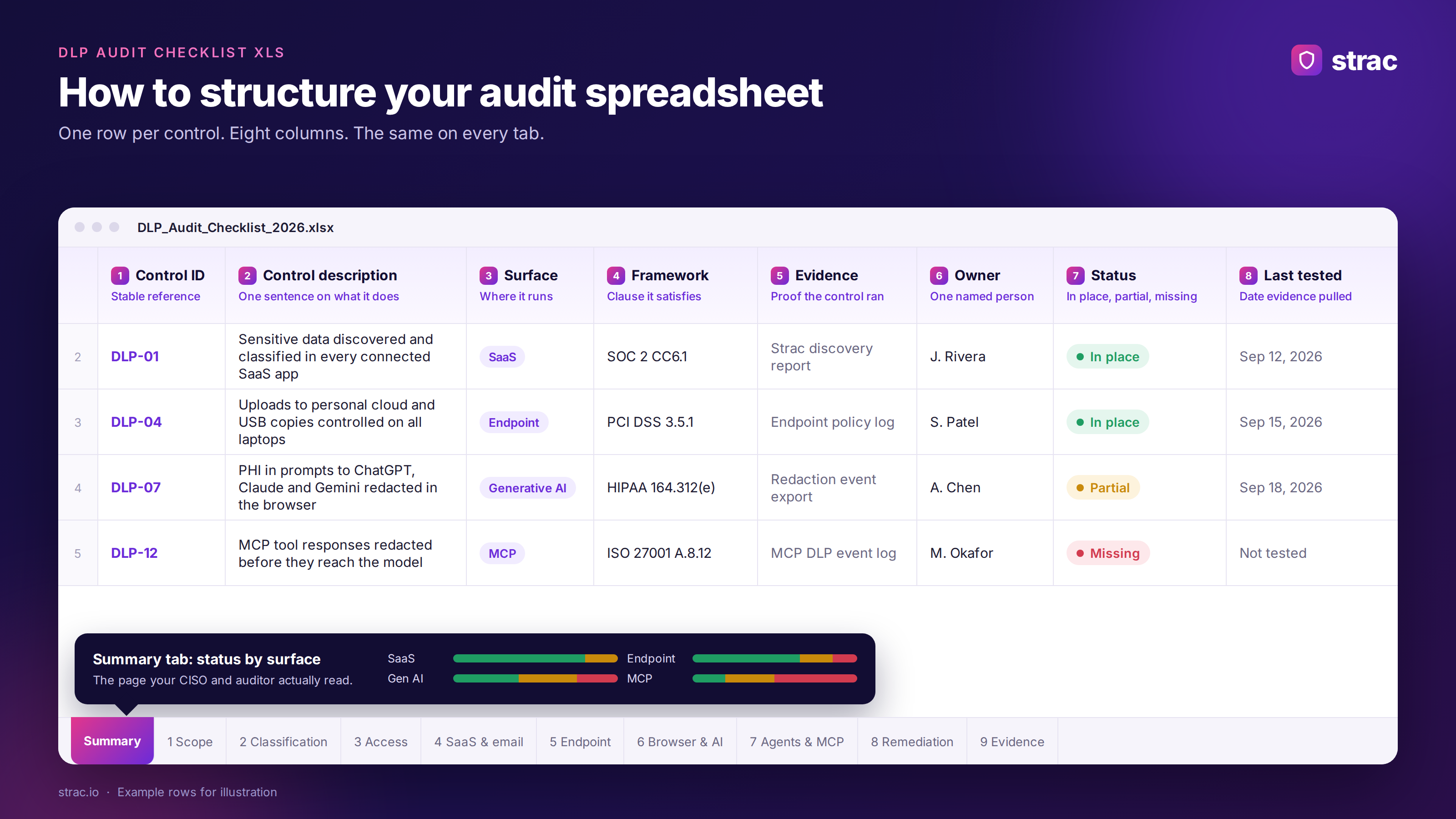
Build one row per control and keep the columns the same across every tab. These columns cover what auditors ask for:
Control ID: a stable reference such as DLP-01 that never changes between audits
Control description: one sentence on what the control does
Surface: SaaS, cloud, endpoint, browser, generative AI, or MCP
Framework mapping: the SOC 2, HIPAA, PCI DSS, GDPR, ISO 27001, or NIST clause it satisfies
Evidence: the log, report, or export that proves the control ran
Owner: one named person, not a team
Status: in place, partial, or missing
Last tested: the date the evidence was last pulled
Use one tab per section below, plus a summary tab that counts status by surface. That summary is the page your CISO and auditor will actually read.
The DLP Audit Checklist: Controls by Section
1. Scope and data inventory
☐ Every system that stores or moves sensitive data is listed, including SaaS apps, cloud storage, endpoints, and AI tools
☐ Sensitive data types are defined for your business, including custom identifiers
Watch Strac detect a card number in a Slack message, redact it in place, and log the action as evidence in one motion.
A checklist row marked "in place" is a claim. A redaction with a timestamp is proof.
This is where most spreadsheet audits stall. Someone marks a row green, the auditor asks for proof, and the team spends a week pulling screenshots. When detection, remediation, and logging run on the same platform, the evidence column fills itself.
🎥 Strac: The Platform Behind Every Row
Strac is a DLP, Data Discovery, and DSPM platform that turns the audit checklist from a document into a running control set.
Detection that holds up in an audit. Built-in detectors cover PII, PHI, PCI data, secrets, and source code, and custom detectors take minutes to create. Machine learning models keep false positives low, and OCR inspects images, screenshots, PDFs, and Word files, where most legacy tools stop. Start with sensitive data discovery and classification.
Coverage for every surface on the checklist.SaaS DLP connects to Slack, Gmail, Google Drive, Microsoft 365, Salesforce, Zendesk, Jira, Confluence, and Box in under ten minutes. Endpoint DLP enforces policy on macOS, Windows, and Linux. AI DLP redacts prompts in ChatGPT, Claude, Gemini, and Copilot. MCP DLP redacts tool responses so an agent with broad access still cannot exfiltrate raw records.
Posture and access.DSPM finds public links, external shares, and excessive access, then fixes them automatically by revoking access or redacting fields.
Remediation by default. Inline redaction and an API let you mask sensitive data wherever it appears, with blocking kept for the narrow cases. Out of the box compliance templates map policies to SOC 2, HIPAA, PCI DSS, GDPR, ISO 27001, CCPA, and NIST.
Evidence without screenshots. Every detection and fix is logged and exportable, and Strac Comply maps one piece of evidence to several frameworks at once. The evidence column in your XLS becomes a link to a report, not a folder of screenshots.
A spreadsheet audit ends with a list of gaps. A Strac audit ends with the gaps already closed.
A DLP audit checklist XLS is only as good as the controls behind each row. Identity, network, and policy controls all fail eventually, so the data layer is the backstop: find sensitive data everywhere, redact it on every action, and log each fix as evidence, so a compromise never becomes a breach. Strac runs that loop across SaaS, cloud, endpoint, browser, GenAI, and MCP. Book a demo to see your checklist fill itself.
🌶️ Spicy FAQs on the DLP Audit Checklist
Is a DLP audit checklist the same as a DLP risk assessment?
No. A risk assessment finds and ranks exposures. An audit checklist tests whether the controls that fix those exposures exist and work. Run the data loss prevention risk assessment first, then use its findings to add rows to the checklist.
Why isn't our existing DLP enough to pass the checklist?
Because most legacy DLP was built for email and file servers. It rarely inspects Slack, browser pastes into generative AI, or MCP tool calls, so those rows stay red. See why legacy DLP fails for AI.
Do the AI rows mean we have to block ChatGPT?
No. Blocking pushes people to personal devices, where you lose visibility completely. Redaction lets teams keep using generative AI while the sensitive fields never leave the browser, which satisfies the control without slowing anyone down.
Can a checklist prove no sensitive data ever leaked?
Not on its own. A checklist proves controls exist, and detection always misses something. That is why remediation belongs at the data layer: redaction on every action means a missed detection rarely becomes a reportable breach.
How often should we update the DLP audit checklist XLS?
Review it every quarter and after any new SaaS app, AI tool, or MCP server goes live. The controls should run continuously even if the spreadsheet is reviewed quarterly. See data loss prevention compliance for the full evidence program.
Discover & Protect Data on SaaS, AI, MCP, Endpoints & Cloud
Strac provides end-to-end data loss prevention for all SaaS and Cloud apps. Integrate in under 10 minutes and experience the benefits of live DLP scanning, live redaction, and a fortified SaaS environment.


.webp)







.avif)



.gif)
