August 19, 2026

5
min read
Is OneDrive PCI Compliant?
Exploring OneDrive's Compliance with PCI DSS Standards
Microsoft OneDrive is one of the most widely used cloud storage platforms for business documents, spreadsheets, PDFs, and collaboration. Because employees frequently upload customer files, invoices, reports, and exports, sensitive payment information often finds its way into OneDrive without security teams realizing it.
The important distinction is this:
OneDrive is not inherently PCI compliant. Microsoft provides security capabilities that can support PCI DSS compliance, but organizations remain responsible for how payment card information is stored, accessed, monitored, and protected.
Compliance depends on your organization's security controls, governance, and continuous monitoring—not simply the platform itself.

Yes, but only when there is a legitimate business need and appropriate PCI DSS controls are in place.
Examples include:
The problem is that these files often contain:
Once these files are shared internally, downloaded, duplicated, or synced across devices, visibility becomes extremely difficult.
Simply encrypting OneDrive is no longer enough.
Modern PCI DSS expects organizations to continuously know:
Absolutely.
In most organizations, PCI data leaks happen because of everyday employee behavior rather than sophisticated cyberattacks.
Common examples include:
These risks grow as organizations rely more heavily on SaaS collaboration.
Without continuous discovery and automated remediation, sensitive payment data can remain exposed for months.
PCI DSS 4.0 places greater emphasis on continuously protecting cardholder data wherever it exists—including cloud storage platforms like OneDrive.
Organizations must know where PAN exists.
This includes:
Unknown PCI data is one of the biggest compliance risks.
Requirement 3 requires organizations to ensure PAN is protected during storage.
This typically includes:
Simply uploading an unencrypted spreadsheet into OneDrive can create compliance issues.
PCI DSS 4.0 introduces stronger expectations around preventing unauthorized copying, movement, and sharing of PAN.
Organizations should be able to identify when payment information is:
Compliance is no longer a one-time exercise.
Security teams should continuously:
If payment information becomes exposed, organizations should be able to:
Fast remediation is now just as important as detection.
Native Microsoft capabilities provide a solid security foundation, but many organizations need broader visibility across cloud applications and faster remediation.
Strac combines DSPM (Data Security Posture Management) with modern SaaS DLP to continuously discover, classify, and remediate sensitive payment data across OneDrive and the rest of your SaaS environment.
Strac continuously scans OneDrive to locate payment card data across:
Rather than relying only on pattern matching, Strac uses ML-powered, content-aware detection to improve accuracy and reduce false positives.
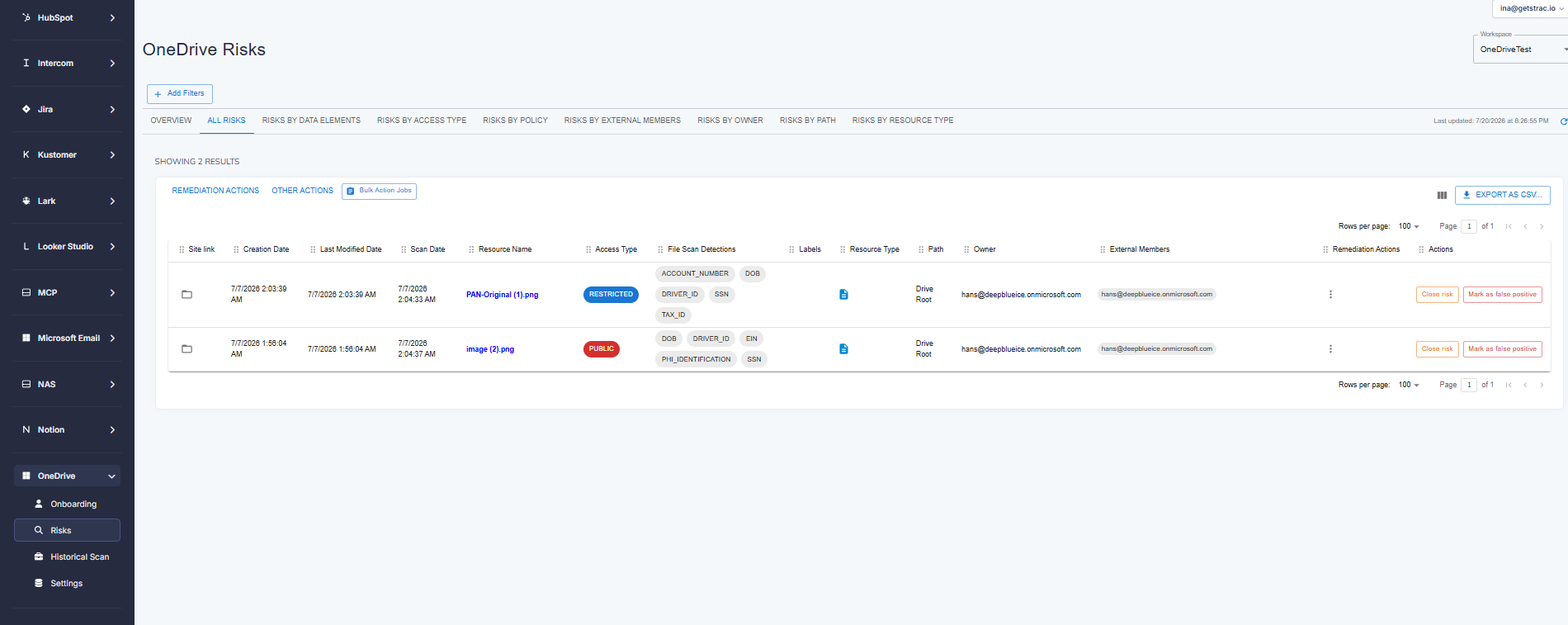
Finding sensitive data is only half the job.
Strac can automatically:
This significantly reduces manual investigation time.

Payment information rarely stays in one application.
Strac extends protection across:
Security teams receive one unified view instead of managing multiple disconnected tools.
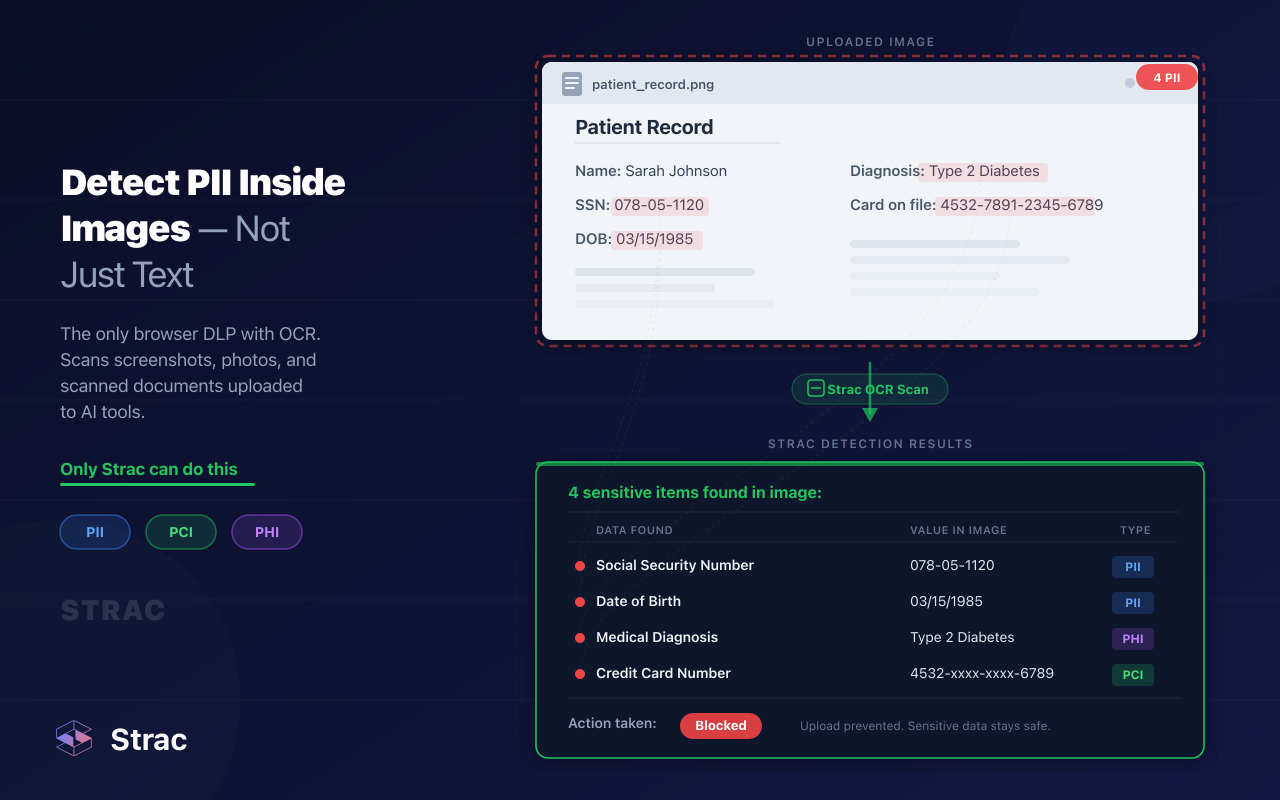
Modern payment data isn't only stored as text.
Strac can detect PCI information inside:
This closes an increasingly common blind spot for traditional DLP solutions.
Strac helps organizations prepare for PCI DSS compliance and audits with:
Unlike traditional DLP tools that generate alerts for security teams to investigate manually, Strac focuses on reducing exposure immediately through automated remediation.
Key advantages include:
OneDrive can absolutely be part of a PCI DSS-compliant environment, but compliance depends on how your organization manages the payment data stored inside it.
As PCI DSS 4.0 shifts toward continuous discovery, monitoring, and rapid remediation, simply encrypting files or restricting access is no longer sufficient. Organizations need visibility into where payment data exists, how it moves, and the ability to remediate exposure automatically.
Strac helps security teams discover, classify, and protect PCI data across OneDrive and the entire modern SaaS ecosystem with AI-powered detection, automated remediation, and unified DSPM + DLP capabilities.
No. Microsoft provides security capabilities that support PCI DSS, but organizations are responsible for configuring controls, monitoring payment data, and meeting PCI DSS requirements.
Yes. Employees frequently upload invoices, spreadsheets, PDFs, CRM exports, support attachments, and screenshots containing cardholder data without realizing it.
Purview provides important classification and DLP capabilities, but many organizations extend it with platforms like Strac for broader SaaS visibility, deeper content inspection, AI application coverage, and automated remediation.
Yes. Strac uses OCR and content-aware AI detection to identify payment card data inside PDFs, Word documents, Excel files, ZIP archives, screenshots, scanned documents, JPEGs, PNGs, and other unstructured content.
Yes. Depending on your policy, Strac can automatically redact, mask, encrypt, quarantine, delete, or otherwise remediate exposed PCI data, helping reduce compliance risk without relying solely on manual investigation.
.avif)


.gif)


.webp)