October 11, 2026

4
min read
Is Notion HIPAA Compliant?
Learn how Notion can be used to handle sensitive PHI in compliance with HIPAA standards.
Reviewed October 2026.
HIPAA compliance is about one thing; protecting PHI everywhere it lives. The Health Insurance Portability and Accountability Act requires organizations that handle health data to implement administrative, technical, and physical safeguards; not just policies on paper.
At a minimum, HIPAA requires:
Security features alone don’t equal compliance. If a tool stores, processes, or exposes PHI; it must support enforceable controls, visibility, and remediation; not just storage.

Notion is a productivity app offering a range of organizational tools such as task management, project tracking, and web bookmarking. A large number of organizations, including healthcare organizations, use Notion for tasks such as project management, collaboration, and documentation.
The good news is that Notion can be used in a way that is HIPAA compliant. However, healthcare organizations should note that Notion’s basic plans are not suitable for handling PHI. In order to comply with HIPAA’s technical safeguarding requirements, specific configuration settings must be applied within Notion.
Notion can be configured to support the following security measures:
To make their Notion workspace HIPAA compliant, users must take the steps that effectively enable these security measures.
To comply with HIPAA, third-party vendors must have a Business Associate Agreement (BAA) in place with their partners.
Notion does offer a BAA that governs the protection of all Personal Health Information (PHI) stored in Notion. However, the BAA is only available to customers that are subscribed to Notion’s Enterprise plan and have more than 100 members.
Also note that, in meeting the terms of the BAA agreement and maintaining compliance with HIPAA, certain Notion features are not usable. These restricted features include Notion Calendar and Cron-related features, and the Notion AI Add-on.
Notion is designed as a general-purpose organization and collaboration tool. The standard plans are not designed, or able, to meet the stringent data security requirements of HIPAA, particularly around safeguarding PHI.

PHI and sensitive patient data can be stored in Notion, but only by organizations on an Enterprise plan that is configured specifically to safeguard PHI. Without implementing these required configuration settings, you risk non-compliance with HIPAA and open yourself up to significant litigation and legal risks.
Considering Notion’s use as a collaboration tool, where data can be easily shared, collaborated and exported concerns over data leaks are warranted. There are legitimate concerns over unauthorized access, but leaks of PHI and patient data from Notion could arise from multiple failures including misconfigured permissions and data interceptions.
At a minimum, the safe handling and effective safeguarding of PHI in Notion requires a BAA and a HIPAA compliant configuration.
The Strac Notion DLP app prevents data leaks, by automatically detecting and redacting sensitive data in messages and files from Notion pages, blocks, and comments.

The Strac Notion DLP adds an additional layer of security to Notion workspaces. This is a solution that is built around Strac’s extensive experience in securing Endpoint & SaaS apps.
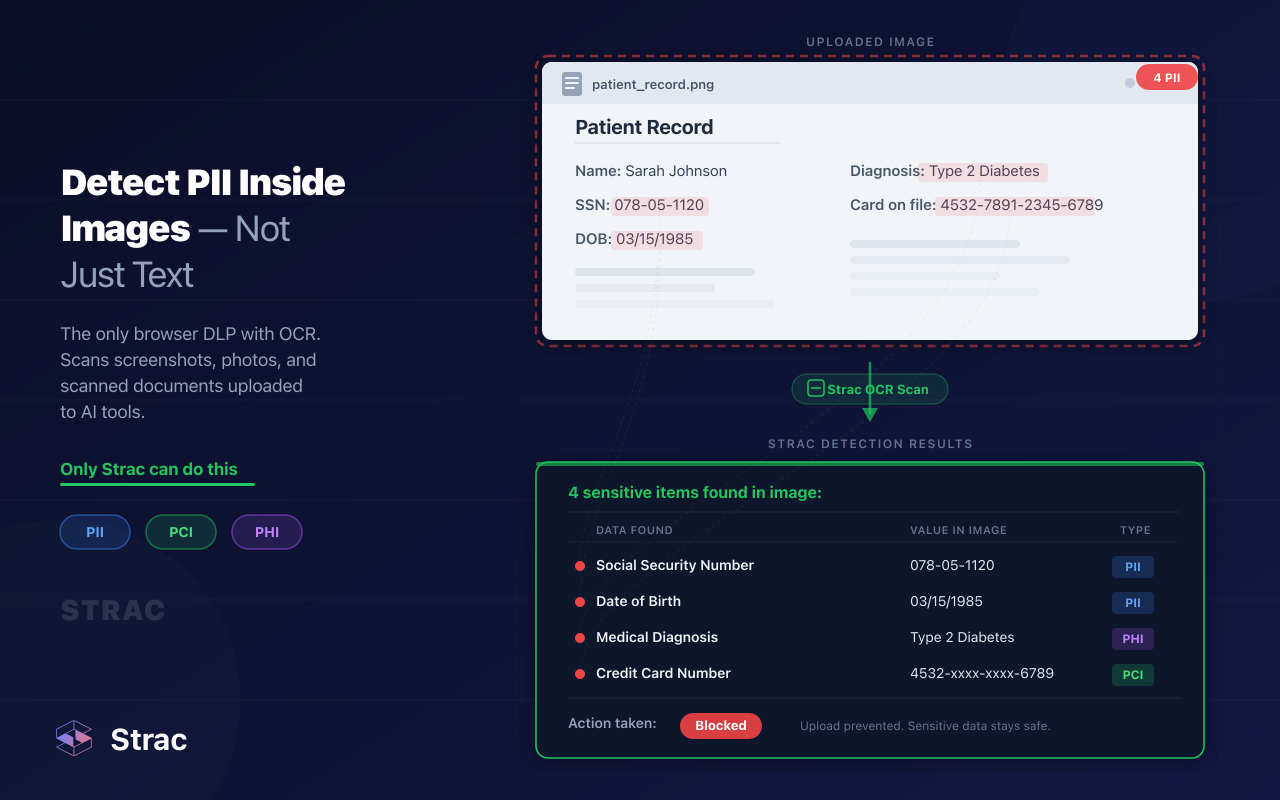


Learn more about how Strac can help organizations comply with HIPAA with our guide to HIPAA Compliance and our complete range of DLP integrations.
Schedule a free 30-minute demo to learn more.

Notion is not HIPAA compliant, and it does not sign a Business Associate Agreement; this makes it unsuitable for storing, sharing, or collaborating on PHI. Although Notion is excellent for documentation and team operations, healthcare organizations and any business handling regulated data must avoid using it for sensitive information. When teams need modern collaboration without HIPAA risk, Strac steps in by providing real-time redaction, automated PHI detection, access posture visibility, and SaaS-wide DLP to eliminate accidental exposure; with Strac, companies get the collaboration flexibility they love while ensuring every piece of sensitive health data stays protected.
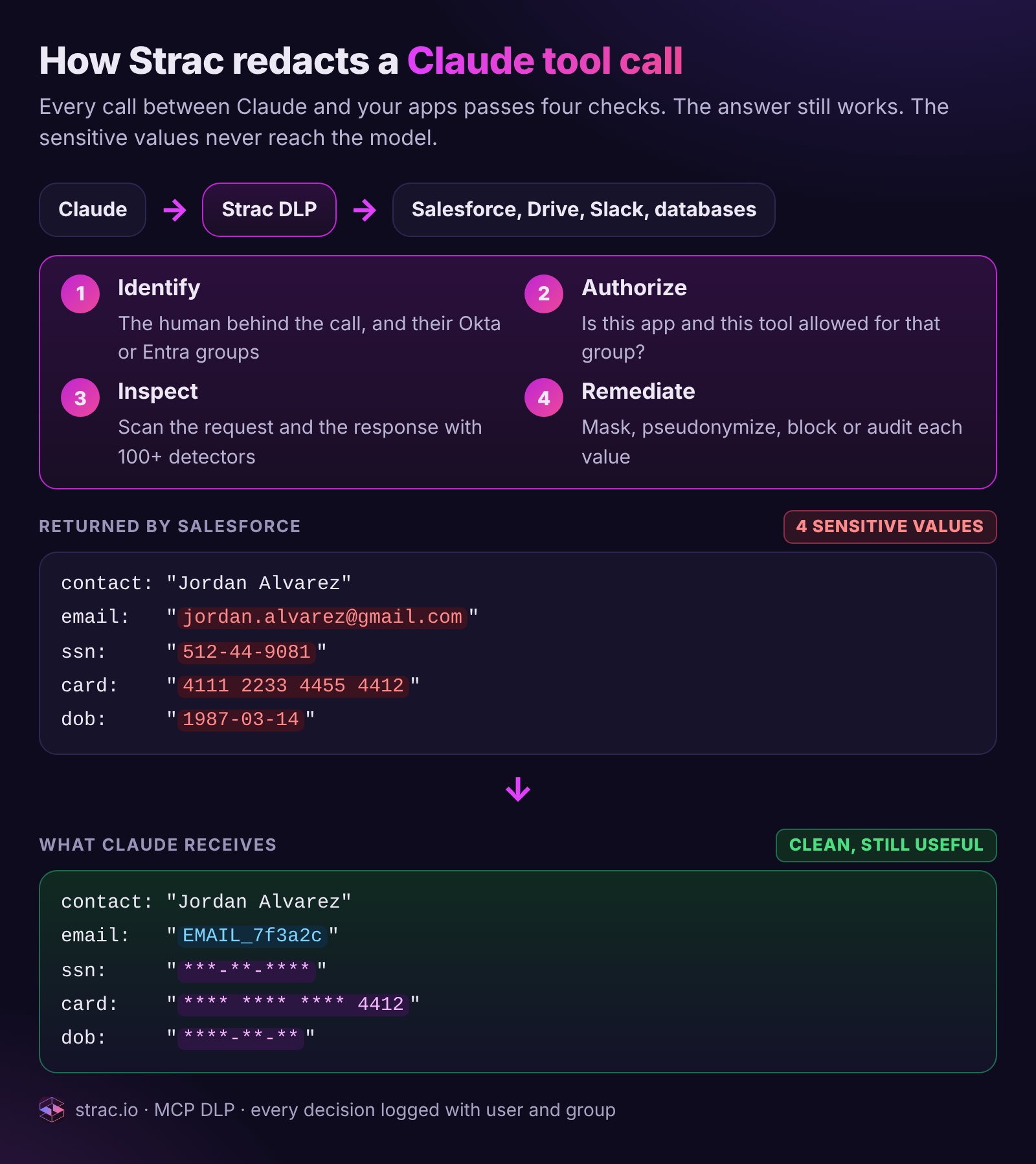
Notion is where teams keep docs, wikis, and databases, which means it routinely holds patient notes, care plans, and intake forms — PHI covered by your BAA. The newest HIPAA risk isn’t Notion itself; it’s what happens when someone connects Notion to an AI assistant over the Model Context Protocol (MCP). Many teams now use Claude Cowork, and Anthropic does not sign a BAA for it. The moment an agent queries Notion over MCP, that PHI can flow straight to a model sitting outside your BAA — a reportable exposure, even though the underlying app is configured correctly.
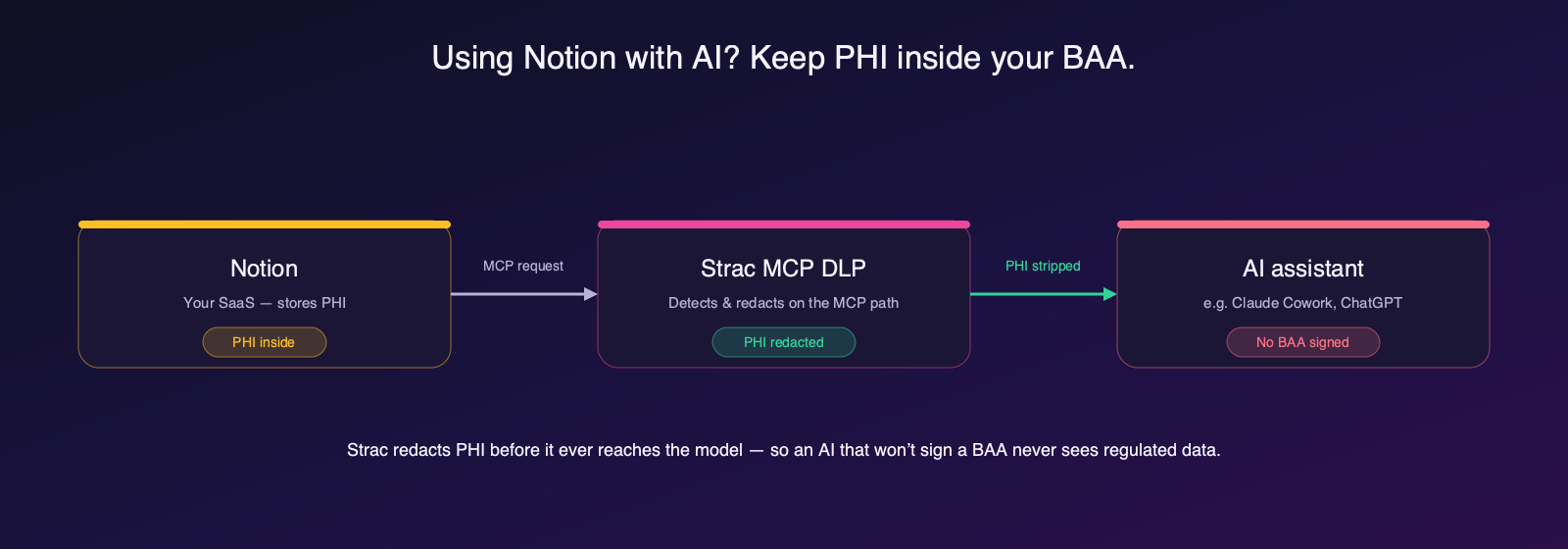
Strac MCP DLP closes that gap. It sits on the MCP path between Notion and the AI, detects PHI in every request and response, and redacts, masks, or blocks it before it reaches the assistant — so an AI that won’t sign a BAA never sees regulated data. Every action is audit-logged for HIPAA. See Notion MCP server for how the connection works.
Related reading:
More HIPAA compliance guides:
Checking other tools too? See is ChatGPT HIPAA compliant for OpenAI’s stance on PHI.
Can I use Notion with Claude or ChatGPT and stay HIPAA compliant? Only if PHI never reaches a model that isn’t under a BAA. Claude Cowork does not sign one, so connecting Notion over MCP can expose PHI. Strac MCP DLP redacts PHI on the MCP path before it reaches the assistant, keeping the connection HIPAA-safe with a full audit trail.
Notion cannot be used to store medical records, PHI, or any HIPAA-regulated information because it does not sign a Business Associate Agreement. Without a BAA, storing PHI automatically violates HIPAA requirements.
How Strac helps: Strac enables safe collaboration by detecting PHI across SaaS apps; automatically redacting or removing it before it becomes a compliance risk.
Notion is intentionally built as a flexible, general-purpose workspace rather than a regulated-data management system. HIPAA compliance requires strict controls; encryption models; audit logs; user-level access policies; breach procedures; and a BAA.
How Strac helps: Strac provides HIPAA-aligned data scanning and remediation across your existing tools; removing sensitive data from non-compliant systems instantly.
Accidentally adding PHI to a non-HIPAA system is considered an unauthorized disclosure; this can trigger reportable breaches, fines, and mandatory notifications. Even brief exposure counts as a compliance violation.
How Strac helps: Strac continuously monitors SaaS tools; detects PHI; and auto-redacts or deletes exposed content so organizations avoid costly violations.
HIPAA-compliant alternatives typically offer BAAs, strong encryption models, audit logs, and granular access control. While Notion focuses on productivity and collaboration, regulated environments should use tools specifically engineered for healthcare workflows.
How Strac helps: Strac overlays an additional layer of DLP and DSPM protection on these platforms; ensuring PHI is properly identified, classified, and remediated across your entire SaaS stack.
Teams can still use Notion for project planning, documentation, and internal operations; they simply need strict guardrails preventing PHI from ever reaching the platform. The safest approach is pairing team workflows with automated PHI monitoring.
How Strac helps: Strac prevents PHI from spreading into Notion by scanning connected apps, detecting sensitive data before upload, and blocking PHI from being copied; stored; or shared in insecure tools.
.avif)


.gif)


.webp)