August 19, 2026

4
min read
Is Google Sheets HIPAA Compliant?
Learn if Google Sheets is HIPAA Compliant, its benefits and drawbacks.
Google Sheets, part of Google Workspace, is a widely used application for data organization and analysis. With healthcare organizations increasingly turning to cloud-based tools for data management and analysis, there are questions around the suitability of certain applications —particularly in relation to HIPAA compliance.
The good news is that Google Sheets is HIPAA compliant, provided it is configured and utilized in the right way.
Healthcare organizations can use Google Sheets to create, manage, and share sheets that contain Protected Health Information (PHI) only when they meet the following requirements:

The foundation of HIPAA compliance within Google Workspace is the Business Associate Agreement; without a signed BAA, no Google product can be used to store, process, or share ePHI. Google offers a BAA, but it only covers specific Workspace services; organizations often assume Sheets is covered when it may not be used correctly under HIPAA safeguards. Understanding what the BAA actually includes helps determine whether Google Sheets is appropriate for managing ePHI.
When using Google Workspace under HIPAA, organizations must confirm:
With the BAA, Google Sheets can be used securely only if all technical safeguards are enforced consistently. Without these controls, Sheets quickly becomes a source of unauthorized access, oversharing, and unmonitored ePHI movement.
Yes, it is possible to store PHI or patient data in Google Sheets, but only under specific conditions.

For example, sensitive data must be protected and the ability of both users and Google to access data must be restricted through access controls and other techniques.
To comply with HIPAA, third-party vendors must have a Business Associate Agreement (BAA) in place with their partners.
Google is willing to sign a BAA for Google Sheets. The BAA that Google offers covers the productivity tools that make up the Google Workspace suite, including Google Sheets, Google Drive, Google Docs, Google Slides, and Google Forms.
This comprehensive BAA underlines Google’s commitment to HIPAA compliance and willingness to meet the needs of Google Workspace customers.
Achieving HIPAA compliance whilst using Google Sheets involves more than just configuring the settings of your Google Workspace apps. Compliance is a shared responsibility that requires active management, including;
When entering into BAA with 3rd-party vendors, it is often the partner organization that ends up liable for security failures and leaks. Always ensure proper data security practices are upheld.
Even with the proper configuration of the Google Workspace, there is a risk of PHI or patient data being leaked. Aside from the improper configuration of settings, common causes for data leaks from Google Sheets include:
Organizations need to be aware of these risks and adopt additional safeguards to protect their handling and storing of PHI in Google Sheets.
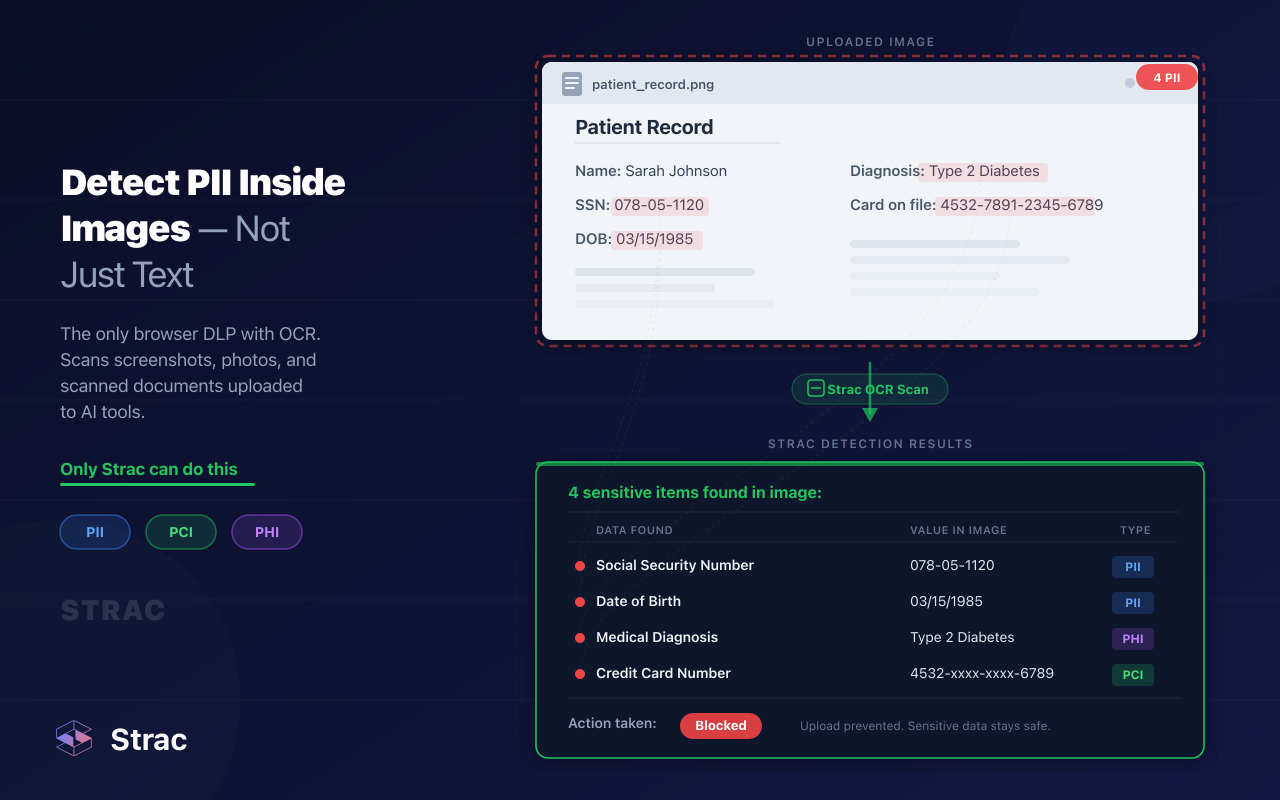
Google Sheets is convenient and widely used, but it introduces several serious risks when storing or sharing electronic protected health information; these risks usually arise from misconfiguration, oversharing, and the lack of granular data protections. Healthcare teams often create spreadsheets to track patient information, billing data, workflows, or schedules, which unintentionally exposes ePHI to unauthorized access. Understanding these risks helps organizations evaluate whether Google Sheets is truly suitable for PHI handling.
Common risks include:
These risks make Google Sheets highly prone to accidental disclosures. When healthcare organizations rely on Sheets without strong DLP and monitoring, the likelihood of HIPAA violations increases significantly.
Strac Google Sheets DLP is a data loss prevention software that replaces sensitive data with format-preserving pseudonyms. This allows developers and business analysts to work with sensitive data whilst staying compliant with data privacy standards such as those set out by HIPAA.

Strac Google Sheets DLP adds an additional layer of security by ensuring sensitive and protected data is only accessible on a need-to-know basis.
To give a simplified version of the process, the software works by creating a copy of the original Google Sheet with sensitive data elements replaced by format-preserving pseudonyms. This process effectively masks PHI or any other sensitive data contained within Google Sheets, CSV files, and even Microsoft Sheets.
The list of sensitive data elements that can be pseudonymized is long and can be configured to meet the needs of your organization.
Learn more about how Strac helps organizations comply with HIPAA with our guide to HIPAA Compliance or see our Google Sheets DLP demo.
Browse our complete range of Strac DLP integrations and book a free 30-minute demo to learn more.
Google Sheets can be used in HIPAA-regulated environments, but only when every required safeguard is configured correctly; most HIPAA violations occur due to oversharing, add-ons, and device misconfigurations rather than Google’s infrastructure. Healthcare organizations that rely on Sheets must enforce strict access controls, auditing, encryption, and DLP to prevent ePHI exposure across the Workspace environment. When in doubt, pairing Google Sheets with an automated DLP solution such as Strac greatly reduces operational risk by detecting, classifying, and remediating sensitive data in real time.
Google Sheets holds your spreadsheets, which means it routinely holds patient tracking sheets and billing data — PHI covered by your BAA. The newest HIPAA risk isn’t Google Sheets itself; it’s what happens when someone connects Google Sheets to an AI assistant over the Model Context Protocol (MCP). Many teams now use Claude Cowork, and Anthropic does not sign a BAA for it. The moment an agent queries Google Sheets over MCP, that PHI can flow straight to a model sitting outside your BAA — a reportable exposure, even though the underlying app is configured correctly.
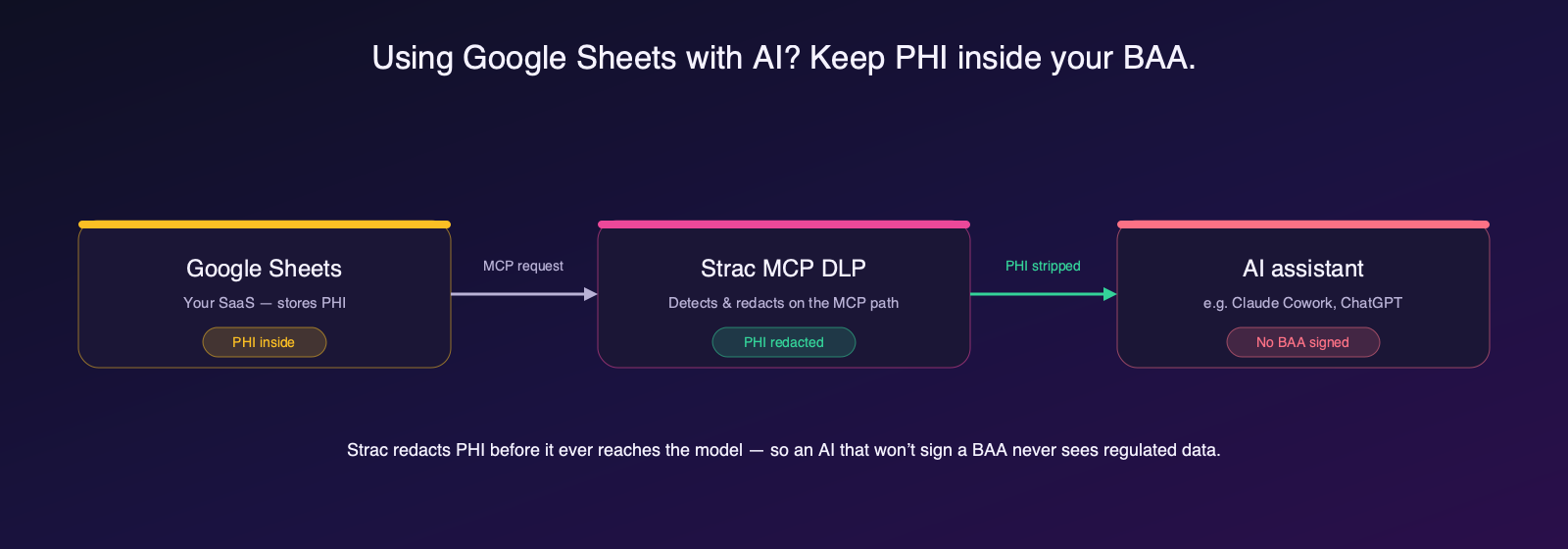
Strac MCP DLP closes that gap. It sits on the MCP path between Google Sheets and the AI, detects PHI in every request and response, and redacts, masks, or blocks it before it reaches the assistant — so an AI that won’t sign a BAA never sees regulated data. Every action is audit-logged for HIPAA. See Google Sheets MCP server for how the connection works.
Can I use Google Sheets with Claude or ChatGPT and stay HIPAA compliant? Only if PHI never reaches a model that isn’t under a BAA. Claude Cowork does not sign one, so connecting Google Sheets over MCP can expose PHI. Strac MCP DLP redacts PHI on the MCP path before it reaches the assistant, keeping the connection HIPAA-safe with a full audit trail.
Google Workspace requires a Business, Enterprise, or Education edition to support HIPAA compliance; these plans allow your organization to sign a BAA with Google. After signing the BAA, only specific Workspace services become HIPAA-eligible, and Sheets is included only when all admin safeguards are properly configured. Lower-tier Workspace plans do not support HIPAA requirements.
Yes; Google Sheets data is encrypted in transit using TLS and encrypted at rest using 256-bit AES as part of the broader Google Workspace security model. Encryption alone does not make Sheets HIPAA-compliant since access controls, auditing, and sharing restrictions must also be correctly applied. Encryption is only one piece of the required HIPAA safeguards.
Generally no; third-party add-ons are not covered under Google’s BAA, which means they may send ePHI to systems that are not compliant. Using add-ons, connectors, data pipelines, automation tools, or scripts increases the risk of exporting PHI to external, non-HIPAA-aligned services. HIPAA-compliant organizations typically disable all add-ons for users handling ePHI.
An accidental share is considered a potential HIPAA breach, which may require formal investigation, reporting, and notification depending on the exposure level. Google Workspace does not automatically retract or redact PHI once it has been viewed or downloaded by unauthorized parties. This is why real-time DLP tools like Strac are essential for detecting sensitive data and preventing risky sharing before a breach occurs.
Yes; HIPAA expects strong user authentication, and Google recommends enabling 2FA or stronger protections such as security keys for all accounts that access ePHI. Without 2FA, stolen credentials or compromised accounts can grant unauthorized access to Sheets containing protected data. Enforcing MFA across the Workspace tenant is a baseline requirement for HIPAA-aligned operations.
.avif)


.gif)


.webp)