August 18, 2026

6
min read
Is AWS S3 PCI Compliant?
Compliance in Cloud Storage: Is AWS S3 Equipped for PCI DSS 4.0?
· Yes, AWS S3 can store PCI data, but usingS3 does not automatically make your environment PCI DSS compliant.
· The bigger challenge in 2026 is knowing wherePCI data actually exists across S3, RDS, Redshift, DynamoDB, backups,files, logs, and other AWS data stores.
· Encryption and IAM matter, but they do not tellyou when PAN or other sensitive data has ended up somewhere it should not be.
· Modern AWS security requires DSPM + DLP tocontinuously discover, classify, monitor, and remediate sensitive data.
· Strac's AWSData Discovery & Classification discovers sensitive data across AWS andcan apply remediation including masking, labeling, access blocking, alerting,and secure deletion.
· AI introduces another AWS data path. GenAIapplications and AI agents can retrieve sensitive AWS data, making GenAI andMCP DLP part of the cloud data security conversation in 2026.
Amazon S3 is one of the world's most widely used object storage services. It is also where organizations can quietly accumulate years of customer exports, transaction records, backups, logs, PDFs, spreadsheets, and other files containing PCI data.
That creates a problem that encryption alone cannot solve.
You need to know where cardholder data exists, whether it belongs there, who can access it, how it is being used, and whether it is moving into SaaS applications, endpoints, browsers, GenAI tools, or AI agents.
That is where AWS data discovery, DSPM, and DLP come together.
Yes. AWS provides infrastructure and security capabilities that can support PCI DSS workloads.
Organizations can use controls including:
But there is an important distinction:
AWS being capable of supporting PCI-compliant workloads does not automatically make your S3 environment PCI compliant.
Your organization remains responsible for configuring and operating the environment appropriately under the shared responsibility model.
And configuration is only part of the problem.
You can have an encrypted, private S3 bucket and still have PCI data stored where your security team never intended it to be.
Consider a customer database that is properly encrypted and access-controlled.
An employee exports a portion to CSV. The CSV lands in S3. Another copy becomes part of a backup. A developer places sample data in another bucket. A support workflow creates an attachment containing cardholder information.
Suddenly, your PCI footprint is much larger than the original database.
This is why modern AWS security starts with sensitive data discovery.
Security teams need to continuously answer:
Knowing that you have 500 S3 buckets is infrastructure visibility.
Knowing that 17 of them contain PCI data is data security visibility.
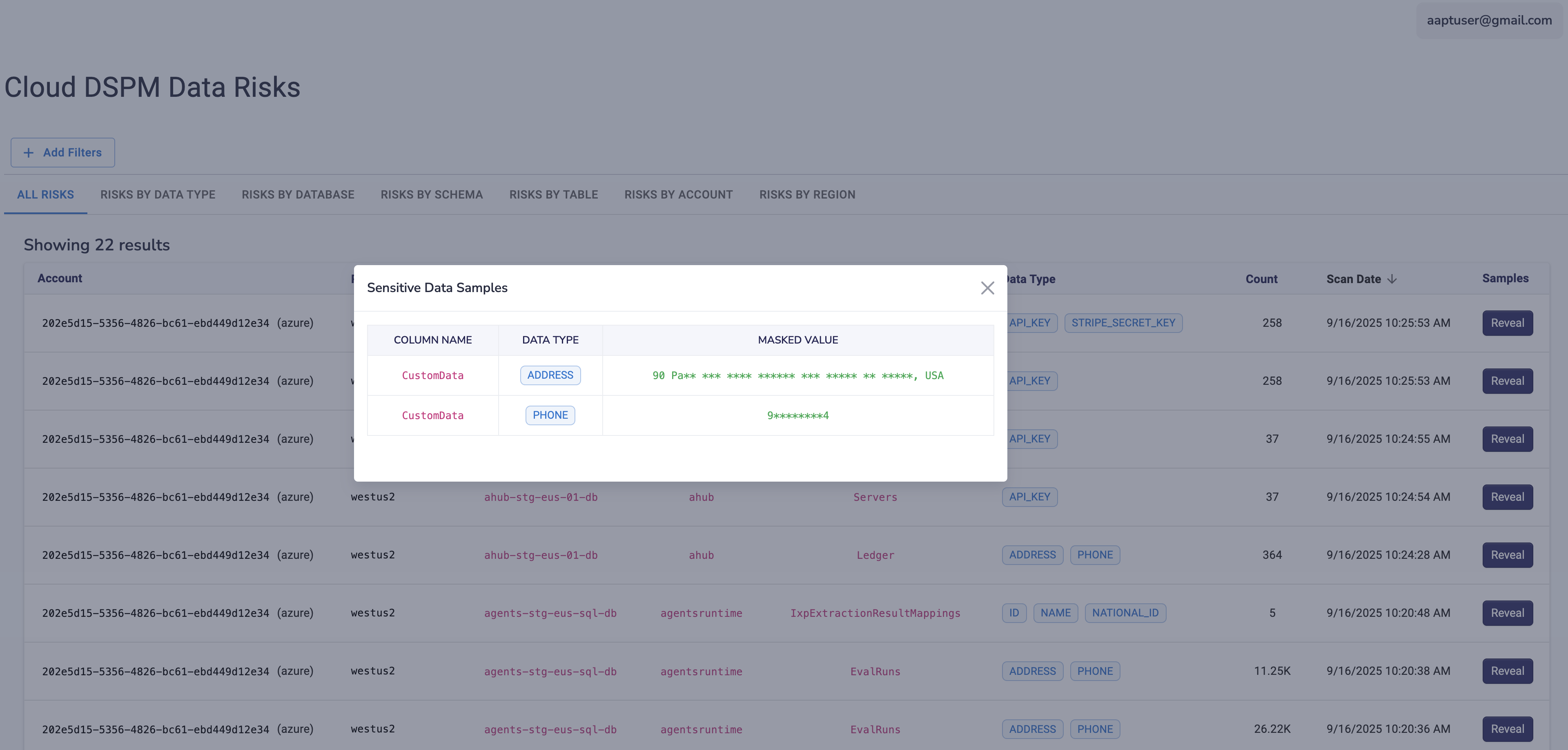
Data Security Posture Management, or DSPM, focuses security around the data itself.
Instead of only asking whether AWS infrastructure is configured correctly, DSPM asks:
Where is our sensitive data, who can reach it, and what risk does that create?
For AWS, that means discovering and classifying sensitive information across cloud data stores and connecting those findings to exposure, permissions, policies, and remediation.
A modern AWS DSPM workflow generally follows four steps:
Continuously scan AWS data stores for sensitive information.
Determine whether discovered data contains PCI, PII, PHI, credentials, secrets, or custom sensitive data types.
Determine where sensitive information is overexposed, incorrectly stored, unnecessarily retained, or accessible by the wrong identities.
Take action instead of generating another alert for someone to investigate later.
That last step is increasingly important.
Discovery tells you there is a problem. Remediation actually reduces the risk.
S3 itself is not inherently insecure. Problems generally emerge from how data is stored, accessed, copied, shared, and governed.
Overly permissive bucket policies, IAM permissions, external sharing, or public access can expose sensitive information.
Least privilege should therefore be continuously enforced rather than treated as a one-time configuration exercise.
One of the most dangerous PCI problems is data you do not know exists.
Cardholder data can appear inside:
Traditional infrastructure monitoring may tell you where a file exists without understanding what is inside it.
Sensitive data discovery closes that visibility gap.
Every unnecessary copy of PCI data expands the attack surface.
Organizations should establish clear retention policies and remove sensitive information that no longer has a legitimate business or regulatory purpose.
PCI data rarely stays inside one AWS resource forever.
It gets downloaded, exported, copied, processed, uploaded, shared, and increasingly fed into AI systems.
Protecting the bucket without understanding where its data moves creates a major blind spot.
PCI DSS puts significant emphasis on controlling, protecting, monitoring, and responding to cardholder data throughout its lifecycle.
For AWS environments, several areas deserve particular attention.
Organizations need controls around how Primary Account Numbers can be copied or relocated.
This becomes particularly important in cloud environments because authorized users and applications can move data between storage locations very quickly.
Knowing where PAN exists is therefore foundational to enforcing where it is allowed to move.
Stored PAN must be protected using approved methods where applicable.
Encryption and strong key management remain essential AWS controls, but organizations also need visibility into where PAN has appeared so those controls can be applied consistently.
You cannot protect sensitive data you do not know exists.
PCI compliance is not simply about protecting approved repositories.
Organizations also need processes for handling PAN discovered somewhere it should not be.
That creates a strong use case for continuous data discovery.
Instead of waiting for a manual audit to discover a forgotten CSV containing payment information, security teams can continuously scan AWS environments and respond when sensitive data appears.
AWS gives organizations powerful controls for securing infrastructure, identities, encryption, logging, and access.
Those capabilities remain essential.
But infrastructure security and data security answer different questions.
AWS security controls can help you determine whether a bucket is public.
DSPM helps determine whether that bucket contains 40,000 records of sensitive customer information.
IAM tells you who has access.
Sensitive data discovery tells you what they have access to.
CloudTrail tells you that an action occurred.
DLP and DSPM add context about the sensitive data involved and help security teams enforce policies around it.
The strongest architecture uses these capabilities together.
Strac AWS Data Discovery & Classification extends security beyond infrastructure configuration by discovering and classifying the sensitive information stored inside AWS environments.
The goal is not simply to find another exposed bucket.
It is to understand the data inside your AWS environment and do something when that data creates risk.
Strac automatically scans AWS data stores to identify sensitive information.
AWS coverage includes environments such as:
This gives security teams broader visibility than treating S3 as an isolated data security problem.
Strac combines machine learning, contextual detection, and OCR capabilities to identify sensitive information across structured and unstructured content.
That matters because PCI data does not always arrive as a neat database column called credit_card_number.
It may be buried inside an uploaded document, spreadsheet, image, PDF, or other unstructured file.
Organizations can also create custom classifications and policies around data specific to their environment.
The sensitive data already sitting in your cloud matters just as much as new data.
Strac supports historical and continuous scanning so organizations can discover legacy sensitive data while monitoring newly created or uploaded content.
This is particularly valuable for AWS environments that have accumulated years of files, exports, backups, and abandoned datasets.
Finding PCI is useful.
Reducing the exposure is better.
Depending on the workflow and policy, Strac supports remediation actions including:
This brings DLP enforcement into the DSPM workflow.
Instead of:
Discover → Alert → Ticket → Wait
security teams can move toward:
Discover → Classify → Assess → Remediate
This is one of the biggest changes in data security in 2026.
Your sensitive data may live in AWS, but that does not mean AWS is where it will leak.
An employee can download an S3 file and upload it to ChatGPT.
A developer can paste a secret into Claude.
A browser session can upload customer records to an unsanctioned SaaS application.
An AI agent can retrieve information directly from a connected data source.
The security boundary has moved from where data is stored to where data can travel.
That is why Strac's broader architecture spans cloud DSPM, SaaS DLP, Endpoint DLP, Browser DLP, GenAI DLP, and MCP DLP.
This is the new AWS data security problem many traditional PCI strategies were not designed for.
AI agents increasingly retrieve enterprise information through APIs, connectors, and the Model Context Protocol (MCP). That means an agent may be able to retrieve information originating from S3, databases, SaaS systems, and other enterprise repositories.
The question is no longer only:
"Can this user access this S3 object?"
It is also:
"Should this AI agent be allowed to retrieve this sensitive information and send it to a model?"
MCP DLP provides a policy enforcement layer for these agentic workflows.
Strac can inspect AI-agent tool calls at the MCP layer and enforce sensitive-data policies before regulated or confidential information reaches an AI model.
For PCI environments, this extends data protection from storage into the emerging AWS → agent → LLM data path.
A strong approach combines several layers.
Use encryption, KMS, IAM, bucket policies, logging, public-access restrictions, and least privilege.
Continuously scan AWS stores to determine where PCI, PII, PHI, secrets, and other sensitive information actually exist.
Understand the sensitivity, location, permissions, exposure, retention, and business context surrounding the data.
Mask, redact, restrict, label, alert on, or securely remove sensitive information according to policy.
Extend DLP beyond AWS into SaaS applications, browsers, endpoints, and GenAI tools.
Inspect MCP and other agentic data flows so sensitive AWS data cannot simply bypass existing controls through an AI agent.
This is the difference between protecting an S3 bucket and protecting the lifecycle of the data stored inside it.
Yes, AWS S3 can be used for PCI data.
But in 2026, the harder question is not whether S3 supports encryption.
It is whether you know everywhere PCI data exists, who can access it, whether it is exposed, where it moves, and whether humans or AI agents can pull it into unauthorized systems.
Strac brings AWS data discovery and classification into a broader DSPM + DLP architecture. Security teams can discover sensitive data across AWS, classify it, identify risk, apply remediation, and extend protection across SaaS, endpoints, browsers, GenAI, and MCP workflows.
That turns AWS PCI security from a configuration exercise into continuous data protection.
AWS provides infrastructure and services capable of supporting PCI DSS workloads, but simply storing cardholder data in S3 does not make an organization compliant. Your configuration, access controls, encryption, monitoring, data handling, retention, and operational processes still matter.
No. Encryption protects the contents under certain threat scenarios, but it does not tell you whether PCI is stored in the wrong bucket, unnecessarily duplicated, overexposed, retained too long, or being moved into another application. That is why data discovery and DSPM matter.
That is exactly where basic pattern matching and infrastructure monitoring can fall short. Modern sensitive-data discovery should inspect unstructured documents and images using capabilities such as contextual detection, ML, and OCR so sensitive data can be classified even when it is buried inside a file.
No. Amazon Macie focuses on discovering sensitive data in Amazon S3. A broader DSPM approach looks across multiple data stores and connects discovery to classification, posture, access, remediation, and other data-security surfaces. Strac extends discovery and remediation across AWS as part of a broader SaaS, cloud, endpoint, browser, GenAI, and MCP security platform.
Yes. If an AI agent or GenAI application has access to enterprise data, sensitive information can potentially move from an approved AWS environment into an AI workflow. Modern DLP therefore needs to govern not only stored data but also GenAI prompts, browser uploads, endpoints, and MCP tool calls that can retrieve sensitive information.
.avif)


.gif)


.webp)