Data Loss Prevention: Exploring Zscaler Alternatives
Explore Zscaler alternatives for effective Data Loss Prevention (DLP), including solutions like Strac DLP, known for scalability, seamless integration, and comprehensive coverage.
Zscaler DLP inspects traffic that passes through the Zscaler cloud. Data that never crosses that path, such as files already sitting in Slack or Google Drive, or text pasted into an AI tool on an unmanaged device, needs another control.
Teams look at alternatives for four reasons: add-on pricing, gaps in SaaS DLP coverage, alert-only workflows, and new exposure through AI DLP and MCP DLP channels.
The five options worth a shortlist are Strac, Symantec DLP, Trellix DLP, Forcepoint DLP and Digital Guardian. The older four are strong on network and endpoint; they are heavier on SaaS, AI and remediation.
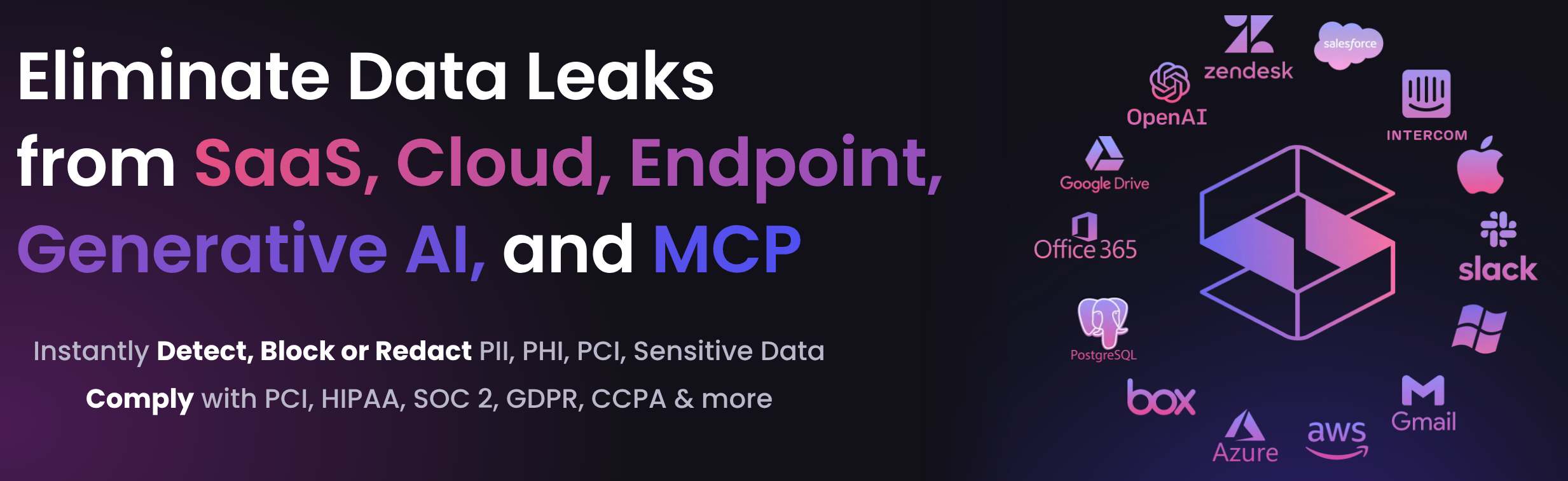
Strac covers SaaS, cloud, endpoint DLP, browser, generative AI and MCP in one platform, and it fixes exposure with redaction instead of only alerting.
What Are Data Loss Prevention Zscaler Alternatives?
Data loss prevention (DLP) is the set of controls that find sensitive data, decide whether a given use of it is allowed, and stop or fix the use that is not. That covers data in motion, data at rest and data in use, across networks, endpoints, SaaS apps, cloud storage and now AI tools.
A data loss prevention Zscaler alternative is any DLP product a team evaluates to replace Zscaler's DLP, or to cover the places Zscaler's DLP does not reach. Some buyers swap Zscaler out entirely. Most keep Zscaler for secure web access and add a dedicated DLP platform beside it.
The distinction matters. Zscaler is a security service edge platform with DLP built in. The alternatives below are DLP products first. The question is not which vendor is better in general; it is which one protects the data you actually have, where it actually sits.
How Zscaler DLP Works, and Where It Stops
Zscaler's DLP is built around inline inspection. Traffic from users routes through the Zscaler cloud, the DLP engine inspects it, and policy is enforced in that path. Zscaler adds out of band CASB scanning for some SaaS apps, an endpoint DLP module through its client agent, email DLP, and DSPM for public cloud data, all sharing one policy engine.
That design is a real strength for teams already running Zscaler for web security. One policy, one console, no extra proxy. It also shapes the limits:
Inline sees traffic, not stored data. A spreadsheet of customer records shared in a Slack channel last year never crosses the proxy again. Only API scanning finds it, and SaaS API coverage is limited to supported apps.
Key modules are add-ons. In Zscaler's published packaging, endpoint DLP and email DLP are add-ons in most editions, and the entry tier limits inline web DLP to monitoring and CASB to a single app.
Unmanaged devices are hard. A contractor on a personal laptop who never touches Zscaler is outside the inline path.
Detection is not remediation. Blocking an upload stops one event. It does not remove the card number already sitting in a Zendesk DLP ticket or the public link on a Google Drive file.
None of this makes Zscaler a weak product. It makes it a network product. For a fuller head to head with its closest peer, see Zscaler vs Netskope.
✨ Why Teams Look for Zscaler DLP Alternatives
Cost. When endpoint, email and full inline DLP are priced separately, the total for complete coverage climbs fast. A dedicated DLP platform can cost less than the add-ons needed to close the same gaps.
SaaS depth. Most sensitive data now lives inside SaaS apps: Slack DLP, Google Drive DLP, Office 365 DLP, Salesforce DLP and support tools. Protecting it means reading and acting inside each app, not watching the network edge.
AI and agents. Employees paste data into chatbots. Agents read databases over the Model Context Protocol. Inline inspection can see some browser traffic to AI sites, but it was not designed to redact a prompt before it is sent or to sit between an agent and its tools. That is the gap MCP DLP and AI DLP were built for.
Remediation. Security teams are tired of alerts that need a person to fix them. They want the platform to redact, revoke or block on its own, and log what it did.
Customization and scale. Regulated teams need custom detectors, data residency options and policies that differ by business unit. Fast growing teams need coverage that scales without rerouting more traffic.
The 5 Best Data Loss Prevention Zscaler Alternatives
1. Strac
Strac is a DLP, data discovery and DSPM platform built for where sensitive data lives now. It connects to SaaS apps through their APIs with no agent, covers devices through endpoint DLP for Windows, Mac DLP and Linux DLP, and covers AI use through Browser DLP, ChatGPT DLP, Claude DLP and MCP DLP.
What sets it apart from a proxy is remediation in place. Strac redacts a Social Security number inside a Slack message, removes a public link on a Drive file, or strips a card number from a prompt before the model sees it. Detectors cover PII, PHI, PCI data, secrets and custom patterns, with OCR for images and PDFs. SaaS integrations go live in minutes, and a customer hosted deployment is available for strict data residency.
Best for: teams that want SaaS, endpoint and AI coverage in one platform, with fixes instead of tickets.
2. Symantec DLP (Broadcom)
Symantec DLP, now part of Broadcom, is one of the longest running enterprise DLP suites. It covers network, endpoint, storage discovery and cloud, with mature content inspection and fingerprinting. The tradeoff is operational weight: on premises servers, detailed policy tuning and dedicated admins are common. See Symantec DLP alternatives and the Broadcom data loss prevention alternative breakdown.
Best for: large enterprises with an existing Symantec footprint and staff to run it.
3. Trellix DLP (formerly McAfee)
Trellix formed when McAfee's enterprise business merged with FireEye, and its DLP line descends from McAfee Total Protection for DLP. It covers endpoint, network, email and discovery, managed through a central policy console. It fits organizations already standardized on Trellix endpoint security, and it is more network and endpoint centered than SaaS native. Trellix appears in the CrowdStrike DLP alternatives comparison as well.
Best for: teams consolidating on Trellix endpoint tools.
4. Forcepoint DLP
Forcepoint DLP is known for risk adaptive protection, which adjusts policy based on user behavior, and for broad coverage across endpoint, network, cloud and email. It offers deep policy control and many prebuilt templates. Common concerns are deployment effort and false positives during tuning. Read Forcepoint alternatives or the direct Forcepoint vs Strac comparison.
Best for: enterprises that want behavior based policy and have time to tune it.
5. Digital Guardian (Fortra)
Digital Guardian, now owned by Fortra, is an endpoint first DLP built around a kernel level agent that tracks data use on Windows, Mac and Linux. It is strong on intellectual property protection and audit trails. SaaS and generative AI coverage is newer and less central to the product. See Digital Guardian alternatives.
Best for: manufacturers and IP heavy teams focused on the device.
How to Choose the Right DLP Platform
Use these five tests on every vendor, Zscaler included.
Coverage across data states. Ask how the product protects data in motion, at rest and in use. Then ask where: Slack, Google Workspace, Microsoft 365, ticketing, cloud storage, laptops, browsers, AI tools and agents. A gap in any one is where the next leak happens. Sensitive data discovery and classification across all of them is the baseline.
Remediation, not just alerts. Check which actions the product takes on its own. Strong DLP remediation follows a clear order:
Redact or mask. Remove the sensitive value in Slack, email, tickets, docs, Google Drive, SharePoint and Box, so the work continues and the data does not.
Block. Stop sensitive data from reaching a place it should never go, such as an unapproved AI tool.
Warn and coach. Explain the policy to the employee in the moment.
Revoke access. Remove public links, external shares and risky permissions when exposure is standing.
Integration effort. Count the agents, proxies and servers each option needs, and how long until the first real policy is enforced. Check SIEM, ticketing and API support so findings reach the tools your team already uses.
Accuracy at scale. Run each vendor on your own data. False positives decide whether a DLP program survives its first quarter. Confirm that detection holds up as data volume and user count grow, and that custom detectors are easy to add.
Compliance evidence. Confirm that every detection and action is logged with time, policy and outcome, and that the logs map to HIPAA, PCI DSS, SOC 2, ISO 27001 and GDPR requirements.
🎥 Strac: DLP for the Data Zscaler Does Not Route
Strac works at the data layer, not the network layer. It reads content inside each app, classifies it, and applies the fix there.
Endpoint and browser.Endpoint DLP watches files, USB, clipboard and uploads on managed devices. Browser DLP covers web apps on any device that runs the extension. Data lineage follows a file from Drive or SharePoint onto a laptop and out.
Generative AI and agents.AI DLP redacts sensitive data in prompts and uploads to ChatGPT, Claude, Gemini and Copilot. MCP DLP inspects every agent tool call, so a hijacked agent still cannot pull raw PII. Visibility into Shadow AI shows which unapproved tools are receiving company data.
Working with Zscaler. Strac does not need to replace Zscaler. Many teams keep Zscaler for web security and inline inspection, and use Strac for SaaS data at rest, AI, agents and in app remediation. Zscaler tells you data is leaving; Strac makes sure what leaves is safe.
Proxies, identity controls and endpoint agents each fail somewhere, and Zscaler's DLP is only as wide as the traffic it sees. The data layer is the backstop: find sensitive data wherever it sits, redact it on every action, and a gap in the network never becomes a breach. Strac covers SaaS, cloud, endpoints, browsers, generative AI and MCP in one platform, beside Zscaler or in place of it.
Book a demo to see what your current DLP is missing.
🌶️ Spicy FAQs on Data Loss Prevention Zscaler Alternatives
Is Zscaler DLP the same as a CASB?
No. Zscaler's CASB controls which cloud apps people use and scans some SaaS data by API. Its DLP engine inspects content for sensitive data. They share one policy engine, but a CASB decides where data may go, while DLP decides what data may go there.
Why doesn't Zscaler's DLP cover all of our SaaS data?
Inline DLP only sees data moving through the Zscaler cloud. Files and messages already stored in Slack, Drive or Zendesk need API based scanning, which depends on supported apps and edition. Agentless SaaS DLP reads that stored data directly.
Will adding another DLP tool slow our teams down?
Not if it redacts instead of blocks. Blocking pushes people to personal accounts and workarounds. Redaction removes only the sensitive value and lets the message, ticket or prompt go through, so the work continues and the exposure does not.
Can any DLP tool stop every leak?
No. Detection misses some data and people find new paths. That is why the data layer matters: if sensitive values are redacted at rest and on every action, a missed event or a compromised account finds far less to take.
Should we replace Zscaler or add a DLP platform beside it?
Usually add. Zscaler remains strong for secure web access and inline inspection. A dedicated platform covers SaaS data at rest, endpoints, AI and agents. The Zscaler alternatives roundup covers full replacements if you want them.
Customer story
“Don’t just alert on problems, fix them.”
Scott Roberts, Chief Information Security Officer, UiPath
Discover & Protect Data on SaaS, AI, MCP, Endpoints & Cloud
Strac provides end-to-end data loss prevention for all SaaS and Cloud apps. Integrate in under 10 minutes and experience the benefits of live DLP scanning, live redaction, and a fortified SaaS environment.