Business Data Loss Prevention in 2026: Why Traditional DLP Is No Longer Enough
Learn how modern Business Data Loss Prevention (DLP) protects sensitive data across SaaS, AI, cloud, browsers, endpoints, and MCP. Discover why traditional DLP falls short and how Strac delivers unified DSPM and DLP for 2026.
· Business DLP has evolved beyond email andendpoints. Organizations now need to secure sensitive data across SaaSapplications, cloud platforms, browsers, AI assistants, and MCP-connectedapplications.
· Traditional DLP solutions struggle withunstructured data, AI prompts, browser uploads, shared cloud files, and moderncollaboration tools, leading to high false positives and security gaps.
· Modern DLP combines Data Security PostureManagement (DSPM), content-aware detection, AI governance, and real-timeremediation to protect data wherever it moves.
· Strac delivers agentless DSPM and DLP acrossSaaS, Cloud, GenAI, browsers, endpoints, and MCP ecosystems with real-timeredaction, blocking, masking, encryption, and policy enforcement.
· Organizations can significantly reduce dataleaks, improve compliance, and accelerate security operations withoutdisrupting employee productivity.
Business data has never been more distributed; or more difficult to protect.
Every one of these platforms represents another opportunity for sensitive data to be accidentally shared, intentionally exfiltrated, or exposed through misconfiguration.
The challenge isn't simply detecting sensitive information anymore. It's protecting data while it moves continuously across SaaS applications, AI conversations, browser sessions, APIs, cloud environments, and endpoints.
Modern organizations need solutions that discover, classify, monitor, and remediate sensitive information in real time; 'without slowing employees down.
What Is Business Data Loss Prevention (DLP)?
Business Data Loss Prevention (DLP) is a collection of technologies and security policies designed to identify, monitor, and prevent sensitive information from being exposed, shared, or accessed by unauthorized users.
Modern DLP protects structured and unstructured data including:
Personally Identifiable Information (PII)
Protected Health Information (PHI)
Payment Card Information (PCI)
Intellectual property
Source code
Financial records
Customer information
Contracts
API keys
Authentication tokens
Internal business documents
Unlike legacy DLP that focused primarily on email gateways and endpoint devices, today's DLP platforms secure data wherever it exists—including SaaS applications, cloud storage, AI platforms, browsers, APIs, and endpoints.
Why Business DLP Matters More Than Ever
Consider a few everyday scenarios.
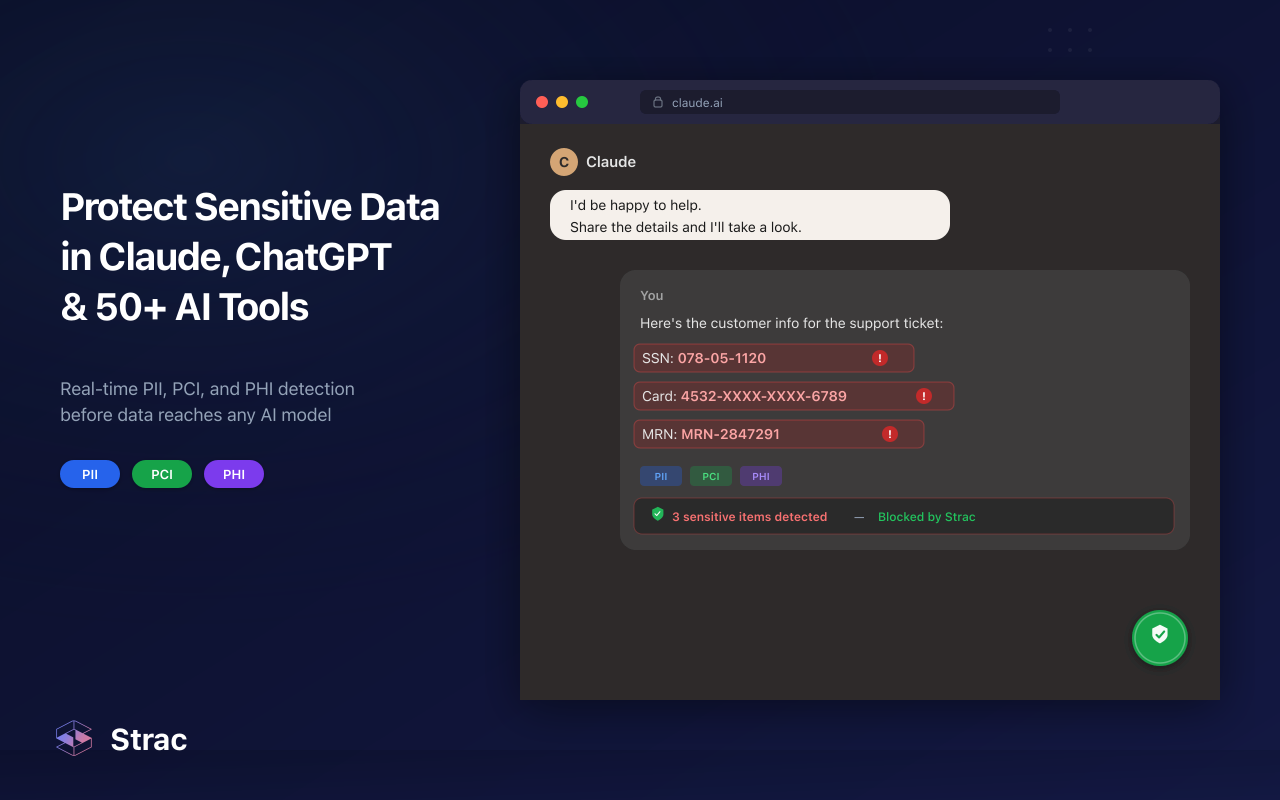
A customer support representative accidentally pastes a customer's Social Security Number into ChatGPT while drafting an email.
A developer commits API keys into Jira tickets that are synchronized across multiple systems.
A salesperson uploads a spreadsheet containing thousands of customer records into an AI assistant to summarize pipeline data.
An HR employee shares a Google Drive folder externally that contains payroll information.
None of these incidents involve sophisticated cyberattacks.
They're simply how modern work happens.
Today's biggest risk isn't only malicious insiders; it is employees moving quickly across dozens of interconnected applications.
Modern DLP exists to reduce these risks without preventing productivity.
The Biggest Data Loss Risks Businesses Face in 2026
Insider Mistakes
Most data leaks happen because employees make mistakes.
Examples include:
Sending sensitive information to the wrong recipient
Publicly sharing cloud folders
Copying confidential data into AI tools
Uploading regulated documents into personal storage
Sharing screenshots containing customer information
Modern DLP detects these events before data leaves your environment.
SaaS Application Sprawl
Organizations often operate hundreds of SaaS applications.
Every application stores, processes, or transfers sensitive information.
Without centralized visibility, security teams cannot answer simple questions such as:
Where does customer data exist?
Which applications contain regulated information?
Who has access?
Is sensitive data overshared?
DSPM and DLP together solve these challenges.
AI and Generative AI Data Leakage
Employees increasingly rely on AI assistants throughout the workday.
While AI improves productivity, it also creates entirely new data leakage vectors.
Examples include:
Sensitive prompts
Uploaded spreadsheets
Source code
Customer conversations
Financial reports
Internal documentation
Organizations need AI-native DLP capable of inspecting prompts, uploaded files, AI responses, and browser interactions before sensitive information leaves the organization.
MCP and AI Agents
One of the fastest-growing risks in 2026 is Model Context Protocol (MCP).
AI agents can access cloud applications, local files, internal documentation, Git repositories, CRMs, ticketing systems, and databases simultaneously.
Without proper governance, an AI agent may unintentionally expose sensitive information across connected systems.
Organizations increasingly require DLP capable of inspecting and controlling data flowing through MCP-connected applications.
Compliance Violations
Regulations continue becoming stricter.
Organizations must protect regulated information across every environment, including:
HIPAA
PCI DSS 4.0
GDPR
SOC 2
ISO 27001
CCPA
Modern DLP reduces compliance risk through continuous discovery, monitoring, automated remediation, and detailed audit trails.
🎥 What Makes an Effective Business DLP Solution?
Not every DLP platform is designed for modern cloud-first organizations.
The most effective platforms combine several capabilities.
Every organization using ChatGPT, Claude, Gemini, Microsoft Copilot, or custom LLMs should have policies controlling:
Prompt inspection
File uploads
AI-generated responses
Browser interactions
Session-level monitoring
AI governance has quickly become one of the core capabilities of modern DLP.
Why Traditional DLP Falls Short
Many legacy DLP platforms were designed for a world centered around email servers, network gateways, and endpoint agents.
Today's work looks completely different.
Legacy DLP often struggles with:
SaaS applications
Browser-based workflows
AI assistants
MCP-connected agents
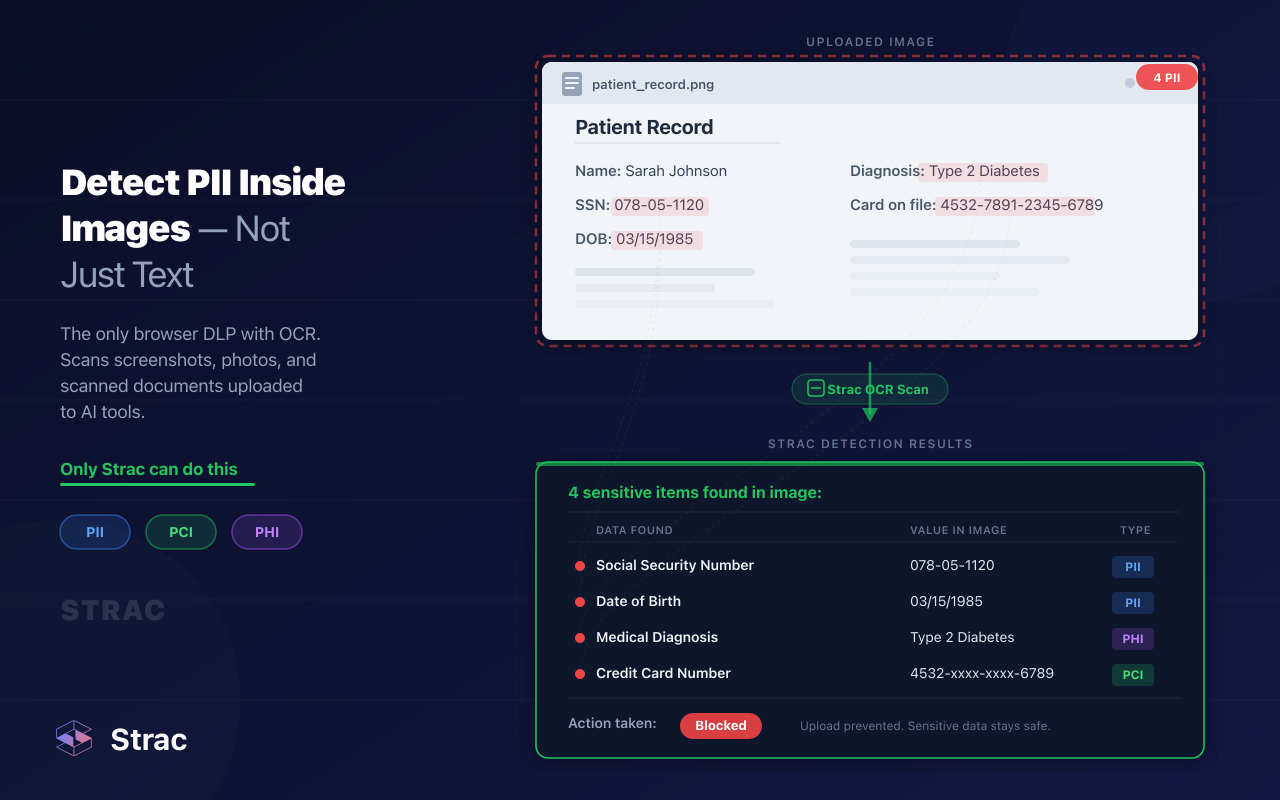
Images and screenshots
PDFs and scanned documents
Unstructured content
Excessive false positives
Complex deployments
Slow policy creation
As organizations adopt AI-first workflows, these limitations become increasingly difficult to manage.
🎥 How Strac Modernizes Business Data Protection
Strac was built specifically for today's SaaS-first, AI-powered organizations.
Instead of relying on legacy rule engines, Strac combines content-aware detection, Data Security Posture Management (DSPM), and Data Loss Prevention (DLP) into a unified platform.
Organizations use Strac to discover, classify, monitor, and remediate sensitive information across:
Rather than generating endless alerts, Strac enables organizations to automatically prevent sensitive information from leaving approved environments.
The Business Impact of Modern DLP
Organizations implementing modern DLP benefit from:
Reduced accidental data exposure
Improved compliance readiness
Better visibility into sensitive information
Lower security operations workload
Faster incident response
Reduced false positives
Safer AI adoption
Protection across rapidly growing SaaS environments
Most importantly, security teams can enable employees to work with modern collaboration and AI tools without sacrificing data protection.
Bottom Line
Business Data Loss Prevention has evolved far beyond blocking emails and monitoring endpoints. As organizations increasingly rely on SaaS applications, cloud platforms, AI assistants, browsers, APIs, and MCP-connected agents, sensitive data is constantly moving between systems. Protecting that data requires more than legacy rules and alerts—it demands continuous discovery, intelligent classification, real-time remediation, and unified visibility. Modern platforms like Strac combine DSPM, DLP, AI governance, browser protection, endpoint security, and content-aware detection into a single solution, allowing organizations to confidently embrace AI and cloud collaboration while keeping their most valuable data secure.
🌶️Frequently Asked Questions
How is Business DLP different from traditional endpoint DLP?
Business DLP protects sensitive information across SaaS applications, cloud platforms, AI tools, browsers, APIs, and endpoints. Traditional endpoint DLP primarily focuses on devices and often lacks visibility into modern cloud-first workflows.
Can Business DLP prevent employees from leaking data into ChatGPT or Claude?
Yes. Modern AI-native DLP solutions inspect prompts, uploaded files, browser sessions, and AI interactions to detect and remediate sensitive information before it reaches external AI models.
Why is DSPM important alongside DLP?
DSPM discovers and classifies where sensitive data lives, while DLP prevents that data from leaving approved environments. Together they provide complete visibility and protection across the entire data lifecycle.
What types of sensitive data should a Business DLP solution detect?
A modern solution should detect PII, PHI, PCI, intellectual property, financial records, customer information, credentials, API keys, source code, contracts, regulated documents, and custom business-specific data.
How does Strac protect sensitive data across SaaS, AI, and MCP?
Strac combines agentless DSPM, content-aware detection, browser DLP, endpoint DLP, AI governance, and real-time remediation—including redaction, masking, blocking, encryption, and quarantine—to protect sensitive information across SaaS applications, cloud platforms, AI assistants, browsers, APIs, endpoints, and emerging MCP-connected AI workflows.
Discover & Protect Data on SaaS, AI, MCP, Endpoints & Cloud
Strac provides end-to-end data loss prevention for all SaaS and Cloud apps. Integrate in under 10 minutes and experience the benefits of live DLP scanning, live redaction, and a fortified SaaS environment.


.webp)







.avif)



.gif)
