
Cart(
0
)
No items found.
Product is not available in this quantity.





Customers paste card numbers into chat and support tickets, engineers paste them into Jira and logs. Every system that stores a PAN pulls itself into PCI scope.
PCI DSS v4.0.1, the FTC Safeguards Rule, NYDFS Part 500 and the amended Regulation S-P all raise the bar on data inventory, access control and breach notification.
KYC documents, bank statements and driver's licenses get emailed, uploaded and shared. Many arrive as images or scans that keyword tools can't read.
Legacy DLP produces thousands of alerts with no fix. Lean security teams need tools that remove the data, not just report it.


Customers paste card numbers into support chats and agents forward them to Slack to resolve disputes. Strac masks PANs, account numbers and IDs in real time, which keeps those tools out of PCI scope.
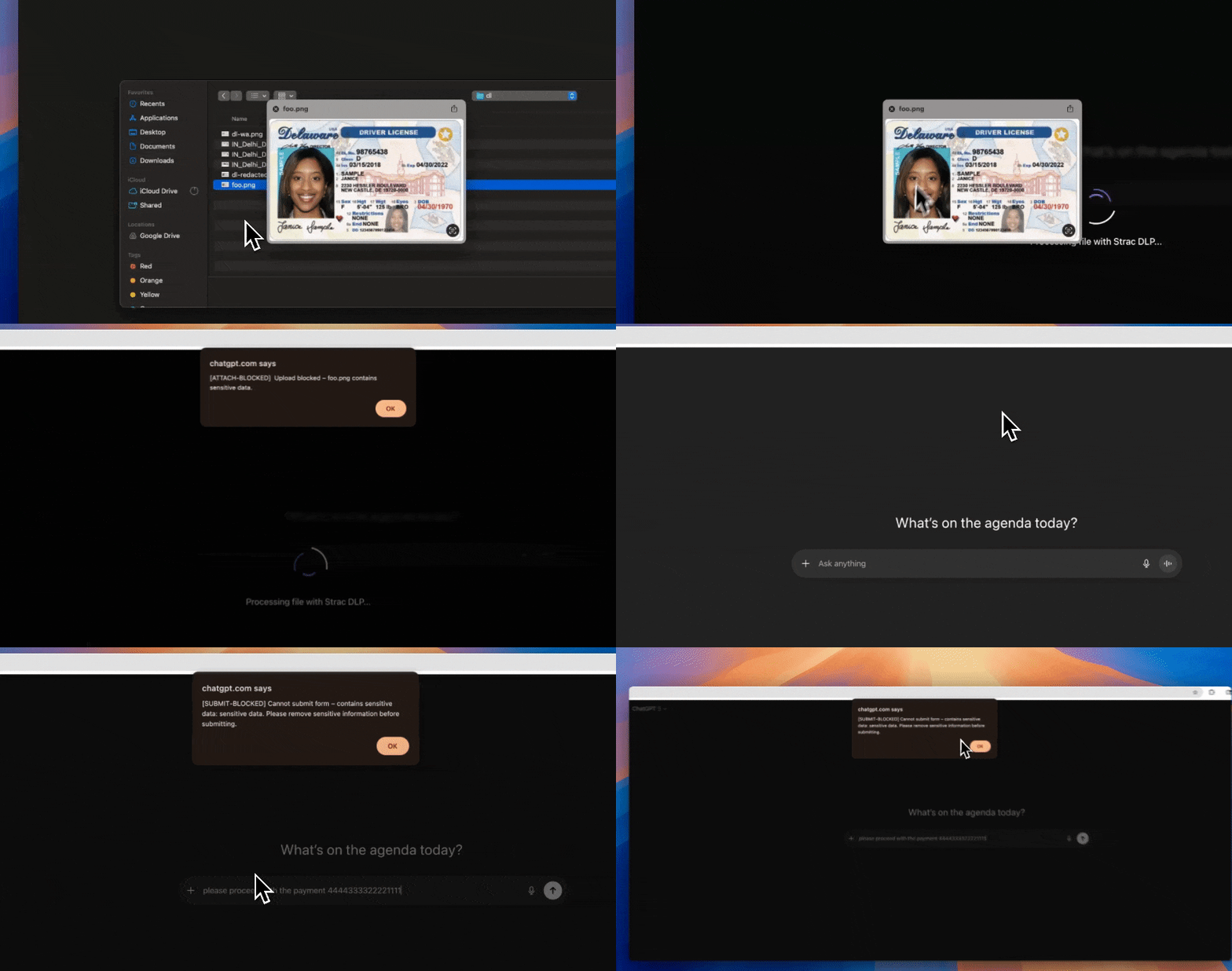
Real product: Strac blocks a driver's license from being uploaded to ChatGPT.
Illustration of Strac's browser and endpoint protection.
Analysts and support agents use AI to draft replies and dig through disputes. Strac removes card numbers, bank accounts and SSNs from prompts and blocks exports full of cardholder data from being uploaded.

AI agents connected to your CRM, data warehouse and support stack can reach a lot of cardholder and account data. Strac gives you one control point to approve tools per agent and redact financial data in every response.
Strac masks PANs, CVVs and bank details in tickets, chats and attachments as they arrive, keeping support tools out of PCI scope.
Real-time redaction for card numbers, account numbers and API keys, with a friendly note to the sender. Payabli uses this to coach users in the moment.
Inventory where card, bank and identity data lives, who can access it, and revoke public or external links.
Redact financial data from prompts and uploads, and enforce the same policies on what AI agents read and write through MCP.
Catch PANs and credentials written to logs and mask sensitive fields in databases used by analytics and engineering.
Strac ships with 250+ pre-built detectors powered by in-house ML and OCR models, so data inside scanned PDFs and images is caught too. Need something unique to your business? Add a custom data element and Strac trains a detector for it. See the full catalog →
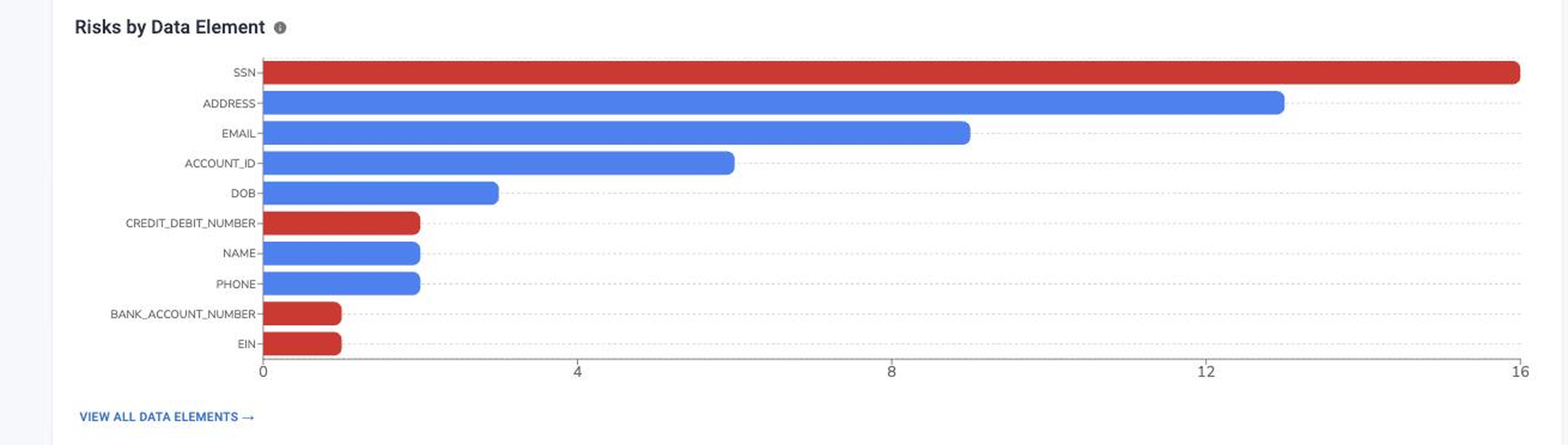
Real product: Strac findings grouped by sensitive data element.
What it asks: Protect stored account data, render PANs unreadable, restrict access, log activity and confirm where cardholder data lives.
How Strac helps: Discover PANs outside the CDE, redact or mask them automatically, and keep logs that support annual scope confirmation.
PCI DSS DLP →What it asks: An information security program with data inventory, access controls, monitoring and notice to the FTC for larger incidents.
How Strac helps: Continuous inventory of customer financial information across SaaS and cloud, with automated remediation and monitoring.
What it asks: Asset inventory, access privilege management, monitoring and timely incident reporting for covered entities.
How Strac helps: Visibility into where nonpublic information lives and who can reach it, with alerts and fixes in real time.
What it asks: Incident response programs and customer notification for unauthorized access to sensitive customer information.
How Strac helps: Reduce the chance of exposure, and know exactly what data was where if you need to investigate an incident.
What it asks: Controls over access to, and integrity of, data that feeds financial reporting.
How Strac helps: Find and restrict sensitive financial data shared broadly in drives, chat and AI tools, with an audit trail.
What it asks: ICT risk management for EU financial entities, and data minimization and security for personal data.
How Strac helps: Data minimization in practice: remove personal and financial data that has no business sitting in collaboration tools.
Strac provides technical controls that support these requirements. It does not by itself make an organization compliant; your auditors and counsel make that call.
55+ native integrations across SaaS, cloud, browser, endpoint and AI, all on the same engine.
Strac finds card numbers that end up outside your cardholder data environment, such as in support tickets, chat, email and drives, and redacts or masks them automatically. Fewer systems storing PANs means fewer systems in scope, and Strac's logs support the annual scope confirmation PCI DSS v4.0.1 requires.
Yes. Strac's in-house OCR models extract text from scanned statements, screenshots and photos of cards or IDs, then run the same classifiers used for text.
Strac supplies technical controls both rules ask for: an inventory of where customer financial information lives, access visibility, monitoring and automated remediation. It supports your program; your auditors and counsel decide compliance.
No. Strac redacts only the sensitive values, leaving the rest of the ticket or message intact, and agents keep working in the same tools. You choose per policy whether to redact, mask, block or alert.
Most teams connect their first integration in under 15 minutes. Paymentology and Payabli both use Strac.
Strac for other industries: