November 14, 2026

4
min read
Solve the Risk of Source Code Leaks
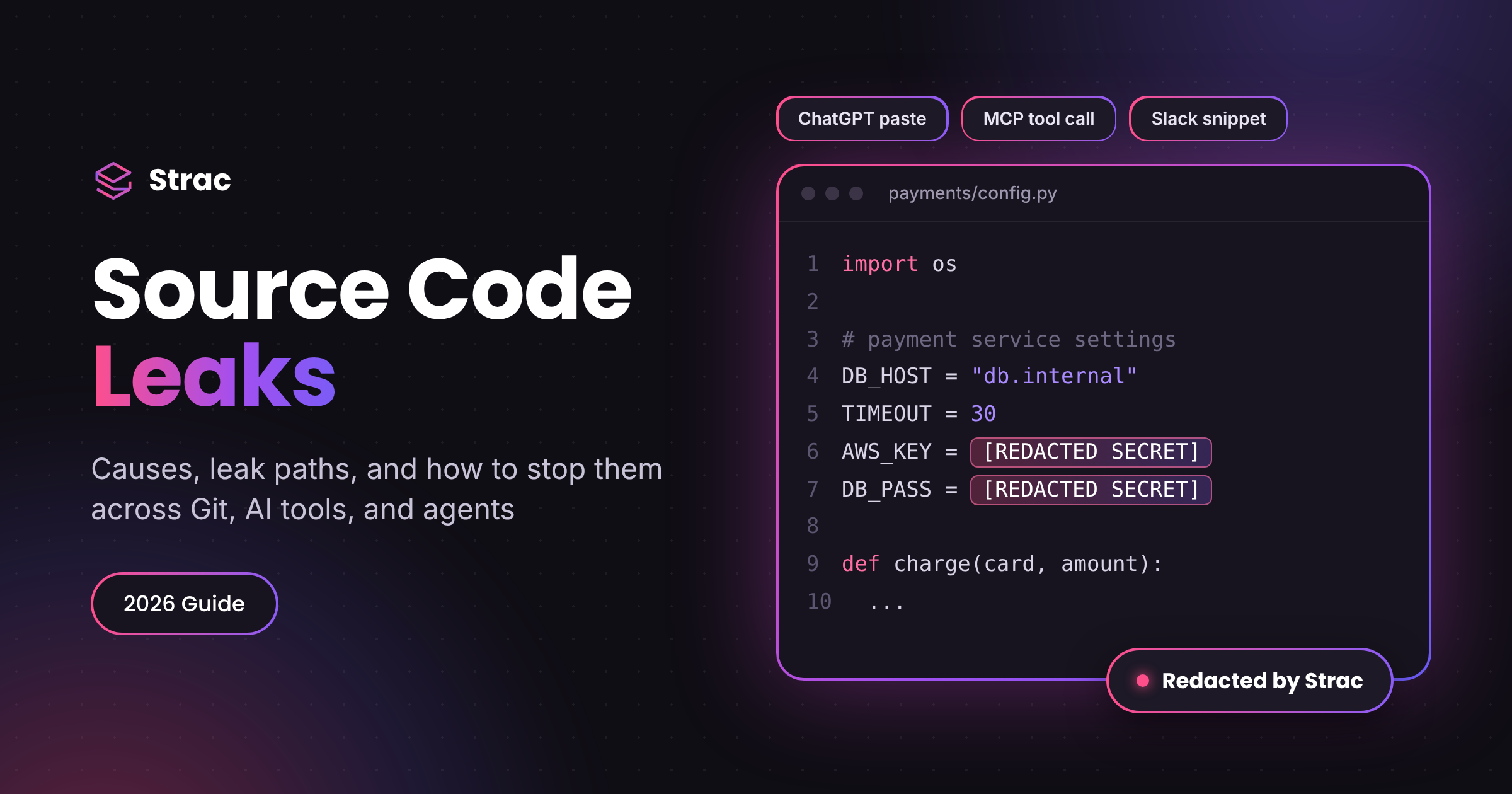
Source code leaks expose IP, secrets, and customer data. See how code escapes through Git, AI tools, and MCP agents in 2026, and how Strac stops each leak.
A source code leak happens when proprietary code reaches a place it was never meant to go. That can be a public repository, a personal laptop, a competitor, a contractor who left, or a generative AI tool that keeps what it is given.
The damage rarely stops at the code. Source files carry API keys, database connection strings, internal hostnames, and sometimes sample customer records used in tests. A leaked repository is often a map of the company plus a set of keys to it. That is why source code protection sits next to credential exposure on every security roadmap.
Leaks come in two kinds. Accidental leaks are the common case: a developer pushes to the wrong remote or pastes a file into a chat assistant to debug it. Deliberate leaks come from insiders, often in the weeks before they resign. Both end the same way, with the code outside your control.
Five years ago, preventing source code leaks meant locking down Git and watching USB ports. Those controls still matter, but code now moves through tools that never touch a repository.
Developers work alongside coding assistants that read whole folders. AI agents pull files through a GitHub MCP server or a GitLab MCP server and pass them to a model. Engineers paste stack traces, config files, and functions into chat tools to get unblocked. Much of that traffic is shadow AI that no admin console records.
The result is simple. The repository is locked; the code is not. Every paste, upload, and tool call creates a copy that repository controls never see.
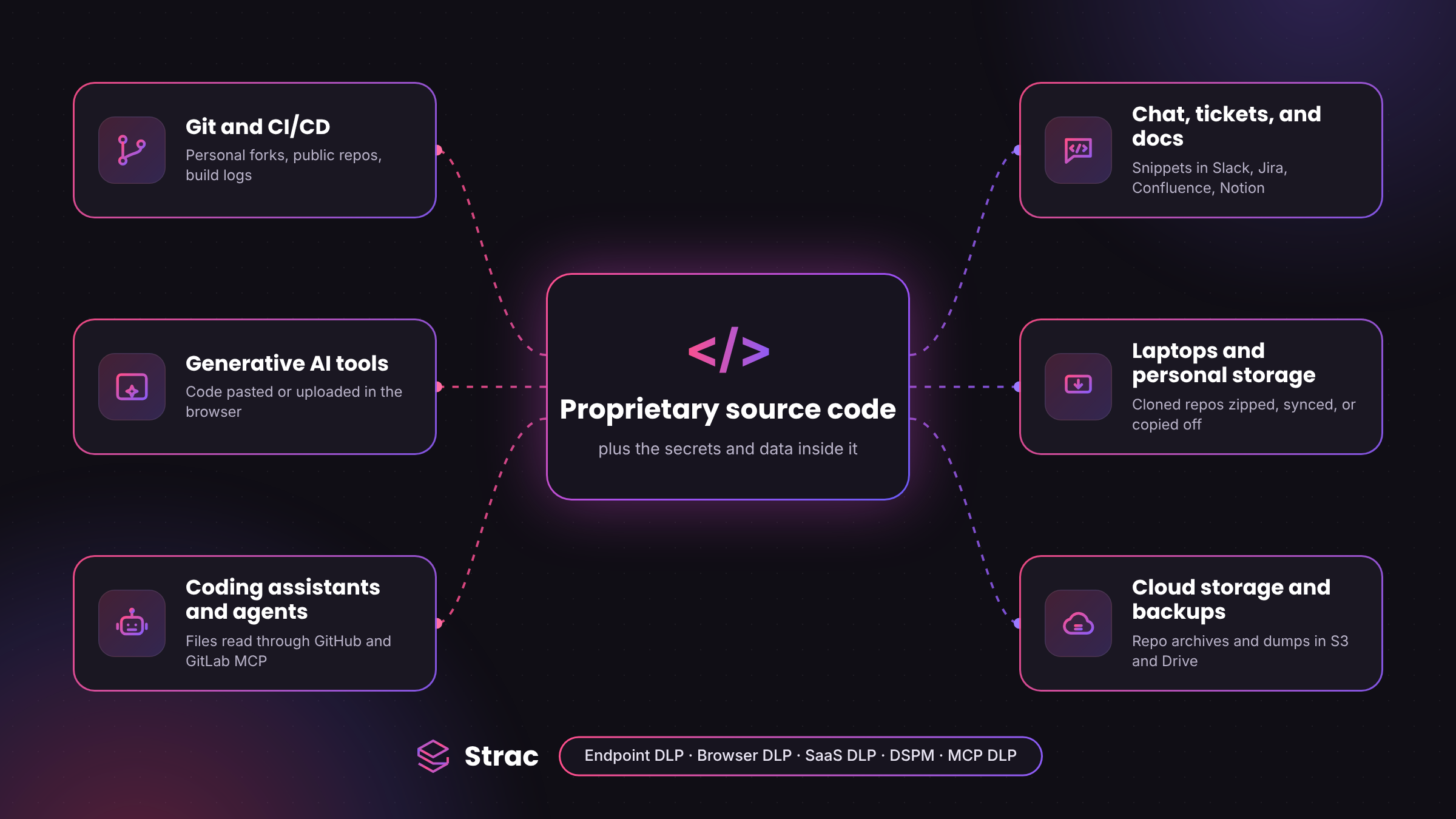
The classic paths still apply: a push to a personal fork, a private repo flipped to public, a mirror created on an unsanctioned host, or build logs that echo config values. Strac's GitHub DLP adds detection and remediation for the secrets and sensitive data that ride along with code, including in comments and attachments.
A developer pastes 300 lines of a payment service into a chat assistant and asks why it times out. The code, and any key inside it, has left the company in one keystroke. AI DLP inspects prompts and file uploads before they are sent, and the same applies to GenAI tools that are sanctioned but not configured for code. For the patterns that work, see how to secure sensitive data in LLM prompts.
Coding assistants index local folders, and agents read repositories through MCP servers. A single file read can return a hardcoded key or a test fixture full of real customer data. MCP DLP inspects each tool response and redacts sensitive data before the model sees it. Cursor data privacy covers the editor side, and an AI agent data leak shows how fast an agent turns one read into an exposure.
Code snippets live in Slack, Jira, Confluence, and Notion. Runbooks carry config blocks; tickets carry stack traces; threads carry entire files. Shared with a guest channel or an external partner, they become a leak without anyone downloading a thing. The Slack DLP guide covers the channel side in detail.
Cloned repositories stay on laptops long after a project ends. From there, code can be zipped and uploaded to a personal drive, synced to a consumer cloud account, or copied off the device. This is the main path for insider leaks, and it is what endpoint DLP is built to watch on macOS, Windows, and Linux. See why you need DLP for macOS for the platform most engineering teams run.
Repository archives, build artifacts, and database dumps pile up in Amazon S3 and Google Drive. DSPM inventories those stores and flags the ones holding code, keys, or customer data with public or over-broad access.
Branch protection, access reviews, and native secret scanning are the right first layer. They answer one question well: who can touch the repository. They cannot answer where the code went after someone touched it.
Three gaps keep showing up. First, visibility stops at the repo, so a paste into a browser tab or a file read by an agent is invisible. Second, strict Git policies slow engineers down, which pushes them toward personal tools that are even harder to see. Third, unsanctioned repositories and hosts sit entirely outside the policy.
Repository controls decide who gets the code. Data-layer controls decide what happens to every copy. A program that only has the first is guarding the front door while the windows stay open.
Strac is a DLP, data discovery, and DSPM platform, and source code protection runs on the same detection engine across every surface it covers. Integrations connect without code and start scanning in minutes.
Detection built for code. Strac recognizes source files and code blocks, and pairs that with detectors for secrets, PII, PHI, and card data from its catalog of sensitive data elements. One policy can catch a pasted function and the key inside it. Context checks keep alert volume low, which is the core of reducing DLP false positives.
Coverage where code actually travels. Endpoint DLP covers laptops and the files leaving them. Browser DLP for Chrome and Edge inspects pastes and uploads into generative AI tools, including ones IT never approved; see how to detect shadow AI. SaaS DLP covers Slack, Jira, Confluence, Notion, and Google Workspace DLP. MCP DLP covers agent tool calls. DSPM covers buckets and drives at rest.
Remediation, not just alerts. When Strac finds code or secrets heading somewhere they should not go, it acts in this order:
Audit evidence. Every finding and action is logged with the user, the destination, and the data type, which supports SOC 2, ISO 27001, PCI DSS, and HIPAA audits. Strac Comply adds daily checks such as whether GitHub secret scanning is turned on.
Blocking everything protects the code and loses the engineers. Redacting the risky part protects the code and keeps the engineers.
Code, secrets, and developer tools
AI tools and agents
Endpoints, SaaS, and cloud
Source code no longer leaks only through Git, so protecting it cannot stop at Git either. Repository permissions, code review, and access policies all fail eventually, and when they do the data layer is the backstop: find the code and the keys inside it wherever they travel, and redact or block before they leave. Strac does that across laptops, the browser, SaaS apps, cloud storage, and every MCP DLP tool call.
Book a demo to see Strac stop source code leaks across your stack.
Not always. A source code leak exposes intellectual property, and it becomes a data breach when the code carries customer data or live credentials that grant access to systems. Most leaked repositories carry at least one of the two.
They cover the repository, which is a strong start. They do not see code pasted into a chat assistant, read by an AI agent, posted in Slack, or uploaded from a laptop. Strac adds those paths and remediates in place.
Not when the default action is redaction. Strac removes the secret and leaves the prompt, message, or file intact, so work continues. Blocking is kept for the few destinations that should never receive proprietary code.
Not completely. A determined insider with legitimate access can always find a path. That is why the data layer matters: watching every upload, paste, and transfer makes theft slow, visible, and logged, which deters most attempts and proves the rest.
Source code exfiltration is the deliberate removal of code from company systems, usually to personal storage, a new employer, or an outside party. It is the insider half of source code leaks. See endpoint DLP and AI data governance for the controls.
“Don’t just alert on problems, fix them.”
Scott Roberts, Chief Information Security Officer, UiPath









Customers include