Secure Your AWS Environment with Strac: AWS DLP Solution
Discover how Strac helps security teams protect sensitive data across AWS S3, RDS, DynamoDB, CloudWatch, SaaS apps, endpoints, and GenAI workflows with unified DSPM + DLP.
Strac helps organizations protect sensitive data across AWS services like S3, RDS, DynamoDB, and CloudWatch.
Unlike legacy DLP tools, Strac focuses heavily on real-time remediation, not just alerting.
Strac combines DSPM + DLP in one platform for data discovery, posture management, classification, and remediation.
The platform supports SaaS apps, cloud infrastructure, GenAI workflows, APIs, and endpoints from one unified system.
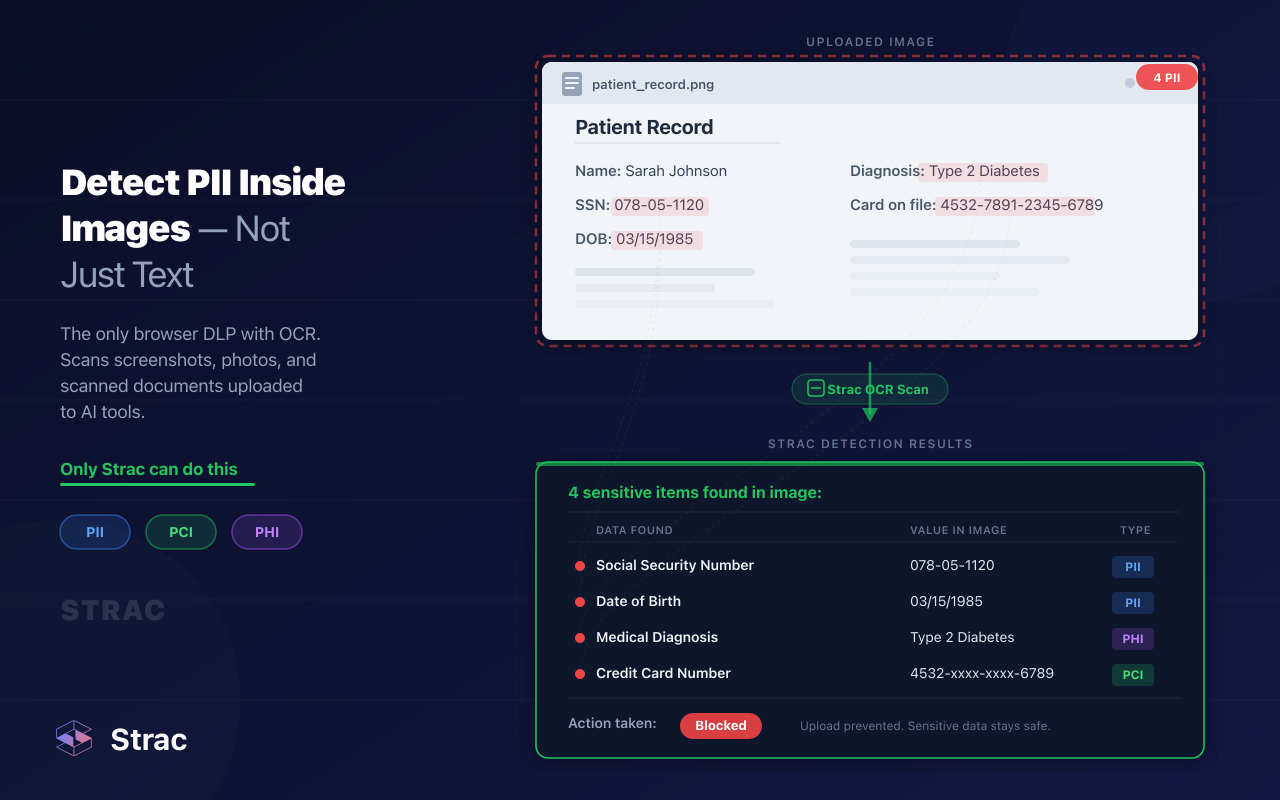
Strac uses ML + OCR-based detection to reduce false positives and improve protection for unstructured data and files.
AWS environments move fast. Sensitive data moves even faster.
Between S3 buckets, RDS databases, CloudWatch logs, internal APIs, support systems, AI workflows, and cloud storage, most companies now have sensitive data scattered across dozens of places at the same time. The problem is not only finding sensitive data anymore. The bigger challenge is continuously monitoring it, understanding exposure risk, and remediating it before it becomes a breach.
That is why modern AWS DLP can no longer be limited to simple regex scans or alert-only workflows.
Instead of only detecting sensitive data, Strac helps teams automatically classify, monitor, redact, mask, remediate, and govern sensitive information across the environments where it actually lives today.
Why AWS DLP Looks Different in 2026
AWS environments have become significantly more complex over the last few years. Sensitive data is no longer sitting inside one central database.
Today, organizations are dealing with:
Sensitive data inside S3 buckets;
Customer data flowing through APIs;
Secrets and tokens leaking into logs;
AI copilots accessing cloud data;
Engineers moving production data into testing environments;
CloudWatch logs containing PII, PCI, and PHI;
Internal teams sharing files across SaaS applications.
Traditional DLP tools were not designed for this type of architecture.
Many legacy solutions still focus heavily on:
Email DLP only;
Static regex rules;
Endpoint-only protection;
Alerting without remediation;
Slow deployments with heavy agents.
Modern cloud environments require a much broader approach.
Strac was built specifically for modern data flows across cloud infrastructure, SaaS applications, AI systems, and endpoints. The platform combines posture visibility with real-time enforcement so teams can both understand risk and automatically reduce it.
✨AWS DLP for S3 with Strac
Amazon S3 remains one of the largest sources of sensitive data exposure inside AWS environments.
Misconfigured buckets, excessive permissions, public sharing, shadow data growth, and archived sensitive files continue to create major risks for organizations handling customer, healthcare, payroll, financial, or regulated data.
Strac helps organizations continuously monitor and protect sensitive data inside S3 environments through:
Sensitive data discovery and classification;
Historical and real-time scanning;
ML + OCR detection across files and attachments;
Access visibility and posture monitoring;
Detection of exposed or over-permissioned data;
Automated remediation workflows.
Unlike older DLP systems that only generate alerts, Strac focuses heavily on remediation. Security teams can automatically redact, mask, revoke access, quarantine, or remediate sensitive data exposures before they become incidents.
Strac also supports context-aware detection instead of relying only on regex patterns. This helps reduce false positives while improving accuracy for unstructured files, screenshots, PDFs, spreadsheets, and uploaded documents.
AWS S3 remains one of the most common places where organizations accidentally expose sensitive data. Modern AWS DLP requires visibility, remediation, and posture management together.
Strac S3 DLP: Automatic Scanning & Classification of Sensitive Data in S3 bucket
✨AWS DLP for DynamoDB with Strac
DynamoDB powers many modern applications, APIs, fintech systems, healthcare platforms, and customer-facing services.
The challenge is that high-scale NoSQL environments often contain large amounts of sensitive operational data that traditional DLP tools struggle to monitor effectively.
Strac helps security teams:
Discover sensitive data across DynamoDB environments;
Monitor access patterns and anomalous behavior;
Detect PII, PCI, PHI, secrets, and regulated data;
Automatically redact or mask sensitive information;
Improve compliance readiness across cloud workloads.
For many organizations, the issue is not simply data storage. It is the movement of data between production systems, analytics pipelines, testing environments, dashboards, APIs, and AI workflows.
Strac helps organizations reduce risk while maintaining operational speed..
One of the biggest changes in cloud security over the last two years has been the rise of AI-driven workflows.
Sensitive data is now flowing through:
ChatGPT;
Microsoft Copilot;
Claude;
Gemini;
MCP workflows;
Browser-based AI tools.
Many traditional DLP vendors were not built for these environments.
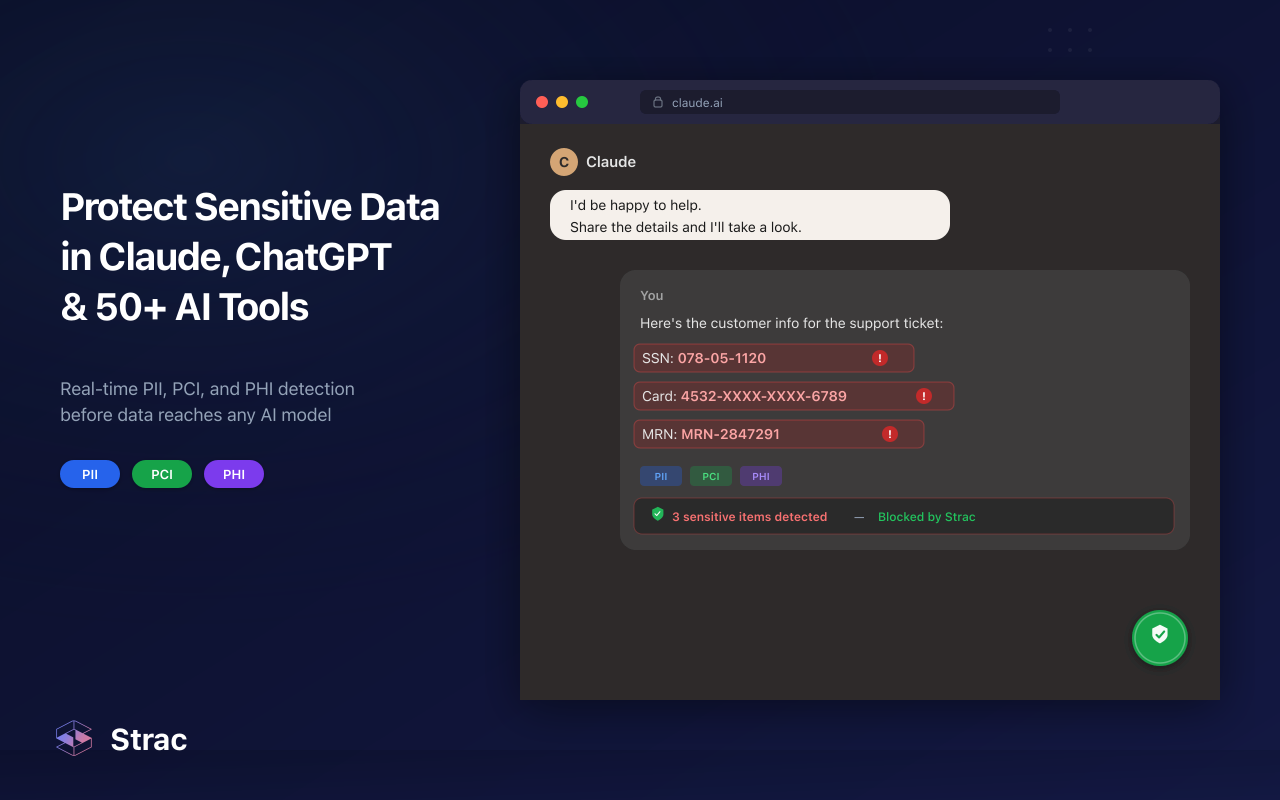
Strac helps organizations apply DLP controls across modern AI workflows through:
Browser DLP;
Prompt and response monitoring;
Real-time redaction;
Sensitive data blocking;
AI workflow governance;
MCP DLP support.
This becomes especially important when AI systems gain access to cloud data, internal files, customer records, tickets, support conversations, or operational systems.
🎥 What Makes Strac Different for AWS DLP
Modern security teams need visibility across the entire data ecosystem; not fragmented tools stitched together with manual workflows. That is where Strac positions itself differently.
Strac combines DSPM + DLP into one unified platform built for AWS, SaaS, GenAI, cloud storage, APIs, and endpoints. Instead of only detecting sensitive data, Strac focuses heavily on real-time remediation, posture visibility, and low-friction deployment for modern environments.
1. Unified Coverage Across Modern Data Environments
Strac supports cloud, SaaS, GenAI, APIs, collaboration systems, and endpoints from one platform.
2. Real-Time Remediation
The platform emphasizes redact, mask, revoke access, block, quarantine, and remediation workflows instead of alert-only security.
3. Agentless Deployment
Many organizations want lower operational overhead and faster onboarding.
4. ML + OCR-Based Detection
Strac uses content-aware detection for structured and unstructured data instead of relying only on regex matching.
This helps reduce false positives while improving visibility across screenshots, PDFs, attachments, and uploaded files.
5. DSPM + DLP Together
Instead of forcing teams to manage multiple disconnected products, Strac combines posture management with DLP enforcement in one system.
Bottom Line
AWS DLP is no longer only about preventing data from leaving a network.
Modern organizations need visibility into where sensitive data exists, who can access it, how it moves across cloud and SaaS environments, and how to automatically remediate exposure risks in real time.
Instead of only generating alerts, the platform focuses heavily on reducing operational risk through continuous discovery, classification, monitoring, and real-time remediation.
For organizations operating heavily inside AWS, modern DLP now requires much more than static policies. It requires visibility, automation, AI-aware governance, and remediation at scale.
🌶️ Spicy FAQs on AWS DLP
What is AWS DLP?
AWS DLP refers to data loss prevention technologies designed to detect, monitor, classify, and protect sensitive data stored or processed across AWS services like S3, RDS, DynamoDB, CloudWatch, Lambda, and cloud storage environments.
Does AWS provide native DLP?
AWS offers several native security services, but many organizations still require third-party DLP platforms for deeper sensitive data discovery, posture management, SaaS integrations, AI workflow governance, and automated remediation.
Can Strac scan AWS S3 buckets for sensitive data?
Yes. Strac supports sensitive data discovery, classification, posture visibility, and remediation workflows for S3 environments, including historical and real-time scanning.
Why is CloudWatch considered a DLP risk?
CloudWatch logs often contain secrets, tokens, PII, operational metadata, customer information, and authentication data that can become long-term exposure risks if left unmonitored.
How is modern AWS DLP different from legacy DLP?
Modern AWS DLP focuses heavily on SaaS applications, APIs, AI workflows, cloud posture management, and real-time remediation. Legacy DLP tools were often built primarily for email gateways, on-prem systems, or endpoint-only environments.
Does Strac support AI and GenAI DLP?
Yes. Strac supports DLP workflows for modern AI environments including browser-based AI tools, LLM workflows, prompt monitoring, response scanning, and MCP DLP use cases.
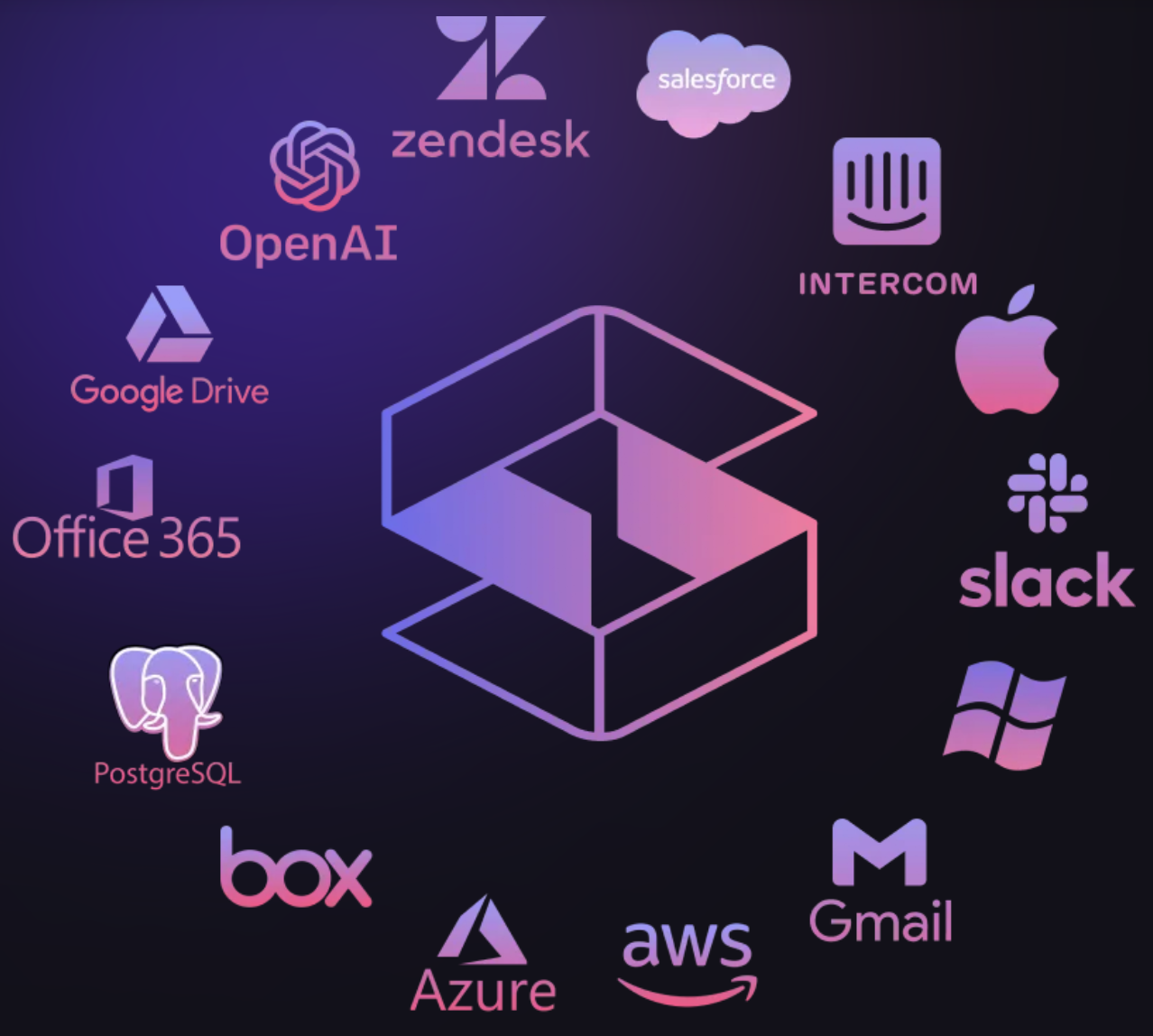
Discover & Protect Data on SaaS, AI, MCP, Endpoints & Cloud
Strac provides end-to-end data loss prevention for all SaaS and Cloud apps. Integrate in under 10 minutes and experience the benefits of live DLP scanning, live redaction, and a fortified SaaS environment.


.webp)









.avif)



.gif)
