August 21, 2026

6
min read
Top 10 Proofpoint Alternatives
The best & top Proofpoint alternatives providing similar features that ensure cost-effectiveness and email security.
Corporate data doesn’t just live in email anymore. It moves through Slack, Google Drive, Salesforce, support tickets, cloud storage, and now even GenAI tools like ChatGPT and Copilot. That shift has changed what real data protection looks like.
Proofpoint is well known for email and insider threat protection; but many security teams are realizing that email-first DLP is no longer enough. As data spreads across SaaS apps, APIs, endpoints, and AI workflows, gaps start to show.
As data spreads across SaaS apps, APIs, endpoints, and AI tools, security teams are starting to question whether older DLP models still fit how their business actually runs. Today’s risk isn’t just in inboxes. It’s in Slack threads, shared drives, support tickets, dev tools, and even AI prompts.
In this guide, we break down the top Proofpoint alternatives in 2026; where Proofpoint still works well, where it struggles, and what really matters in a modern SaaS- and AI-ready DLP platform. If you’re thinking about replacing Proofpoint or simply expanding beyond email protection, this will help you make the right call.

Proofpoint DLP is built around email security and insider risk control. It’s most commonly used by large enterprises that already rely on Proofpoint’s email gateway and want policy enforcement layered on top.
Here’s what it does well:
Email scanning and enforcement
Outbound emails and attachments are scanned in real time. If sensitive data is detected, messages can be blocked, encrypted, or flagged before leaving the company.
Pre-built compliance templates
It includes ready-made policies for GDPR, HIPAA, PCI DSS, and other regulations. This helps teams get started faster without building rules from scratch.
Endpoint monitoring
Proofpoint can monitor file transfers, USB usage, and clipboard activity on endpoints to reduce insider-driven data leaks.
Centralized policy management
Security teams manage policies and incidents from a single console, with the ability to forward alerts to SIEM or SOAR tools.
Email encryption workflows
When sensitive data is detected, encryption or secure messaging can be triggered automatically.
Proofpoint is strong in email-centric DLP. The question most teams now ask is whether that’s enough in a SaaS- and AI-heavy environment.
While Proofpoint is a highly regarded email security solution, several shortcomings can prompt businesses to consider alternatives.
These alternatives offer a range of features and price points to meet varying business needs.

Strac is considered the best Proofpoint alternative for its comprehensive data protection solutions. It is designed to secure sensitive information across various platforms. The platform combines advanced threat detection, data loss prevention, and encryption to ensure robust security.
Key Features:



Most suitable for:
Teams usually don’t move off Proofpoint just for more alerts. They switch because their data risk has changed.
Most companies today are SaaS-heavy. Sensitive data flows through Slack threads, Salesforce cases, support tickets, shared drives, APIs, and now AI tools. Email is just one piece of the puzzle.
What security leaders like about Strac is the shift in approach. Instead of managing heavy infrastructure or juggling multiple consoles, they get broader visibility across modern collaboration tools with far less operational friction.
It’s also built for how teams actually work now. Fast product teams. Remote employees. AI-assisted workflows. High-velocity environments where data moves constantly.
For companies that feel Proofpoint is too email-focused or too operationally heavy, Strac often feels more aligned with today’s SaaS-first reality.


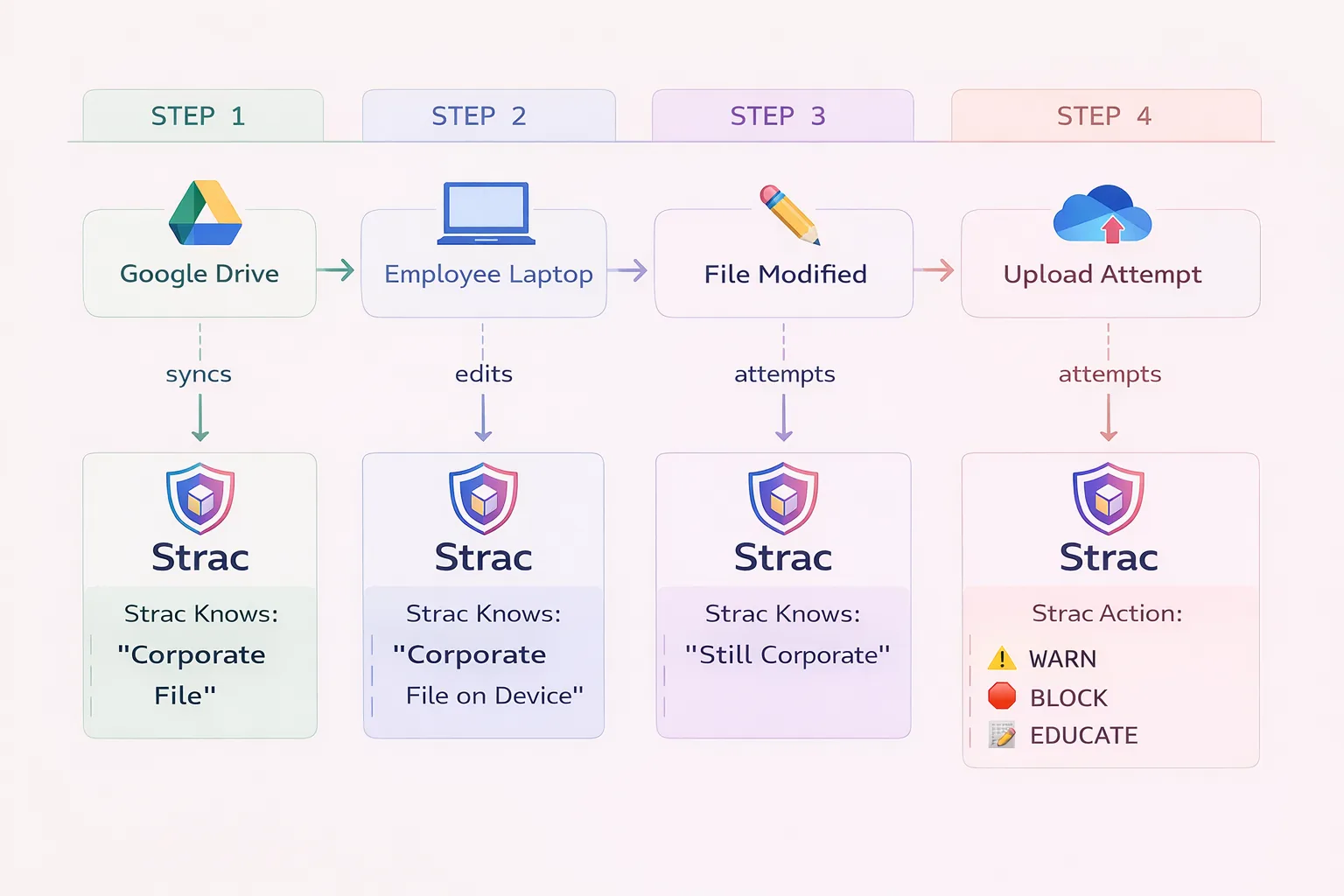
Strac’s endpoint agent enforces where network tools are blind — a file copied to USB, an AirDrop to a personal phone, a local print, a screenshot. It reads the content on the device and applies Block, Warn, or Audit per channel on Mac and Windows, coaching employees in the moment rather than only alerting after the fact.

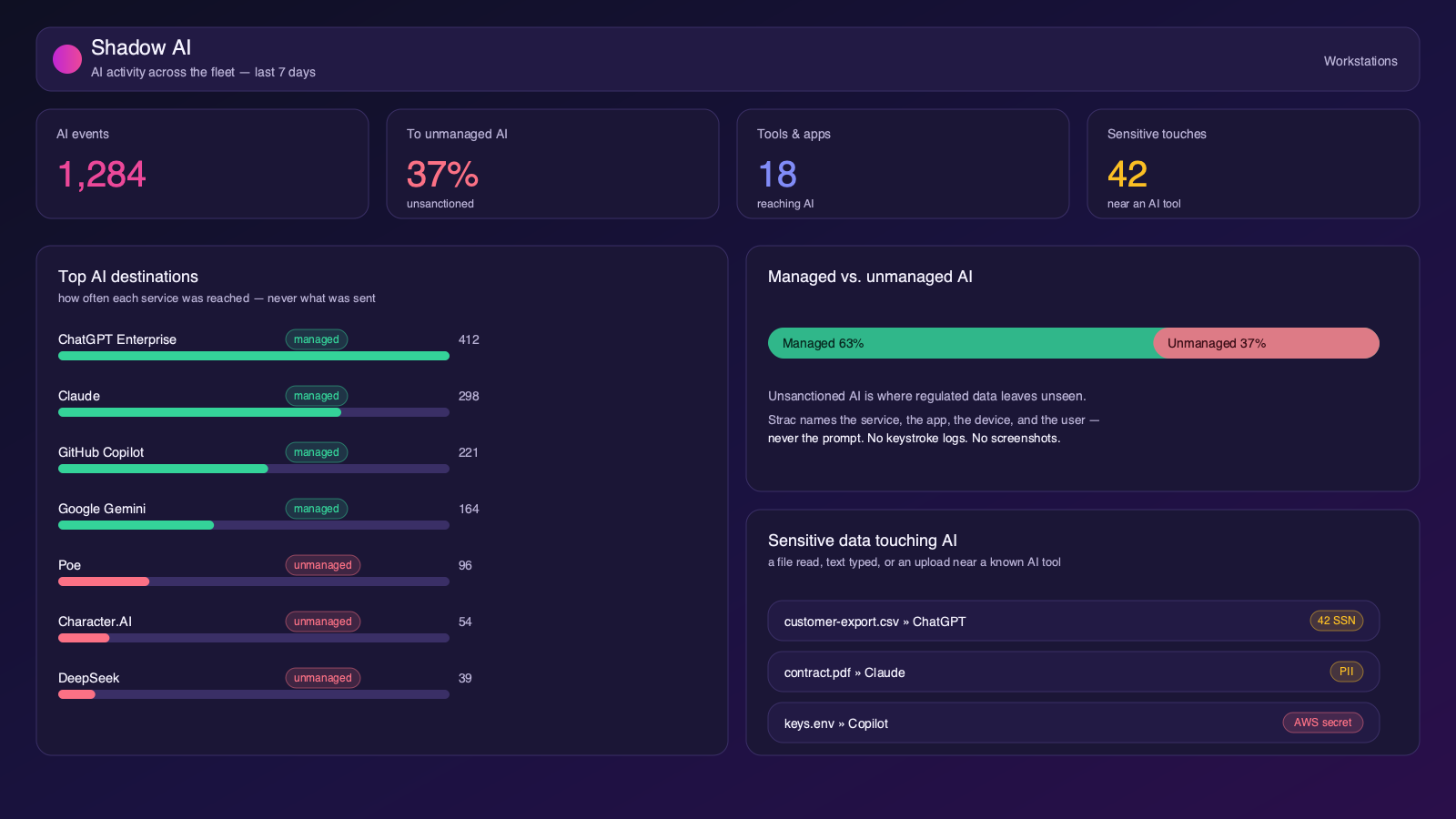
Strac turns Shadow AI from an unknown into a managed surface: it inventories the AI apps and agents in use, scores the data risk of each, and stops regulated content from reaching them — in the browser and at the MCP layer — while respecting employee privacy with no keystroke logs or screenshots.
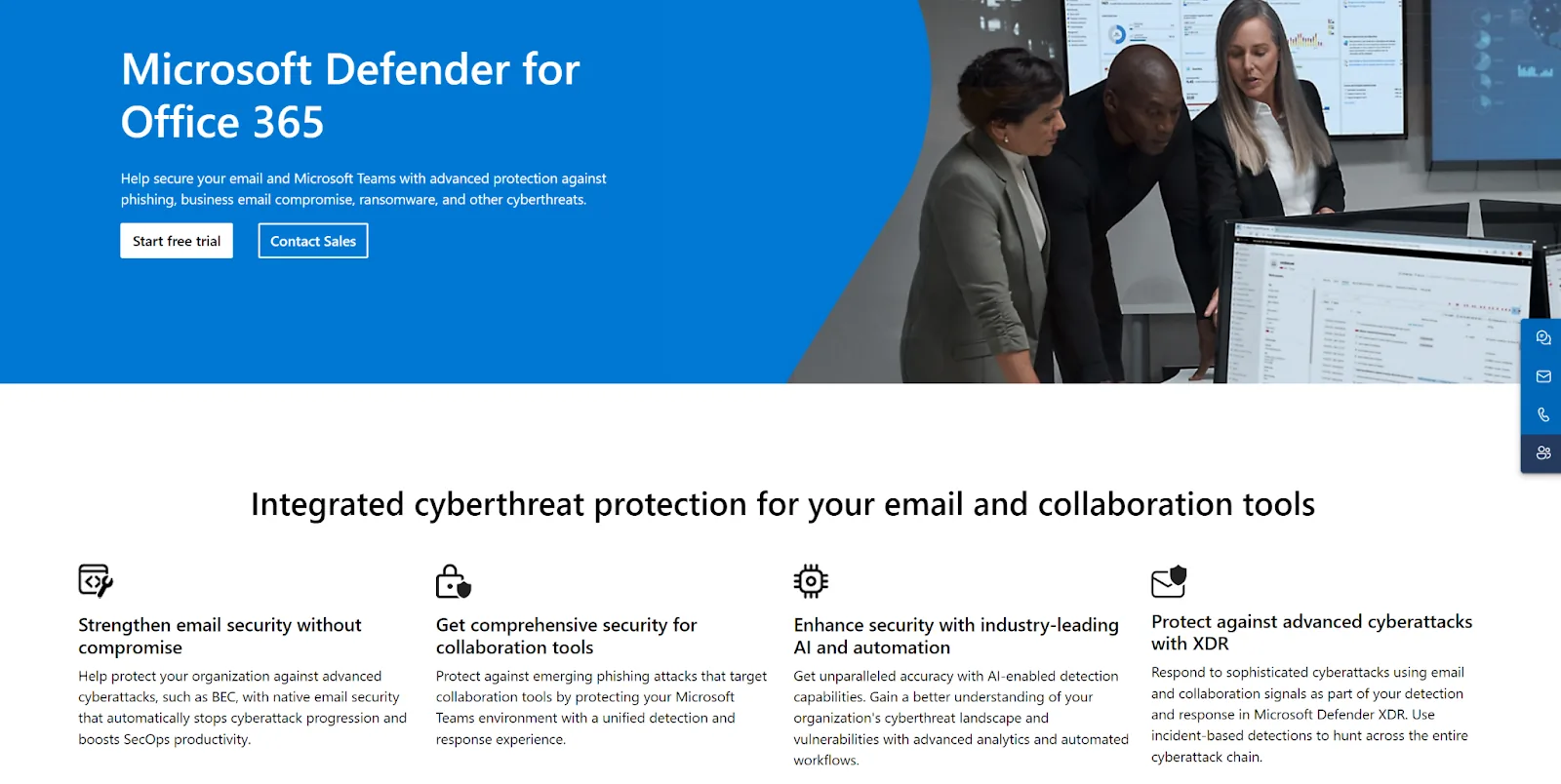
Microsoft Defender for Office 365 offers comprehensive email filtering and protection against advanced threats like phishing, business email compromise, and malware attacks. While Proofpoint offers a dedicated email security solution, MS Defender provides seamless integration with the MS 365 ecosystem. Built-in threat intelligence and automated response capabilities provide robust defenses to help organizations safeguard their communications.
Key Features:
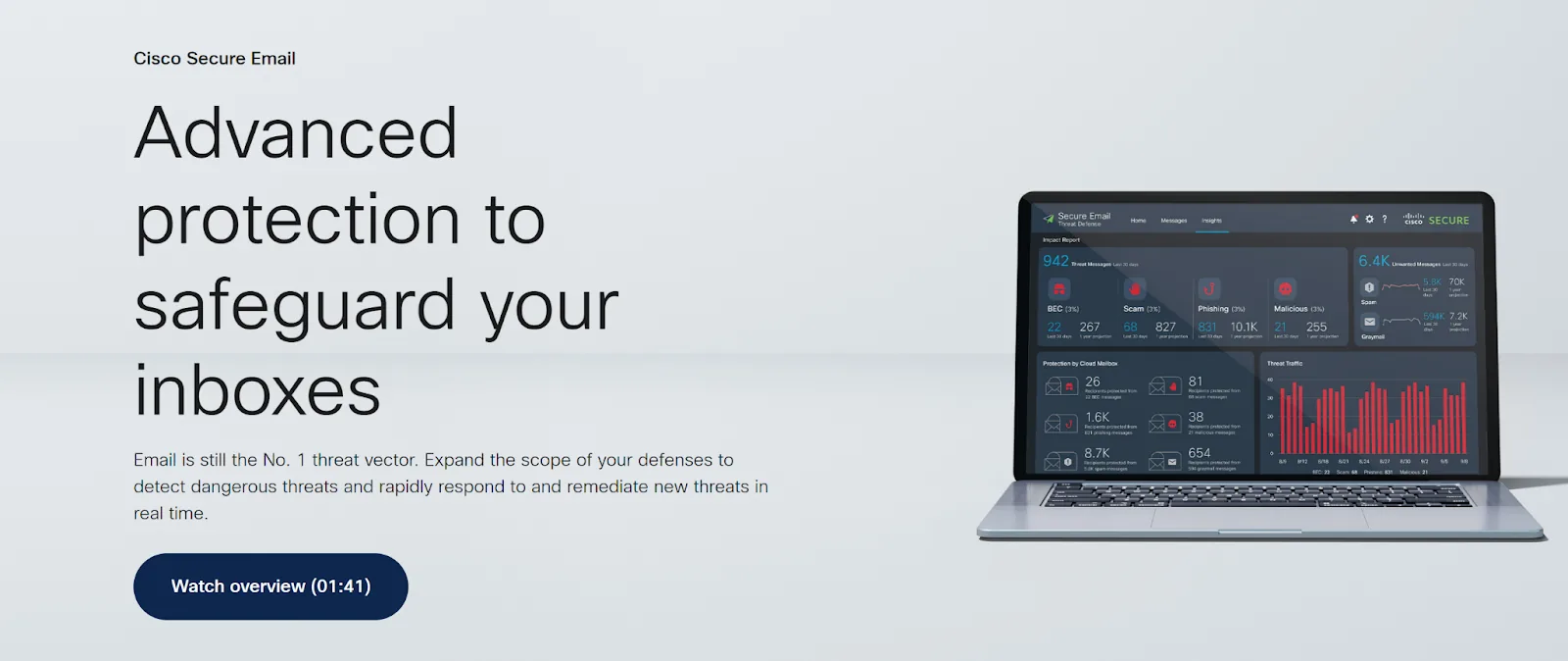
Cisco offers Email Security Appliance and Secure Email solutions, providing robust protection against spam, malware, and phishing attacks. It features forged email detection, flexible deployment options, and integration with cloud-based threat intelligence. Compared to Proofpoint, Cisco’s flexibility in deployment and integration offers additional benefits for organizations.
Key Features:

Both Proofpoint and Trustwave offer robust protection against email threats. Trustwave’s strength lies in its multi-layered security and extensive policy controls. It captures a high rate of malware and exploits with layered protection. Trustwave's comprehensive security solutions help organizations enforce security policies and maintain compliance with industry regulations.
Key Features:
Forcepoint provides security solutions that protect against advanced threats, data theft, and fraud. Its solutions include advanced threat protection, data loss prevention, and encryption to secure inbound and outbound emails. Its strong focus on behavioral analysis and user behavior education provides a unique approach to threat detection and prevention. In our Proofpoint vs. Forcepoint comparison, we have thoroughly examined their features and capabilities.
Key Features:

Netskope offers cloud-based email security solutions that protect against threats and data loss while ensuring compliance. It provides visibility and control over sensitive data across email and cloud applications. Organizations seeking comprehensive cloud application protection may find Netskope's features more suitable than Proofpoint.
Netskope Alternative: Netskope Vs Strac
Key Features:
Fortinet's email security solutions, including the FortiMail Email Security platform, offer protection against spam, malware, and other email threats. It features high-performance mail filtering, data loss prevention, and encryption. Fortinet's Zero Trust Access solution continually verifies users and devices, ensuring secure access to network resources.
Key Features:

Sophos is a cloud-based secure email gateway that leverages deep-learning neural networks to protect against phishing, spam, and malware, including zero-day attacks. Its advanced email sandboxing capabilities block unwanted applications and first-time ransomware, while behavioral analysis prevents boot-record attacks.
Key Features:
Zscaler email security leverages its cloud-native architecture and advanced AI-powered capabilities to protect against email-borne threats. Its zero-trust exchange ensures secure connections directly to applications, minimizing the attack surface. Zscaler Internet Access (ZIA) provides comprehensive internet security with URL filtering, SSL inspection, and data loss prevention. Similarly, Zscaler alternatives are available that better align with every specific need.
Key Features:

Cloudflare offers comprehensive email security solutions to protect against threats, prevent data loss, and ensure email continuity. Its integrated security measures, including DDoS protection, web application firewall (WAF), and SSL/TLS encryption, help organizations safeguard sensitive data.
Key Features:
Proofpoint was built for an email-first world. In 2026, that’s no longer where most data lives.
Sensitive information now moves through Slack, Google Drive, Salesforce, support tools, cloud storage, and AI platforms like ChatGPT and Copilot. Email is just one channel; not the main one.
Here’s why teams start looking elsewhere:
SaaS sprawl
Data is scattered across dozens of cloud apps. Email-only visibility isn’t enough.
Operational overhead
Legacy DLP can be heavy to manage; agents, tuning, and false positives create friction.
Alert fatigue
Security teams want automatic remediation; not just more alerts.
AI risk exposure
Generative AI introduced new leakage paths that older DLP tools weren’t designed to monitor.
For many companies, the issue isn’t that Proofpoint doesn’t work. It’s that their data environment has evolved faster than their DLP.
As we've explored the strengths and features of Proofpoint competitors, it becomes clear that a comprehensive data protection solution is paramount. One must prioritize a security-first approach that protects against current threats and adapts to future challenges.
Strac excels in providing a complete, AI-driven data protection solution that surpasses its competitors in features. Its modern approach to data security makes it the right choice for organizations of all sizes.
Proofpoint's strength is email security, and its DLP — built substantially on the ObserveIT insider-risk agent — centers on user-activity monitoring: session recording and behavior analytics. That model raises real employee-privacy concerns and still leans toward alerting on people rather than preventing data movement by content.
Where a legacy endpoint tool blocks bluntly or only alerts, Strac enforces content-aware policy across every exit on the machine — file opens and downloads, USB and removable-media writes, printing, screenshots, AirDrop, clipboard, browser uploads, and text typed directly into a GenAI prompt — each set independently to Block, Warn, or Audit on Mac and Windows.
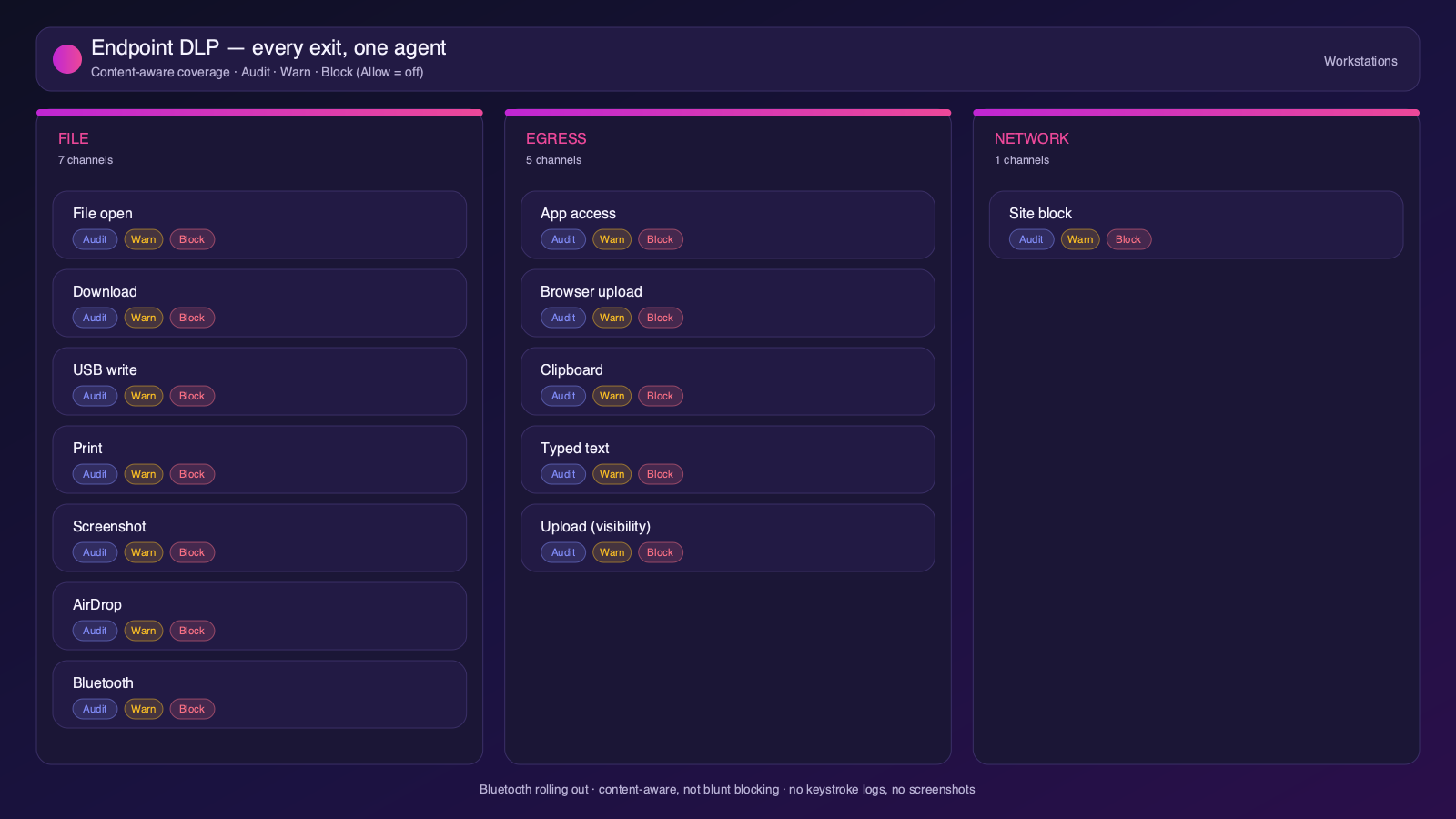
Strac's endpoint agent takes the opposite approach. It inspects the content of what is leaving and Blocks the regulated file or action at the exact channel — USB, print, AirDrop, clipboard, browser upload, GenAI prompt — with Warn and Audit options, and it does so without keystroke logging or screen recording.
That privacy-first design still gives investigators what they need through Data Lineage, and the same agent adds Shadow AI detection. It shares one policy with Strac's email, SaaS, browser, and MCP coverage — prevention across surfaces, not surveillance on the endpoint.
Proofpoint is email-security-first; its DLP is strongest on the email channel and was never designed for AI agents pulling data from SaaS and databases.
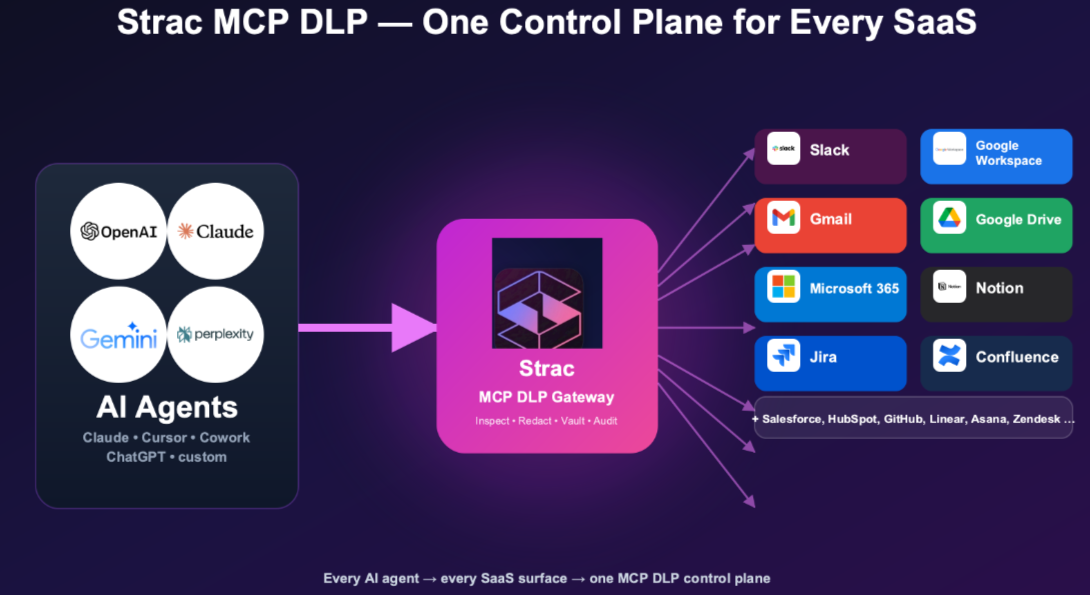
Strac is AI-native data security. It inspects every prompt to Claude, ChatGPT, and Copilot before it reaches the model, and governs every AI-agent tool call at the MCP layer — the ingress path where agents pull sensitive data in from your SaaS and databases. See, control, block, and remediate across browser, endpoint, cloud, and the MCP connector directory — agentless, in under 10 minutes.
Strac remediates sensitive data in the browser and at the MCP layer — the AI-era data risk legacy tools were not built for.
Many organizations start looking for Proofpoint alternatives when their security needs expand beyond email. Modern data risk spans SaaS apps, cloud storage, endpoints, APIs, and GenAI tools. Teams often want broader visibility, real-time remediation instead of just alerts, simpler deployment, and more predictable pricing.
When evaluating a Proofpoint alternative, focus on SaaS coverage, real-time data redaction or blocking, AI-powered detection (not just regex rules), compliance support, and ease of deployment. A strong platform should protect data across Slack, Google Workspace, Salesforce, cloud storage, endpoints, and AI workflows; not just email.
Yes. Several vendors offer more flexible pricing models and lower operational overhead. Modern, agentless platforms often reduce infrastructure costs and deployment complexity compared to legacy DLP systems that require heavy configuration and maintenance.
Most modern Proofpoint competitors provide SaaS DLP and cloud data protection. This includes monitoring and remediating sensitive data in collaboration tools, CRM systems, support platforms, cloud storage, and even data warehouses like Snowflake.
Many legacy DLP tools were built before generative AI became mainstream. Leading alternatives now include GenAI DLP capabilities; allowing organizations to monitor prompts, redact sensitive data, and prevent leakage in AI workflows.
{"@context": "https://schema.org", "@type": "FAQPage", "mainEntity": [{"@type": "Question", "name": "1. Why are companies looking for Proofpoint alternatives?", "acceptedAnswer": {"@type": "Answer", "text": "Many organizations start looking for Proofpoint alternatives when their security needs expand beyond email. Modern data risk spans SaaS apps, cloud storage, endpoints, APIs, and GenAI tools. Teams often want broader visibility, real-time remediation instead of just alerts, simpler deployment, and more predictable pricing."}}, {"@type": "Question", "name": "2. What should I look for in a Proofpoint alternative?", "acceptedAnswer": {"@type": "Answer", "text": "When evaluating a Proofpoint alternative , focus on SaaS coverage, real-time data redaction or blocking, AI-powered detection (not just regex rules), compliance support, and ease of deployment. A strong platform should protect data across Slack, Google Workspace, Salesforce, cloud storage, endpoints, and AI workflows; not just email."}}, {"@type": "Question", "name": "3. Are there cost-effective alternatives to Proofpoint?", "acceptedAnswer": {"@type": "Answer", "text": "Yes. Several vendors offer more flexible pricing models and lower operational overhead. Modern, agentless platforms often reduce infrastructure costs and deployment complexity compared to legacy DLP systems that require heavy configuration and maintenance."}}, {"@type": "Question", "name": "4. Can Proofpoint alternatives protect data in SaaS and cloud apps?", "acceptedAnswer": {"@type": "Answer", "text": "Most modern Proofpoint competitors provide SaaS DLP and cloud data protection. This includes monitoring and remediating sensitive data in collaboration tools, CRM systems, support platforms, cloud storage, and even data warehouses like Snowflake."}}, {"@type": "Question", "name": "5. Do Proofpoint alternatives support GenAI tools like ChatGPT or Copilot?", "acceptedAnswer": {"@type": "Answer", "text": "Many legacy DLP tools were built before generative AI became mainstream. Leading alternatives now include GenAI DLP capabilities; allowing organizations to monitor prompts, redact sensitive data, and prevent leakage in AI workflows."}}]}{"@context": "https://schema.org", "@type": "ItemList", "name": "Top Proofpoint Alternatives in 2026", "numberOfItems": 10, "itemListElement": [{"@type": "ListItem", "position": 1, "name": "Strac"}, {"@type": "ListItem", "position": 2, "name": "Microsoft Defender"}, {"@type": "ListItem", "position": 3, "name": "Cisco"}, {"@type": "ListItem", "position": 4, "name": "Trustwave"}, {"@type": "ListItem", "position": 5, "name": "Forcepoint"}, {"@type": "ListItem", "position": 6, "name": "Netskope"}, {"@type": "ListItem", "position": 7, "name": "Fortinet"}, {"@type": "ListItem", "position": 8, "name": "Sophos"}, {"@type": "ListItem", "position": 9, "name": "Zscaler"}, {"@type": "ListItem", "position": 10, "name": "Cloudflare"}]}
.avif)


.gif)


.webp)