October 1, 2026

4
min read
Is HubSpot HIPAA Compliant?
Is HubSpot HIPAA compliant? Not by default. Learn how to protect PHI with access controls, audit logs, and real-time DLP enforcement.
HubSpot HIPAA compliance is a growing concern for healthcare and healthtech organizations using HubSpot to manage patient communication, marketing, and support workflows. While HubSpot is a powerful CRM, achieving HubSpot HIPAA compliance is not automatic; it requires strict controls around how Protected Health Information (PHI) is collected, stored, and shared across emails, forms, and integrations.
Without the right safeguards, teams risk exposing sensitive data through everyday workflows like contact forms, ticketing systems, or email automation.
This is where combining HubSpot with a modern DLP solution like Strac becomes critical, enabling real-time detection, redaction, and control of PHI across your SaaS stack while ensuring HubSpot HIPAA compliance at scale.
To be HIPAA compliant, your CRM system must have certain data security features in place, including:
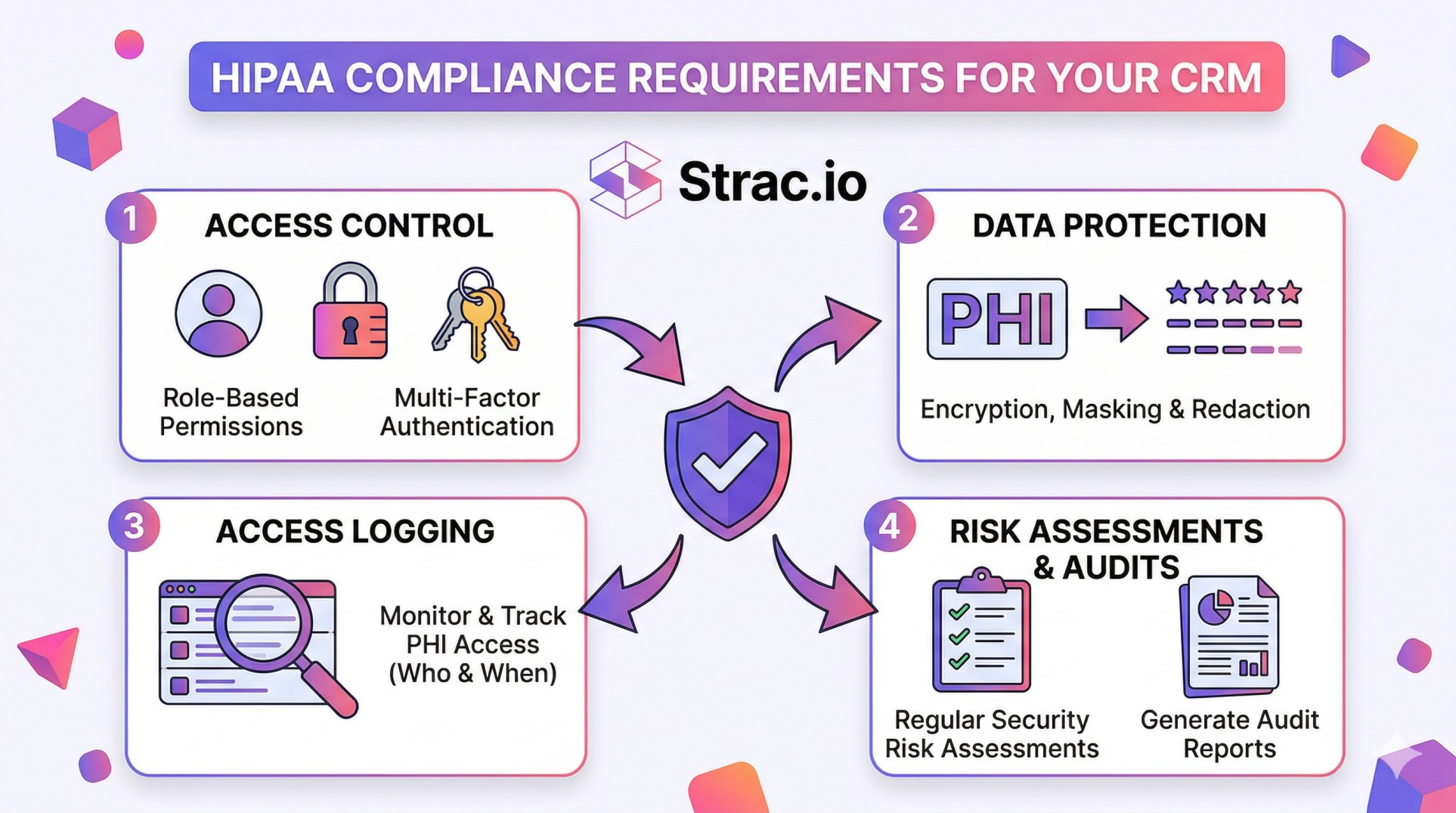
Strac HubSpot DLP can be used to customize and secure sensitive data elements within HubSpot, mask and redact sensitive data, enable Single Sign-On (SSO) capabilities, configure alerts when sensitive information is detected, generate audit reports and more.
Yes. It is possible to manage PHI within HubSpot provided you use solutions that restrict sensitive data, protect against data leakages, and prevent unauthorized access.

Like any platform that handles sensitive data, there is always a risk of Protected Health Information (PHI) being leaked or exposed due to various factors such as cybersecurity breaches, human error, or system vulnerabilities. HubSpot takes measures to secure data and protect against unauthorized access.
However, no system can be entirely immune to risks. Ensuring your employees are trained on data security best practices is the first step to preventing data leaks.
HubSpot is not HIPAA-compliant straight out of the box. Reviewing HubSpot’s Terms of Service, we note two key clauses:
Healthcare organizations should note HubSpot is not designed to be HIPAA-compliant and that HubSpot absolves themselves of any liability relating to the mishandling of sensitive data.
This highlights the importance of integrating DLP software that can effectively bring the use of HubSpot into compliance with HIPAA standards.
A Business Associate Agreement (BAA) is a necessary component of HIPAA compliance. There is no clear cut answer to this question. HubSpot does offer the ability to sign a Business Associate Agreement (BAA) for customers who require HIPAA compliance, but this service is typically available for customers on certain enterprise-level plans.
It's important to note that not all parts of HubSpot's service may be HIPAA-compliant or covered under a BAA. Therefore, it's crucial for organizations that operate in the healthcare sector and handle PHI to directly contact HubSpot to discuss their specific needs, confirm the availability of a BAA, and understand which aspects of the service can be used in compliance with HIPAA regulations.
Strac offers a comprehensive Data Loss Prevention (DLP) solution that’s designed for smooth integration with HubSpot. Automatically detect, classify, and remediate sensitive data such as PHI, personal identifying information, and financial information.

Our solution is tailored to work with HubSpot, providing additional layers of security, and ensuring that PHI and other sensitive data are protected.


Strac doesn’t just protect data inside HubSpot; it also secures what happens after. In real workflows, teams often copy PHI from HubSpot into tools like ChatGPT or Claude or Copilot to draft responses or summarize tickets. That’s where leaks happen. Strac closes this gap by detecting and redacting sensitive data before it reaches AI tools; keeping your data protected across the full workflow.
Overall, Strac’s DLP software can be configured to identify, redact and restrict access to a wide range of sensitive data, ensuring your use of HubSpot is HIPAA compliant. As well as specific patient information, Strac can redact personally identifiable information such as Social Security numbers, dates of birth, driver's license numbers, passport details, credit and debit card numbers, API Keys; and financial information like bank statements and payment records.

While HubSpot may not be HIPAA-compliant straight out of the box, combining the right practices with Strac’s tailored HubSpot DLP can bring healthcare organizations into full compliance.
Strac provides another layer of protection in the way it effectively mitigates the risk of data leaks. Sensitive PHI data is automatically detected and redacted within messages and attachments exchanged through HubSpot's email system.
Strac’s other features; including regular security audits, and Single Sign-On (SSO) capabilities further reduce the risk of leaks.
Significantly enhance HubSpot’s existing data protection capabilities and ensure that sensitive patient data is adequately protected by integrating Strac’s HubSpot DLP solution. Checkout Strac's HIPAA Compliance
Learn more about Strac's DLP integrations and our full catalog of sensitive data elements.
HubSpot HIPAA compliance is not something you get out of the box; it’s something you architect and enforce. While HubSpot provides strong CRM capabilities, it was not designed to handle PHI by default, which means the responsibility falls on your organization to implement the right controls.
To safely use HubSpot in healthcare workflows, you need more than policies; you need real enforcement. That means controlling who accesses PHI, protecting it in transit and at rest, monitoring every interaction, and most importantly, preventing exposure before it happens.
This is where Strac becomes critical. By adding real-time detection, redaction, and automated remediation across HubSpot and connected tools, Strac turns a non-compliant CRM into a secure, compliant data environment.
If you're using HubSpot and handling PHI, the question isn’t whether you need DLP; it’s how long you can afford to operate without it.
HubSpot is your CRM and marketing hub, which means it routinely holds patient contact records and email threads — PHI covered by your BAA. The newest HIPAA risk isn’t HubSpot itself; it’s what happens when someone connects HubSpot to an AI assistant over the Model Context Protocol (MCP). Many teams now use Claude Cowork, and Anthropic does not sign a BAA for it. The moment an agent queries HubSpot over MCP, that PHI can flow straight to a model sitting outside your BAA — a reportable exposure, even though the underlying app is configured correctly.
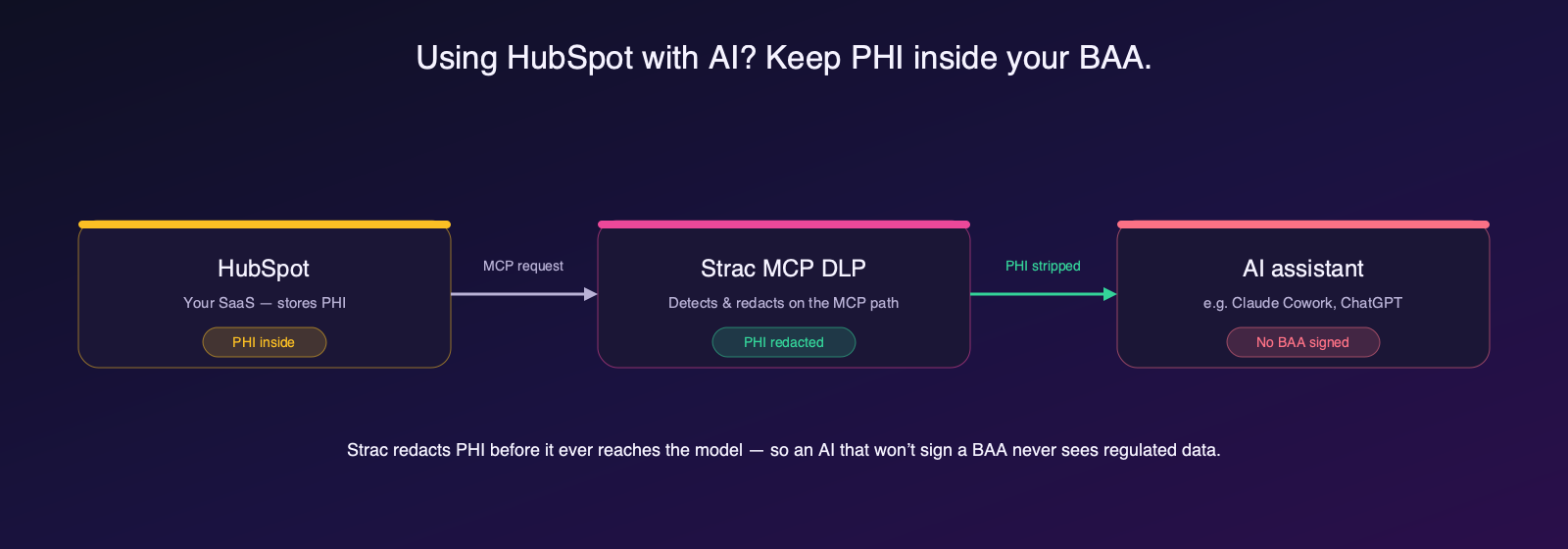
Strac MCP DLP closes that gap. It sits on the MCP path between HubSpot and the AI, detects PHI in every request and response, and redacts, masks, or blocks it before it reaches the assistant — so an AI that won’t sign a BAA never sees regulated data. Every action is audit-logged for HIPAA. See HubSpot MCP server for how the connection works.
Related reading:
Can I use HubSpot with Claude or ChatGPT and stay HIPAA compliant? Only if PHI never reaches a model that isn’t under a BAA. Claude Cowork does not sign one, so connecting HubSpot over MCP can expose PHI. Strac MCP DLP redacts PHI on the MCP path before it reaches the assistant, keeping the connection HIPAA-safe with a full audit trail.
No. HubSpot is not HIPAA compliant by default and explicitly states it is not designed for HIPAA-regulated data. You need additional controls and safeguards to use it in healthcare environments.
Yes, but only with the right setup. This includes signing a BAA (if available), restricting PHI usage, and implementing a DLP solution like Strac to detect, redact, and control sensitive data across workflows.
The biggest risks include:
These risks typically come from day-to-day usage, not just cyberattacks.
HubSpot may offer a BAA for certain enterprise plans, but it does not cover all features. You must verify exactly which services are included and ensure additional protections are in place.
Strac adds a critical enforcement layer by:
This ensures PHI is protected before, during, and after it moves through HubSpot.
HIPAA protects PHI, including:
Any of this data inside HubSpot must be secured and controlled.
.avif)


.gif)


.webp)