Calendar Icon White
November 13, 2026
Clock Icon
2
 min read

How to ensure data is not leaked from Zendesk tickets?

Stop data leaks from Zendesk tickets in 2026. Strac redacts card numbers, IDs, and health data in comments, attachments, and AI agent reads automatically.

How to ensure data is not leaked from Zendesk tickets?
ChatGPT
Perplexity
Grok
Google AI
Claude
Summarize and analyze this article with:

TL;DR

  • Zendesk DLP is the practice of detecting and removing PII, PCI, and PHI from tickets, comments, and attachments before that data can be exported, synced, or read by the wrong person or agent.
  • Support tickets are now an input to AI: copilots and MCP clients read full ticket histories, so one pasted card number can reach a model in seconds.
  • Zendesk's native redaction covers comment text and suggestions on PDFs; images, spreadsheets, old tickets, and copies outside Zendesk stay exposed.
  • Strac redacts at the data layer across Zendesk, MCP DLP, the browser, Slack, and the endpoint, with automated remediation on every action.
  • This post is a spoke of the SaaS DLP pillar; start there for the full cluster.

What Is Zendesk DLP?

__wf_reserved_inherit

Zendesk DLP applies Data Loss Prevention (DLP) to the help desk. It inspects every comment, chat message, email reply, and attachment, classifies what it finds, and acts on it automatically.

The data it targets is the data customers volunteer to get help:

  • PCI: card numbers, CVVs, and bank account details typed into chat
  • PII: Social Security numbers, passport and driver's license scans, dates of birth
  • PHI: diagnoses, insurance cards, and medical forms sent to a patient support team
  • Secrets: API keys, passwords, and auth tokens pasted into internal notes during an escalation

Customers decide what lands in a ticket. Your business owns the liability the moment it does. Zendesk DLP closes that gap by removing the data instead of asking people to stop sending it.

Why Zendesk Tickets Break Traditional Data Security

A ticket is not a file sitting on a server. It is a living record that dozens of people, apps, and agents read for years.

  • It is unstructured. A card number arrives mid-sentence, inside a screenshot, or in a forwarded email quoted ten times.
  • It is permanent. Closed tickets stay searchable long after the problem is solved.
  • It moves. Agents paste tickets into Slack, escalate them to Jira, and download attachments to a laptop. Reporting tools sync them to a warehouse.

The newest path is AI. Copilots summarize ticket histories, and MCP clients like Claude, ChatGPT, and Cursor query Zendesk directly. An agent asking for "the last five tickets from this customer" pulls every ID scan and card number in those threads into the model's context.

Network DLP watches traffic it can see; ticket data leaks through API calls it never sees. That is why the control has to sit on the data itself, and why MCP DLP now belongs in any Zendesk security plan.

Zendesk Redaction: What Native Controls Cover and Where They Stop

Zendesk ships useful baseline controls, and every team should turn them on. Role-based access, manual redaction, and deletion schedules for closed tickets come with most plans.

The Advanced Data Privacy and Protection (ADPP) add-on, sold per agent on Enterprise plans, goes further:

  • Redaction suggestions that highlight standard PII in comments
  • Custom suggestions built from regular expressions
  • Automatic comment redaction through ticket triggers
  • PII suggestions on PDF attachments, added in April 2026

The gaps show up where real support data lives:

  • Images and files. Photos, screenshots, Word, Excel, and zip files are not scanned. ID and card photos are among the most common uploads in support.
  • Agent clicks. PDF findings are suggestions; a busy agent skips them and the data stays.
  • Pattern matching. Regex finds a clean card number. It misses a passport number in a sentence or a key inside a log file.
  • Zendesk only. Redaction applies inside Zendesk. Copies already in Slack, Jira, an AI tool, or a warehouse are untouched.

Native redaction cleans the ticket; it does not clean the trail the ticket left. For step-by-step mechanics, see Zendesk redaction and the Zendesk ADPP alternative breakdown.

🎥 DLP and DSPM for Zendesk: Two Jobs, One Platform

DSPM tells you what sensitive data already sits in your tickets. DLP decides what happens to the next piece that arrives.

  • DSPM: scans every historical ticket and attachment, classifies findings by type, and shows which groups and brands hold the most exposure. It produces the inventory auditors ask for under PCI DSS, HIPAA, GDPR, and SOC 2.
  • DLP: inspects new comments and files as they land, then redacts, blocks, or alerts according to policy. It follows the same data into Slack, the browser, and AI agents.

A DSPM report without DLP is stale by the next morning. DLP without DSPM leaves years of old tickets untouched. The order that works: discover, clean up the backlog, then protect in real time so the backlog never rebuilds.
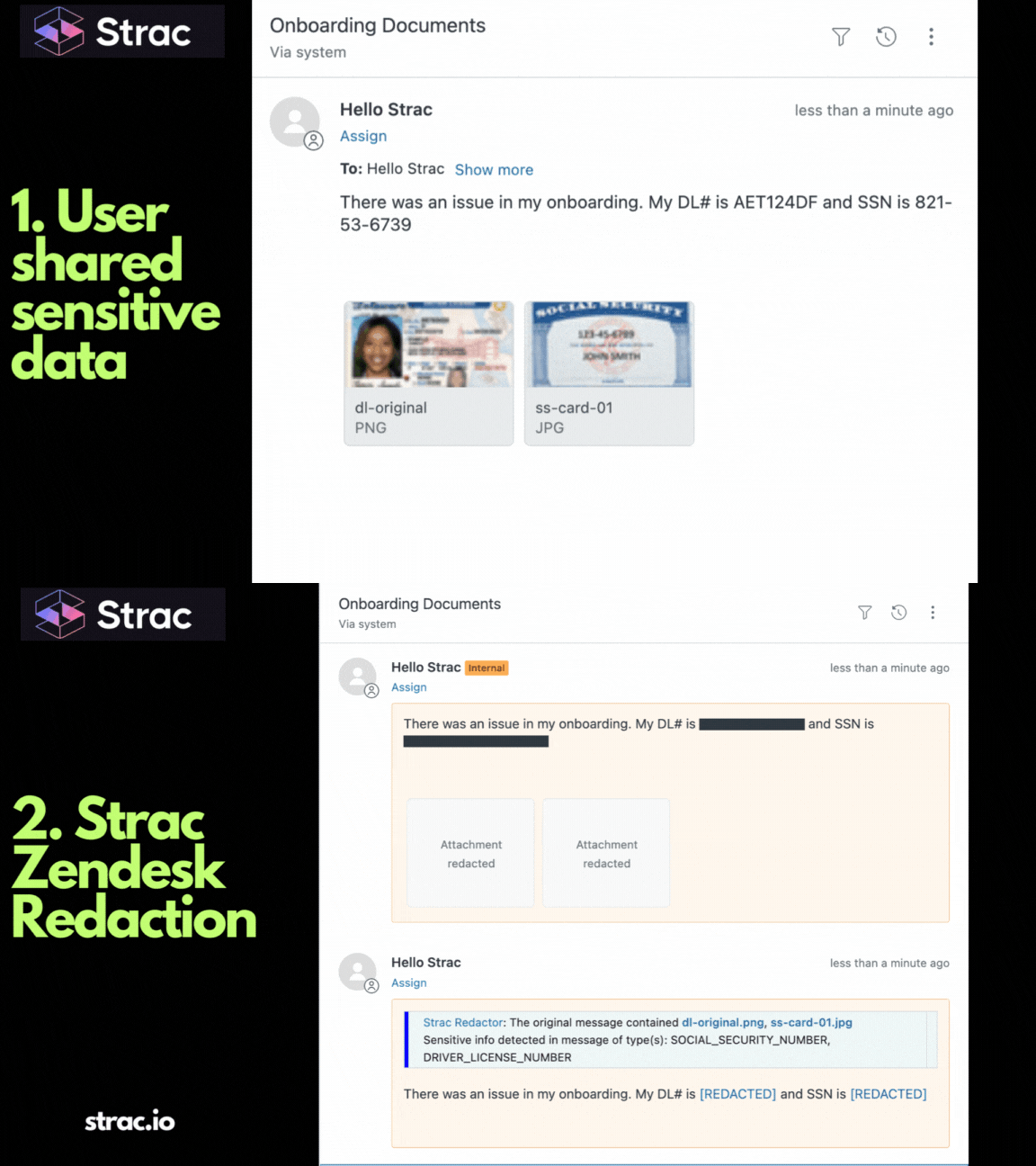
✨ How Real-Time Zendesk Redaction Works

__wf_reserved_inherit

Strac connects to Zendesk through the API, with no agent on the agent's laptop and no proxy in front of the help desk. From there, every ticket event follows the same path:

  1. A comment or attachment lands. Chat, email, web form, or an internal note.
  2. Strac inspects it. Detection models read text, and OCR reads images, scanned PDFs, and screenshots across 100+ file types.
  3. Policy decides the action. Redact a card number now, mask health data when the ticket closes, alert on an API key.
  4. The ticket updates in place. The agent keeps working; the sensitive value is gone from Zendesk storage.
  5. The event is logged. What was found, what changed, and when, ready for an audit.

A redacted ticket still resolves the customer's problem; it just cannot leak the card number that came with it.
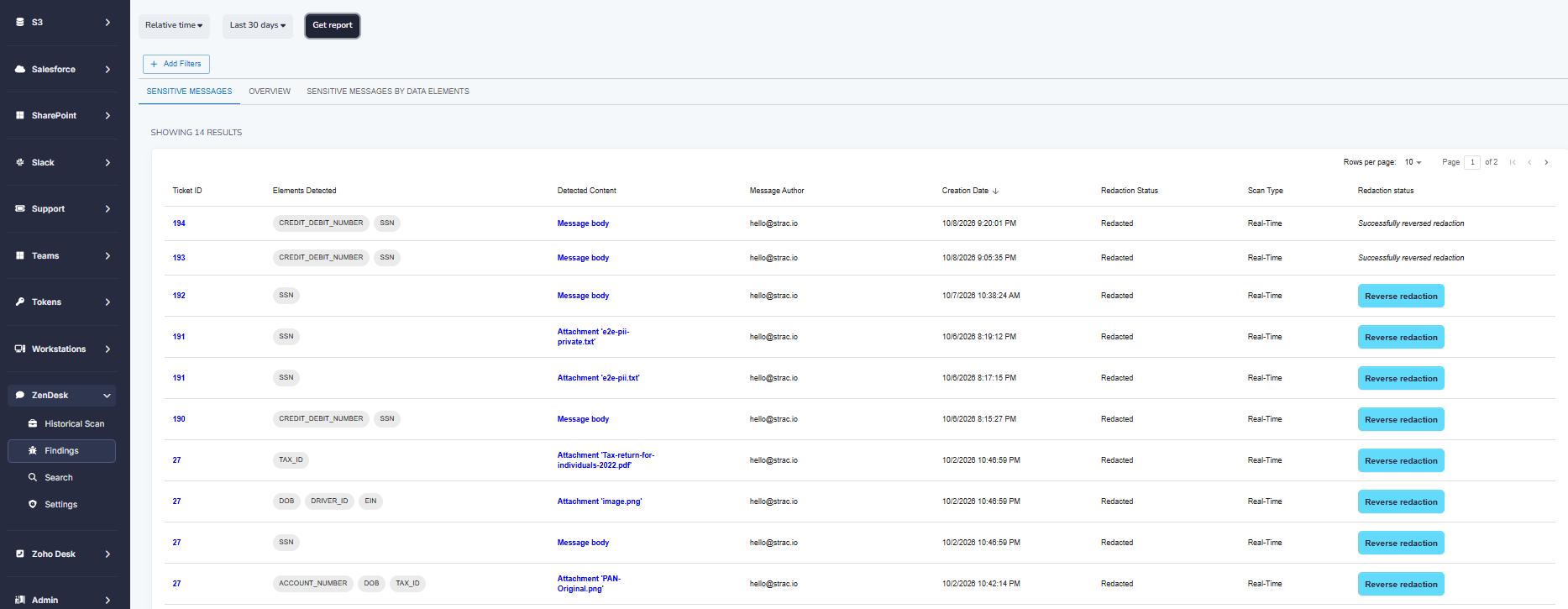
✨ Strac: How Strac Secures Zendesk Tickets, Attachments, and AI Agents

__wf_reserved_inherit

Strac treats Zendesk as one surface in a single data layer, so a card number gets the same policy in a ticket, a Slack thread, and an AI agent's context. Zendesk DLP installs from the Zendesk Marketplace in minutes and works on the Team, Growth, Professional, and Enterprise suites.

What Strac covers

  • Zendesk tickets: real-time and historical scanning of comments, chat, email replies, and attachments, with configurable delayed redaction after a ticket closes or a set number of days.
  • AI agents: Zendesk MCP DLP inspects every tool response when Claude, ChatGPT, Copilot, or Cursor reads a ticket, and redacts before the content reaches the model. See MCP DLP for the full architecture.
  • Browser: AI DLP stops agents from pasting ticket contents into generative AI tools.
  • Collaboration: Slack DLP, Jira, Gmail, and Office 365 catch the same data when a ticket is escalated or shared.
  • Endpoint: endpoint DLP covers attachments downloaded to Mac, Windows, and Linux.

Seeing every card number across five years of tickets turns a vague risk into a cleanup list.

Remediation actions
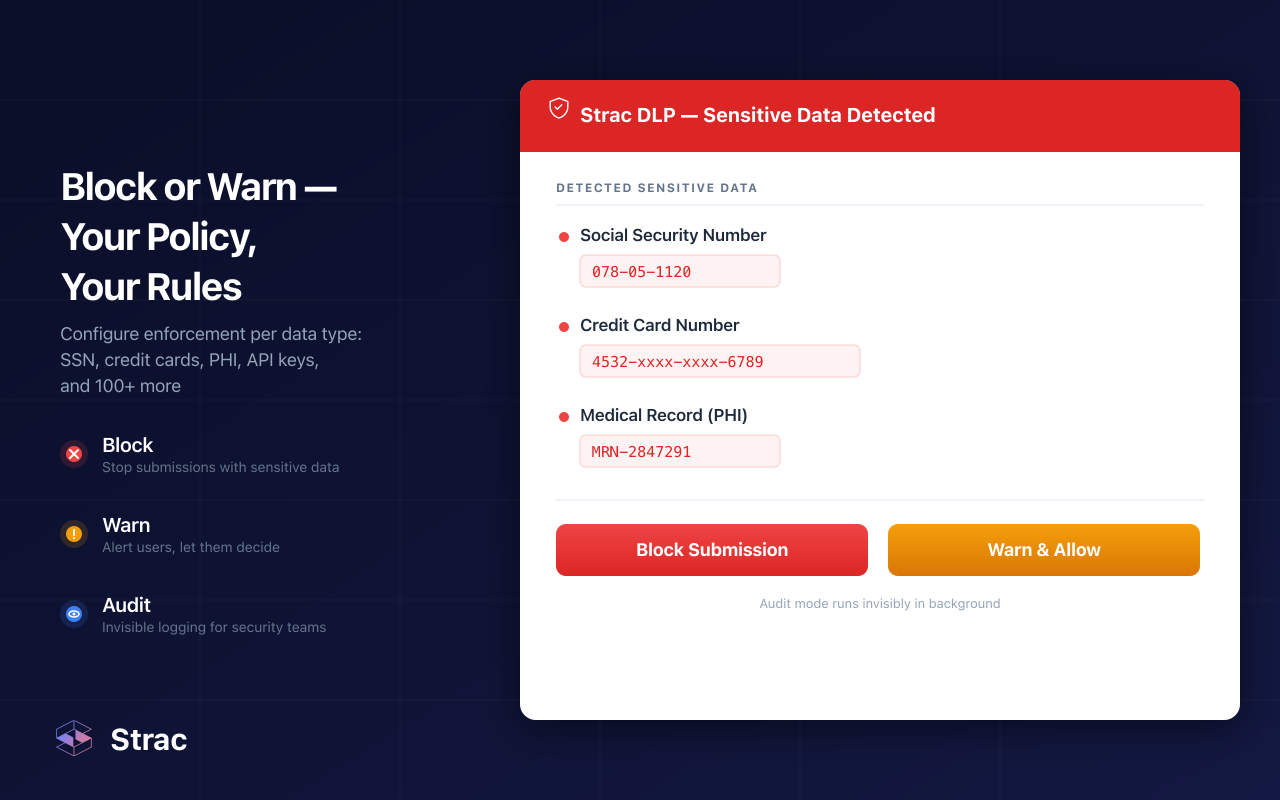
  • Redact / mask: replace sensitive values in Zendesk comments and attachments, Slack messages, email, and AI tool responses, or delete the file outright.
  • Block: stop a paste into a generative AI tool or an MCP tool call that would carry raw PII to a model.
  • Warn and coach: notify the agent in Slack or the browser at the moment of the mistake, so habits change without a ticket to security.
  • Revoke access: remove public links and external shares on files in Google Drive, SharePoint, and Box when a ticket attachment ends up there.
__wf_reserved_inherit

Alerts route to the Strac dashboard, Slack, email, or your SIEM.

OCR is what makes attachment redaction real; a regex cannot read a photo of a driver's license.

👉 Related reading:

The Bottom Line

Access roles, agent training, and native redaction all fail eventually, because customers keep sending data and tickets keep traveling. The data layer is the backstop: redact sensitive data on every ticket, attachment, and AI agent read, and a leaked ticket never becomes a breach. Strac does that across Zendesk, Slack, the browser, endpoints, and MCP from one policy. Book a demo to see a historical scan of your own Zendesk account.

🌶️ Spicy FAQs for Zendesk DLP

Is Zendesk DLP the same as Zendesk redaction?

No. Redaction is one action; Zendesk DLP is the full loop of finding sensitive data in tickets and attachments, classifying it, choosing an action by policy, and logging the result. DLP also follows ticket data into Slack, browsers, and AI agents.

Does Strac replace Zendesk's ADPP add-on?

For redaction, yes. Strac redacts comments and every common attachment type automatically, including images through OCR, and covers data after it leaves Zendesk. Some teams keep ADPP for customer-managed encryption keys and run Strac for detection and remediation.

Will redaction slow down support agents?

No. Strac redacts and masks rather than blocks, so the ticket keeps moving. Delayed redaction lets agents use a value during the conversation, then removes it when the ticket closes or after a set number of days.

Can you stop customers from sending sensitive data in the first place?

Not reliably. Customers paste whatever they think solves their problem fastest, and no form warning changes that. That is why the data layer matters: redact what arrives, and an oversharing customer never becomes a stored liability.

Where does Zendesk DLP fit in SaaS data security?

Zendesk DLP is one spoke of SaaS data protection, alongside Slack, Google Workspace, and Microsoft 365. The same policies and detectors apply across all of them. Start from the SaaS DLP pillar, then see MCP DLP for AI agents.

Customer story

“Don’t just alert on problems, fix them.”

Scott Roberts, Chief Information Security Officer, UiPath

  • UiPath
  • Crypto.com
  • Inmar Intelligence
  • thredUP
  • Paymentology
  • Enveda
  • Genesis Molecular AI
  • MeridianLink
More customer stories →
Discover & Protect Data on SaaS, AI, MCP, Endpoints & Cloud
Strac provides end-to-end data loss prevention for all SaaS and Cloud apps. Integrate in under 10 minutes and experience the benefits of live DLP scanning, live redaction, and a fortified SaaS environment.

Customers include
  • UiPath
  • Crypto.com
  • Inmar Intelligence
  • thredUP
  • Paymentology
  • Enveda
  • Genesis Molecular AI
  • MeridianLink
Trusted by enterprises
Data Security + Compliance Automation

Latest articles

Browse all

Get Your Datasheet

Thank you! Your submission has been received!
Oops! Something went wrong while submitting the form.
Close Icon